When people build a small office network, a security camera system, or a home WiFi setup, they often hear two similar terms: PoE switch and regular switch. At first glance, both devices look almost the same. They both have Ethernet ports, they both forward network traffic, and they both connect devices such as computers, routers, access points, and cameras. However, the difference becomes very clear once power delivery is involved.
A regular network switch only handles data. It allows multiple wired devices to communicate through Ethernet cables. A PoE switch does the same job, but it can also send electrical power through the same Ethernet cable. This is the key difference. PoE stands for Power over Ethernet, and it is especially useful when a device needs both network access and power but is installed in a place where a power outlet is not convenient.
What Is a Regular Switch?
A regular switch is the basic device used to expand a wired network. For example, if your router has only four LAN ports but you need to connect eight wired devices, you can connect a switch to the router and then connect the devices to the switch. The switch manages data traffic between those devices and the rest of the network.
Regular switches are commonly used for desktop PCs, printers, NAS storage, smart TVs, game consoles, and other equipment that already has its own power adapter. In this case, the switch does not need to provide power. It only needs to provide stable data transmission.
For many traditional networking tasks, a regular switch is enough. It is usually cheaper, cooler, quieter, and simpler than a PoE switch. If all devices near the switch already have power sockets, there is no need to pay extra for PoE.
What Is a PoE Switch?
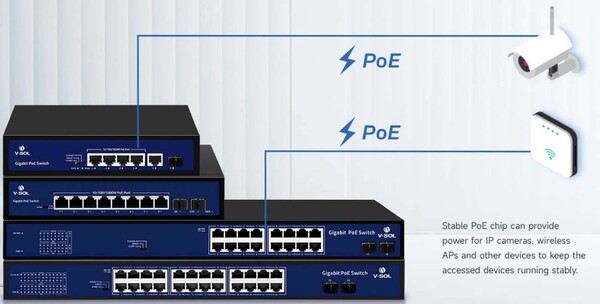
A PoE switch combines data transmission and power supply in one device. It sends power and data through a standard Ethernet cable, usually Cat5e, Cat6, or better. This means one cable can both connect the device to the network and power it at the same time.
This is very useful for devices mounted on ceilings, walls, corridors, outdoor poles, or other places where installing a power outlet would be inconvenient or expensive. Typical PoE devices include IP cameras, wireless access points, VoIP phones, door access controllers, intercom panels, and some IoT gateways.
For example, if you install a ceiling-mounted WiFi access point, a regular switch would only provide the network connection. You would still need a separate power adapter near the ceiling. With a PoE switch, one Ethernet cable is enough. This makes the installation cleaner and more reliable.
PoE Switch vs. Regular Switch: Main Differences
| Item | PoE Switch | Regular Switch |
|---|---|---|
| Data Transmission | Yes | Yes |
| Power Delivery | Yes, through Ethernet cable | No |
| Typical Devices | IP cameras, APs, VoIP phones, access control | PCs, printers, TVs, NAS, routers |
| Installation Cost | Higher switch cost, lower wiring cost | Lower switch cost, may need separate power wiring |
| Power Budget | Important specification | Not applicable |
| Best Use Case | Devices far from power outlets | Devices with nearby power sockets |
The Importance of PoE Power Budget
When choosing a PoE switch, port count is not the only thing to check. The total PoE power budget is just as important. A switch may have eight PoE ports, but that does not mean it can supply maximum power to all eight ports at the same time.
For example, if each wireless access point needs 15 watts and you plan to connect six access points, the total power requirement is about 90 watts. In this case, you should not buy a PoE switch with only a 60-watt power budget. A safer choice would be a switch with at least 120 watts or more, leaving some margin for stability and future expansion.
This is one area where many beginners make mistakes. They only count the number of ports and ignore the total power budget. The result can be unstable cameras, restarting access points, or devices that fail to power on.
PoE Standards Matter
Not all PoE ports provide the same amount of power. Common standards include IEEE 802.3af, 802.3at, and 802.3bt. The 802.3af standard is suitable for lower-power devices such as basic IP phones or small cameras. The 802.3at standard, often called PoE+, supports higher power and is commonly used for wireless access points and better cameras. The 802.3bt standard supports even higher power and is used for more demanding equipment.
Before buying a PoE switch, always check the power requirement of the device. If an access point requires PoE+, using a basic PoE switch may not work properly. Matching the switch standard with the device requirement is essential.
When Should You Choose a PoE Switch?
A PoE switch is the better choice when you are installing ceiling access points, security cameras, smart doorbells, access control panels, or VoIP phones. It is also useful in clean home networking designs where you want fewer exposed power adapters.
For a modern home WiFi system with multiple ceiling or wall-mounted access points, PoE is often the cleaner and more professional solution. The access points can be powered directly from the network cabinet, and the entire system can be backed up by one UPS if needed.
When Is a Regular Switch Enough?
A regular switch is enough when all connected devices already have their own power supply. Desktop computers, TVs, game consoles, and NAS devices usually do not need PoE. In these cases, a regular unmanaged or managed switch is often more cost-effective.
Regular switches are also suitable for high-speed local networks where power delivery is not needed. For example, if you only need 2.5G or 10G Ethernet between computers and storage devices, PoE may not bring any real benefit.
Final Thoughts
The main difference between a PoE switch and a regular switch is simple: a regular switch sends data, while a PoE switch sends both data and power. The right choice depends on the devices you plan to connect.
If your network includes IP cameras, ceiling WiFi access points, VoIP phones, or access control devices, a PoE switch can simplify wiring and make the installation cleaner. If your devices already have power nearby, a regular switch is usually enough.
For many homes and small offices, the best approach is to use both. A PoE switch can serve cameras and access points, while a regular switch can serve computers, TVs, and storage devices. This keeps the network practical, stable, and cost-efficient.
下一則: PX30 SBC for Smart Home Applications: A Practical Platform for Connected Control Panels
- Round LCD Displays: A Practical Engineering Guide for Embedded Products
- Smart Control Panels for Embedded Products: What Engineers Should Check Before Production
- Custom SBC Manufacturing for IoT Gateways and Industrial Control Devices
- PX30 SBC for Smart Home Applications: A Practical Platform for Connected Control Panels
- Designing a Custom Industrial Control Panel for Automation Systems
- Device Tree in Android SBCs: The Practical Layer That Makes Hardware Work
限會員,要發表迴響,請先登入


