What are the abnormality judgment methods of hollow shaft stepper motors?
2025/05/30 17:21
瀏覽10
迴響0
推薦0
引用0
1. Basic introduction of hollow shaft stepper motors
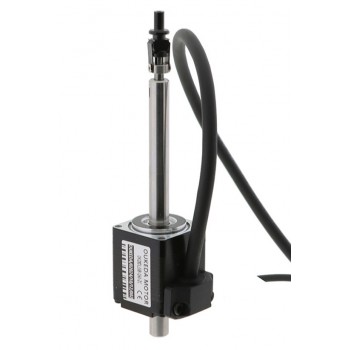
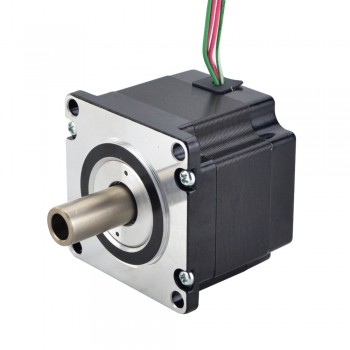
Hollow shaft stepper motors are a specially designed stepper motor, the core feature of which is that they have one or more hollow shafts. These hollow shafts not only allow other parts of the motor to pass through, but also integrate additional functions as needed, such as heat dissipation, connection to other devices, etc. The design of the hollow shaft allows the inner hole of the stepper motor to be used for routing, light transmission, or other media such as air, which optimizes the mechanical design, facilitates wiring, and saves design space and production costs.
2. The basic principle of hollow shaft stepper motors
The basic principle of hollow shaft stepper motors is based on the law of electromagnetic induction, which controls the rotation angle and direction of the rotor by controlling the number and sequence of energized coils. Specifically, when the current in the wire coil changes, a magnetic field is generated around it, which generates a force on the nearby coils, causing the coil to move.
3. Structural design features of hollow shaft stepper motors
1. Hollow shaft design: The core feature of hollow shaft stepper motors is that they have one or more hollow shafts. These shafts not only allow other parts of the motor to pass through, but also integrate additional functions as needed, such as heat dissipation, connection to other devices, etc. This design makes the motor more stable during operation and provides additional heat dissipation space for the motor.
2. High precision and high speed: Since the gap between the stator and the rotor is very small, generally between a few microns and tens of microns, high-precision position control can be achieved. In addition, since there is no mechanical friction and resistance of traditional motors, hollow shaft stepper motors can achieve high-speed rotation.
3. High efficiency and long life: The control system of the hollow shaft stepper motor adopts digital control, which can achieve precise current control and time control, thereby improving the efficiency of energy conversion. Because the gap between its stator and rotor is very small and it is made of high-strength materials, it has a long service life.
4. Versatility: The design of the hollow shaft allows the motor to be easily connected to other mechanisms to achieve flexible motion control. For example, a ball screw or TM-screw can be directly connected without a coupling, thereby avoiding the resonance (vibration and noise) caused by the coupling.
3. In addition, the hollow structure facilitates wiring and can avoid cable twisting and damage, which is particularly important in application scenarios where cables, wires, and sensor signals need to be transmitted.
5. Application scenarios: Hollow shaft stepper motors are widely used in situations where precise positioning and synchronous control are required, such as automated production lines, robot arms, medical devices, optical equipment, precision instruments, etc. In optical equipment, its hollow structure can easily transmit light beams, simplifying the design and integration of optical paths.
4. Abnormal judgment method of hollow shaft stepper motors
1. Physical inspection: First, visually check whether the motor has physical damage, such as breakage, deformation, or burn marks. These obvious damages can directly determine motor abnormalities.
2. Resistance measurement: Use a multimeter to measure the coil resistance of the stepper motor. Under normal circumstances, the resistance value of each phase winding should meet the requirements of the specification. If the resistance of one phase is abnormal (too high or too low), or the resistance values of the two phases differ greatly, it may indicate that the coil is short-circuited or open-circuited.
3. Manual rotation test: Manually rotate the motor shaft without connecting any equipment or wires. A good motor should rotate smoothly with only a certain amount of force, without any jamming or abnormal resistance in the middle. If a certain position is stuck or cannot rotate at all, it may indicate that the motor is broken, the bearing may be displaced or the internal rotor and stator may be worn.
4. Power-on test: Observe the operation of the motor after powering it on. Under normal circumstances, the motor should be able to rotate normally without abnormal noise or step loss. If the motor does not rotate, shakes, makes abnormal noises, or cannot keep pace, it may indicate that there is a problem with the drive circuit or the motor itself.
5. Sound judgment: The stepper motor may make various sounds during operation, and these sounds can be used to determine whether the motor is abnormal. For example, if the motor makes a high, low and heavy sound, it may be due to uneven air gap between the stator and the rotor, unbalanced three-phase current, or loose core. 6. Bearing inspection: If the motor makes a "squeaking" sound, the bearing may be short of oil; if it makes a "chirping" sound, the grease may be dry or short of oil; if it makes a "clicking" sound, the ball bearing in the bearing may be damaged or the grease may have dried up due to long-term non-use.
自訂分類:不分類
上一則: How to improve the operating efficiency of helical planetary gearboxes?下一則: What are the selection principles of harmonic reducer gearbox?
你可能會有興趣的文章:
限會員,要發表迴響,請先登入


