Design features and maintenance methods of five-phase stepper motors
2025/03/25 17:33
瀏覽13
迴響0
推薦0
引用0
1. What is a five-phase stepper motor?
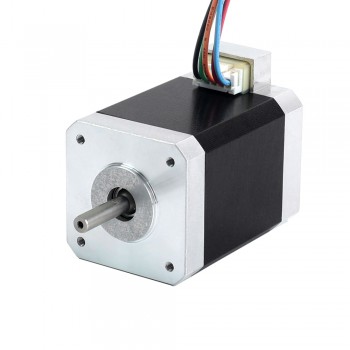
A five-phase stepper motor is a special stepper motor whose operating principle is based on electromagnetism. It achieves precise control of the rotation angle by gradually changing the relative position between the stator and the rotor. The five-phase stepper motor has five different phases, each of which can generate a specific electromagnetic field to drive the rotor to rotate at a predetermined step angle. This design enables the five-phase stepper motor to achieve very high rotation accuracy and stability.
2. Working principle of five-phase stepper motor
The working principle of the five-phase stepper motor is based on the interaction between electromagnetic induction and electromagnetic force. When the coil on the stator is energized, a specific electromagnetic field is generated. This electromagnetic field interacts with the permanent magnet on the rotor to generate a force that rotates the rotor. By activating the coils on the five phases in a specific order, it is possible to ensure continuous and stable rotation of the rotor at the preset step angle.
3. Design features of five-phase stepper motors
1. High precision: Five-phase stepper motors can achieve very high rotation accuracy. By precisely controlling the change of the electromagnetic field of each phase, it can be ensured that the rotor rotates precisely according to the preset step angle.
2. High stability: The five-phase stepper motor has a stable electromagnetic field distribution during operation, so its rotation process is very smooth and almost no vibration or noise is generated, which makes it have significant advantages in application scenarios that require high stability.
3. Strong controllability: The rotation speed and direction of the five-phase stepper motor can be easily controlled by changing the frequency and phase of the electromagnetic field. This strong controllability makes the five-phase stepper motor have a wide range of application prospects in industrial automation, robotics and other fields.
4. Subdivision capability: The five-phase stepper motor has a higher subdivision capability and can achieve a smaller step angle. For example, the step angle of the five-phase stepper motor is generally 0.72° or 0.36°, while the high-performance five-phase stepper motor can even subdivide the step angle to 0.09° or less.
5. Low-frequency vibration characteristics: Compared with the two-phase stepper motor, the five-phase stepper motor exhibits a lower vibration frequency when running at low speed. This is because the design of the five-phase motor makes it more stable when running at low speed, reducing low-frequency vibration.
4. Maintenance and care of five-phase stepper motors
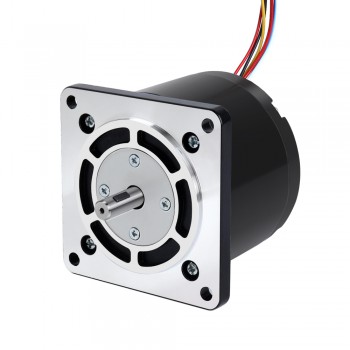
1. Keep the motor clean: Regularly clean the dust and debris on the outside of the motor, and ensure that there is no dust, water stains and debris within 3 meters around the air inlet to prevent it from being sucked into the motor and causing a short circuit. At the same time, keep the surface of the motor clean, and the air inlet should not be blocked by dust, fibers, etc.
2. Check the operation of the motor: Regularly check the operation of the motor, including sound, vibration, temperature, etc., to ensure the normal operation of the motor. Pay special attention to the temperature and sound of key parts such as motor bearings and windings, and deal with abnormalities in time. Regularly check the grounding of the motor to ensure good grounding and prevent safety problems such as leakage.
3. Replace wearing parts: Regularly replace the wearing parts of the motor, such as bearings, seals, etc., to ensure the normal operation of the motor. For motors that require lubrication, regularly replace the lubricating oil to ensure good lubrication inside the motor.
4. Maintain the control system: Regularly maintain the control system of the motor, including checking whether the wiring is loose, cleaning dust, etc., to ensure the normal operation of the control system.
5. Check the starting device: Ensure that the contactor contacts, coil core, wiring screws, etc. are reliable, and the mechanical parts are flexible. Unclean contactor contacts will increase resistance, causing heat and burning contacts. Rust and dust accumulation of the iron core of the suction coil will cause the coil to be loosely sucked, generate noise and increase current, causing failures.
6. Measure the working voltage and current: Regularly measure the three-phase working voltage and current of the motor to see if they are balanced. The error between the current of each phase and the average value should not exceed 10%, otherwise there may be a short circuit between turns or wrong connection method.
7. Bearing maintenance: Regularly check the radial clearance of the bearing. If it exceeds the allowable range, replace the bearing. Bearing maintenance should be cleaned with hot oil or soaked in kerosene, check the appearance and clearance, replace it if it exceeds the allowable range, and lubricate it well.
8. Check other parts: Check the wear of the brush, and replace it in time when it is worn to 1/3 of the original length. Check the fan blades for damage, the surface for oil stains, and the buckles for cracks and damage. Use a brush or iron hook to clean the iron core for dirt and oil stains.
自訂分類:不分類
上一則: What are the key designs of integrated servo motors?下一則: Points to note in the design of linear stepper motors
你可能會有興趣的文章:
限會員,要發表迴響,請先登入


