Common faults of magnetic particle clutch
2026/04/13 17:16
瀏覽12
迴響0
推薦0
引用0
1.Brief knowing about magnetic particle clutch
A magnetic particle clutch is a torque‑control device that provides infinitely variable torque transmission proportional to the excitation current applied to its electromagnetic coil. Unlike friction clutches, it does not rely on mechanical pressure plates or friction linings. Instead, it uses the shear resistance of magnetically aligned particles to transfer torque smoothly, even under continuous slip conditions.In industrial applications, a magnetic particle clutch is defined as a precision tension‑control actuator used in web handling , unwinding/rewinding stands, and test dynamometers.
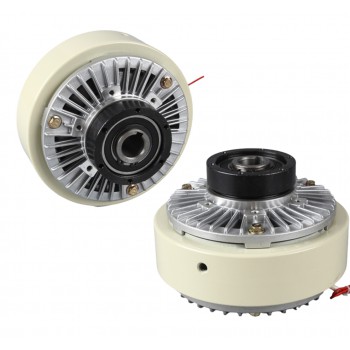
2.Main components of magnetic particle clutch
1.Input Rotor/Drive Cylinder (Input member): Typically the outer rotating member connected to the power source (motor), designed for heat dissipation.
2.Output Rotor/Shaft (Output member): Rotates within the input rotor and is connected to the load.
3.Excitation Coil (Coil): A stationary ring coil within the housing that produces a magnetic field when DC current is applied, allowing for torque control.
4.Magnetic Powder (Ferro/Chrome powder): Fine magnetic particles filling the air gap between the input and output rotors, forming chains to transmit torque when magnetized.
5.Stator/Housing (Stators): The outer assembly that houses the coil and components, holding the magnetic field structure.
6.Bearings & Seals: Bearings allow the input and output members to rotate freely, while seals contain the powder.
3.The importance of magnetic particle clutch
1.Good Tension Control Without Breaking A Sweat:Imagine unwinding a roll of thin film or copper wire. If the tension varies even a little, the material stretches or tears. A magnetic particle clutch lets you dial in the exact torque you need – and it holds that torque steady as the roll diameter changes.
2.Sliping Without Wearing Out:Most clutches hate slipping. Friction plates overheat and wear down in minutes. But a magnetic particle clutch is designed to slip continuously. The magnetic powder takes the abuse, not solid surfaces.
3.Precision torque control:Torque is almost perfectly linear with current. Turn the knob a little, torque goes up a little. No guesswork, no weird jumps. You can build a closed‑loop tension system with a cheap controller and a load cell.
4.Soft Starts Feel Effortless:Starting a heavy flywheel or a long conveyor with a regular clutch gives you a violent jerk. The magnetic particle clutch ramps up torque smoothly. Your machine components last longer, and your operators don’t get thrown off balance.
5.Keeping Running In Dirty:Friction clutches choke on dust and oil. The magnetic particle clutch is sealed. The powder stays inside, the dirt stays outside. You’ll find them on printing presses, paper mills, and textile lines – places where ordinary clutches die young.
6.Fast Responds:Apply current, and torque builds in milliseconds. Cut the current, and it releases almost instantly. That kind of speed lets you do precise tension control on high‑speed packaging lines. The clutch keeps up with the machine, not the other way around.
7.No Speed Limitation:Some clutches only work when there’s a speed difference. Others need full speed to engage properly. The magnetic particle clutch delivers the same torque at zero RPM as it does at full speed.
8.Save Cost:Magnetic particle clutch costs more upfront than a simple friction clutch. But it lasts years longer, needs less maintenance, and doesn’t eat up replacement plates and linings. Add up the downtime and parts, and the magnetic clutch pays for itself.
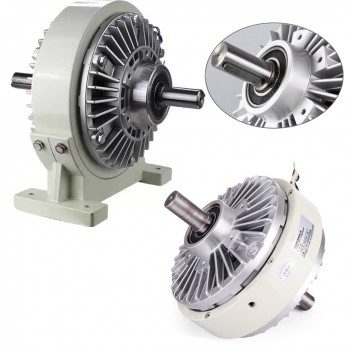
4.Common faults of magnetic particle clutch
1.Insufficient Torque or Slipping:One of the most common faults is a reduction in transmitted torque. In this condition, the clutch may slip under load or fail to deliver the required holding force. This problem is often caused by deterioration of the magnetic powder, insufficient excitation current, overheating, or excessive internal wear.
2.Failure to Engage:A magnetic particle clutch may sometimes fail to engage when power is applied. This usually indicates an electrical problem, such as a damaged coil, broken wiring, poor terminal contact, or a malfunction in the power supply or controller. When engagement does not occur, the clutch cannot transmit torque, which may interrupt normal equipment operation.
3.Excessive Residual Drag:Even when the clutch is in the disengaged state, some units may continue to produce abnormal drag torque. This issue is commonly associated with residual magnetism, contaminated or agglomerated magnetic particles, internal wear, or mechanical misalignment.
4.Overheating:Overheating is a serious and frequent fault in magnetic particle clutches. It may result from prolonged slipping, excessive current, poor ventilation, or operation beyond the rated load. High temperature not only reduces clutch performance but may also accelerate the aging of the magnetic powder, insulation materials, bearings, and seals.
5.Abnormal Noise During Operation:Unusual noise is often a sign of internal mechanical problems. Bearing wear, loose mounting components, rotor-stator friction, or damaged internal parts may all generate abnormal sounds.
6. Slow Response or Delayed Action:A magnetic particle clutch is expected to respond promptly to changes in input current. If the response becomes slow, the problem may be related to aging magnetic powder, weakened magnetic performance, controller faults, or excessive heat buildup.
7. Coil Burnout or Electrical Failure:The excitation coil is one of the key components of the clutch. If it is exposed to overvoltage, overcurrent, poor heat dissipation, or insulation breakdown, it may burn out or fail electrically.
8.Magnetic Powder Leakage:Leakage of magnetic powder is another important fault that should not be overlooked. It is generally caused by seal failure, aging components, overheating, or mechanical shock. Once powder leakage occurs, the clutch torque will decrease, and internal contamination may further damage adjacent parts.
Source:https://joliet.pixnet.net/blog/posts/884361835075954658
Source:https://joliet.pixnet.net/blog/posts/884361835075954658
你可能會有興趣的文章:
限會員,要發表迴響,請先登入


