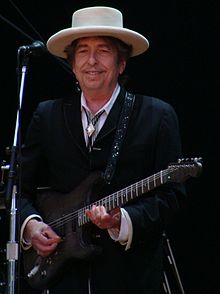
Bob Dylan is an American musician, singer-songwriter, artist, and writer. He has been an influential figure in popular music and culture for more than five decades. Much of his most celebrated work dates from the 1960s, when he was an informal chronicler and a seemingly reluctant figurehead of social unrest.
African-American Civil Rights Movement
Dylan's lyrics have incorporated a variety of political, social, philosophical, and literary influences. They defied existing pop music conventions and appealed hugely to the then burgeoning counterculture. Initially inspired by the performance style of Little Richard, and the songwriting of Woody Guthrie, Robert Johnson, and Hank Williams, Dylan has both amplified and personalized musical genres. His recording career, spanning fifty years, has explored many of the traditions in American song.
Apartheid 南非種族分解
有分解,分離的意思: separate, segregate, select, elect, apart from
Beat generation: beat: 古典之意
The Beat Generation was a group of American post-World War II writers who came to prominence in the 1950s, as well as the cultural phenomena that they both documented and inspired. Both Howl and Naked Lunch were the focus of obscenity trials that ultimately helped to liberalize publishing in the United States.
hippie
Lost generation: The "Lost Generation" was the generation that came of age during World War I. The term was popularized by Ernest Hemingway, who used it as one of two contrasting epigraphs for his novel, The Sun Also Rises. In A Moveable Feast, published after Hemingway and Stein's death, Hemingway claims that Stein heard the phrase from a garage owner who serviced Stein's car. When a young mechanic failed to repair the car quickly enough, the garage owner shouted at the boy, "You are all a "génération perdue." Stein, in telling Hemingway the story, added, "That is what you are. That's what you all are ... all of you young people who served in the war. You are a lost generation."This generation included distinguished artists such as F. Scott Fitzgerald,[2] T. S. Eliot, John Dos Passos, Waldo Peirce, Isadora Duncan, Abraham Walkowitz, Alan Seeger, and Erich Maria Remarque.
Expatriate: 自我放逐的美國人
Where Are You Going, Where Have You Been?
Connie: The main character of Oates' story is Connie, a beautiful, self-absorbed 15-year-old girl, who is at odds with her mother—once a beauty herself–and with her dutiful, "steady", and homely older sister. (Text)
She drew her shoulders up and sucked in her breath with the pure pleasure of being alive, and just at that moment she happened to glance at a face just a few feet from hers. It was a boy with shaggy black hair, in a convertible jalopy painted gold. He stared at her and then his lips widened into a grin. Connie slit her eyes at him and turned away, but she couldn't help glancing back and there he was, still watching her. He wagged a finger and laughed and said, "Gonna get you, baby," and Connie turned away again without Eddie noticing anything. .. It was an open jalopy, painted a bright gold that caught the sunlight opaquely. Her heart began to pound and her fingers snatched at her hair, checking it, and she whispered, "Christ. Christ," wondering how bad she looked. The car came to a stop at the side door and the horn sounded four short taps, as if this were a signal Connie knew.
jalopy: A decrepit car
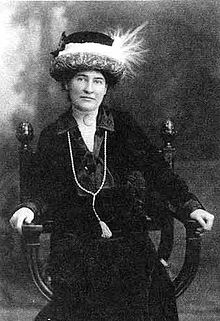
Willa Cather
Willa Sibert Cather was an American author who achieved recognition for her novels of frontier life on the Great Plains, in works such as O Pioneers!, My Ántonia, and The Song of the Lark. In 1923 she was awarded the Pulitzer Prize for One of Ours (1922), a novel set during World War I.
她的第一本著作為 Alexander's Bridge,文風深受亨利·詹姆斯影響,後認識作家Sarah Orne Jewett,建議她改變寫作方向,多描述自己的故鄉內布拉斯加,她因而回到故鄉尋找寫作靈感,著作深受文藝評論及讀者歡迎。