● Dramatic Elements
The 12 Dramatic Elements
These twelve dramatic elements are at the core of all drama. These elements are typically taught at professional acting classes such as TakeLessons acting classes. They can be used in isolation or simultaneously and are manipulated by the performer for dramatic effect.
www.thedramateacher.com/dramatic-elements
1. Focus
2. Tension
3. Timing
4. Rhythm
5. Contrast
6. Mood
7. Space
8. Language
9. Sound
10. Symbol
11. Conflict
12. Climax
.
● Dramatic structure

en.wikipedia.org/wiki/Dramatic_structure
e.g., Major conflict of the Iliad is Achilles' rage.
p.s. resolution or denouement
.
● Vocabulary
theater /ˈθɪətə(r)/ n.
the American spelling of theatre
a building, room, or outside area used for performing plays
e.g., the open-air theatre in London’s Regents Park
.
crucial /ˈkruːʃ(ə)l/ adj.
something that is crucial is extremely important because it has a major effect on the result of something
e.g., crucial moment
e.g., We believe the question being investigated by the Commission is one of crucial importance to the country.
.
verb, verv: word
e.g., verbalize (to express your feelings or ideas with words)
e.g., verve (energy and enthusiasm)
e.g., veracity (truth, or honesty)
.
foil /fɔɪl/ n.
very light thin sheets of metal used for wrapping things, especially food
e.g., Wrap the cheese in foil to keep it moist.
.
I'd been there before. 我知道你在想什麼
"But I reckon I got to light out for the Territory ahead of the rest, because Aunt Sally she's going to adopt me and sivilize me, and I can't stand it. I been there before." -The Adventures of Huckleberry Finn, Chapter XLIII
.
illuminate, reveal, suggest
illuminate: to make something clear and easier to understand
illuminate: e.g., His comments can illuminate aspects of a writer’s work unforgettably.
reveal: to let something become known, for example a secret or information that was previously not known
reveal: e.g., Cockpit recordings may reveal the cause of the crash.
suggest: to remind you of something
suggest: e.g., The architecture suggested a chapel.
.
● Stage
thrust

In theatre, a thrust stage (also known as a platform stage or open stage) is one that extends into the audience on three sides and is connected to the backstage area by its upstage end.
proscenium
A proscenium is the area of a theatre surrounding the stage opening. A proscenium arch is the arch over this area.
amphitheater
An amphitheatre or amphitheater is an open-air venue used for entertainment, performances, and sports.
arena stage
An arena stage is characterized by a central stage surrounded by audience on all sides. The stage area is also often raised to improve sightlines.
.
● Greek Theater

en.wikipedia.org/wiki/Theatre_of_ancient_Greece
.
● Dithyramb
The dithyramb was an ancient Greek hymn sung and danced in honor of Dionysus, the god of wine and fertility.
Dithyrambs were sung by choirs at Delos, but the literary fragments that have survived are largely Athenian. In Athens, dithyrambs were sung by a Greek chorus of up to fifty men or boys dancing in circular formation, who may or may not have been dressed as Satyrs, probably accompanied by the aulos. They would normally relate some incident in the life of Dionysus or just celebrate wine and fertility.

Dionysus (Roman equivalent: Bacchus) is the god of the grape harvest, winemaking and wine, of ritual madness, fertility, theatre and religious ecstasy in Greek mythology.
.
● Irony
Irony, in its broadest sense, is a rhetorical device, literary technique, or event in which what appears, on the surface, to be the case, differs radically from what is actually the case. Irony may be divided into categories such as: verbal, dramatic, and situational.
Verbal irony: A statement in which the meaning that a speaker employs is sharply different from the meaning that is ostensibly expressed. The ironic statement usually involves the explicit expression of one attitude or evaluation, but with indications in the overall speech-situation that the speaker intends a very different, and often opposite, attitude or evaluation.
Dramatic irony: This type of irony is the device of giving the spectator an item of information that at least one of the characters in the narrative is unaware of (at least consciously), thus placing the spectator a step ahead of at least one of the characters.
Situational irony: This is a relatively modern use of the term, and describes a sharp discrepancy between the expected result and actual results in a certain situation.
.
● Classical Unities (Three Unities 三一律)
The classical unities, Aristotelian unities, or three unities are rules for drama derived from a passage in Aristotle's Poetics. In their neoclassical form they are as follows:
1. unity of action: a play should have one action that it follows, with minimal subplots.
2. unity of time: the action in a play should occur over a period of no more than 24 hours.
3. unity of place: a play should exist in a single physical space and should not attempt to compress geography, nor should the stage represent more than one place.
.
● Roman Numerals

|
1 |
5 |
10 |
50 |
100 |
500 |
1000 |
|
I |
V |
X |
L |
C |
D |
M |
e.g., 2014 = MMXIV; 90 = XC; 99 = XCIX
.
● Vernacular
A vernacular or vernacular language is the native language or native dialect of a specific population, especially as distinguished from a literary, national or standard language, or a lingua franca used in the region or state inhabited by that population.
e.g., Adventures of Huckleberry Finn by Mark Twain. [Adventures of Huckleberry Finn is a novel by Mark Twain. Commonly named among the Great American Novels, the work is among the first in major American literature to be written throughout in vernacular English, characterized by local color regionalism.]
.
● Closet Drama
A closet drama is a play that is not intended to be performed onstage, but read by a solitary reader or, sometimes, out loud in a small group. A related form, the "closet screenplay," developed during the 20th century. "Although the term sometimes carries a negative connotation, implying that such works either lack sufficient theatrical qualities to warrant staging or require theatrical effects beyond the capacity of most (if not all) theaters, closet dramas through the ages have had a variety of dramatic features and purposes not tied to successful stage performance."
.
● Quiz
dev.wwnorton.com/college/english/litweb11/quizengine/main.aspx?ch=genre_drama&fd=fiction
Q: In a dramatic performance, how does the exposition occur?
A: It is conveyed implicitly through the play’s dialogue.
A: e.g., The nurse in Medea, and thewatch man in Agamemnon.
.
● John Milton
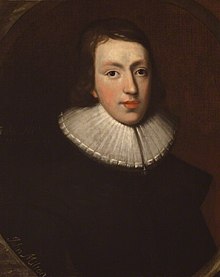
John Milton (9 December 1608 – 8 November 1674) was an English poet, polemicist, man of letters, and a civil servant for the Commonwealth of England under Oliver Cromwell. He wrote at a time of religious flux and political upheaval, and is best known for his epic poem Paradise Lost (1667), written in blank verse.
.
● Samson Agonistes

Samson Agonistes is a tragic closet drama by John Milton. It appeared with the publication of Milton's Paradise Regain'd in 1671, as the title page of that volume states: "Paradise Regained / A Poem / In IV Books / To Which Is Added / Samson Agonistes". It is generally thought that Samson Agonistes was begun around the same time as Paradise Regained but was completed after the larger work, possibly very close to the date of publishing, but there is no agreement on this.
.
● Samson
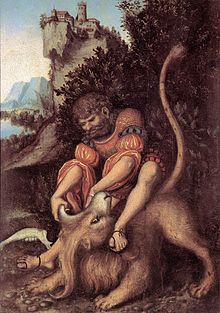
According to the biblical account, Samson was given supernatural strength by God in order to combat his enemies and perform heroic feats such as killing a lion, slaying an entire army with only the jawbone of an ass, and destroying a pagan temple. Samson had two vulnerabilities, however: his attraction to untrustworthy women and his hair, without which he was powerless. These vulnerabilities ultimately proved fatal for him.
.
● Delilah
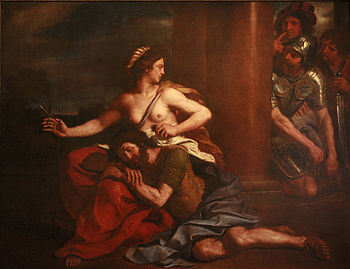
Delilah is the "woman in the valley of Sorek" whom Samson loved, and who was his downfall.
The story of Samson in Judges 13-16 portrays a man who was given great strength by God but who ultimately loses his strength when Delilah allows the Philistines to shave his hair during his slumber (Judges 16:19).
.
● Goldilocks and the Three Bears

下一則: WEEK 14 文導筆記 (Approaches to Literature)
限會員,要發表迴響,請先登入


