● Orientation
| Student orientation or new student orientation (often encapsulated into an Orientation week, Welcome Week or Freshers' Week) is a period of time at the beginning of the academic year at a university or other tertiary institution during which a variety of events are held to orient and welcome new students. |
Syllabus: http://140.126.22.95/wbcmsc/cmain1.asp
Course Objectives: This course is a basic introduction to literature and literary criticism. It includes examples of various periods and genres of literary works and literary criticism and theory. Its objective is to offer students the opportunity to study literary texts from a variety of periods, genres, and points of view as well as major critical approaches.
Textbook: The Norton Introduction to Literature

Genre: A literary genre is a category of literary composition. Genres may be determined by literary technique, tone, content, or even (as in the case of fiction) length. Genre should not be confused with age category, by which literature may be classified as either adult, young-adult, or children's. They also must not be confused with format, such as graphic novel or picture book. The distinctions between genres and categories are flexible and loosely defined, often with subgroups.
The most general genres in literature are (in loose chronological order) epic, tragedy, comedy, novel, and short story.They can all be in the genres prose or poetry, which shows best how loosely genres are defined.
.
● Epic/Tragedy
Epic: An epic is a lengthy narrative poem, ordinarily concerning a serious subject containing details of heroic deeds and events significant to a culture or nation.The first epics were products of preliterate societies and oral poetic traditions. In these traditions, poetry is transmitted to the audience and from performer to performer by purely oral means.
Tragedy: The term is Greek in origin, dating back to the 5th century BC. It was a name assigned by the Greeks to a specific form of plays performed on festivals in Greece. The local governments supported such plays and the mood surrounding the presentation of these plays was that of a religious ceremony, as the entire community along with the grand priest attended the performances. The subject matter of the Greek tragedies was derived chiefly from Homer’s “Iliad” and “Odyssey” which included misfortunes of heroes of history and religious mythology. The three prominent Greek dramatists were Aeschylus (525–456 BC), Sophocles (496–406 BC), and Euripides (480–406 BC).3333
.
● Vocabulary
1. ori- : beginning
e.g., orientation, original, originate
2. glossary:(noun) /ˈɡlɒsəri/ a dictionary of the special terms in a particular field or job
e.g., A welcome addition to the book would be a glossary of acronyms used in the chapters.
3. trim:(verb) /trɪm/ to cut something such as hair so that it looks tidy
e.g., Someone is trimming the grass outside with shears.
4. plagiarism:(noun) /ˈpleɪdʒəˌrɪz(ə)m/ the process of taking another person’s work, ideas, or words, and using them as if they were your own. Someone who does this is called a plagiarist
e.g., Evidence of plagiarism has been found in his latest book.
.
● Novel
The Reader, by Bernhard Schlink
 |
 |
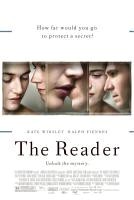
Movie trailer:www.youtube.com/watch?v=8tCqSm4Phug
Middle aged German barrister Michael Berg recollects to himself his lifelong acquaintance with Hanna Schmitz, a relationship with whom he never disclosed to anyone close to him. Michael first met Hanna in 1958, when he was fifteen, she thirty-six. The two had a turbulent summer long love affair, dictated by Hanna that their encounters would begin with him reading to her followed by lovemaking. Michael next encountered Hanna in 1966, when Michael, now a law student, attended the Nazi war crimes trial of six female former S.S. concentration camp guards, one of whom is Hanna. Through listening to the testimony, Michael comes to the realization that he is in possession of information which could save Hanna from a life in prison, information which she herself is unwilling to disclose. In deciding what to do, Michael is torn between his differing views of justice.
● The Lady with the Dog, by Anton Chekhov

"The Lady with the Dog" (Russian: Дама с собачкой, Dama s sobachkoy) is a short story by Anton Chekhov first published in 1899. It tells the story of an adulterous affair between a Russian banker and a young lady he meets while vacationing in Yalta. The story comprises four parts: part I describes the initial meeting in Yalta, part II the consummation of the affair and the remaining time in Yalta, part III Gurov's return to Moscow and his visit to Anna's town, and part IV Anna's visits to Moscow. Vladimir Nabokov declared that it was one of the greatest short stories ever written
.
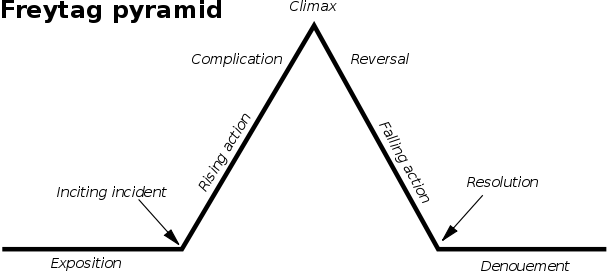
● Freytag Pyramid
.
● Outside Reading
How to Read Literature Like a Professor
How to Read Novels Like a Professor
.
● Shall I compare thee to a summer's day?
William Shakespeare, 1564 - 1616
Shall I compare thee to a summer’s day?
Thou art more lovely and more temperate.
Rough winds do shake the darling buds of May,
And summer’s lease hath all too short a date.
Sometime too hot the eye of heaven shines,
And often is his gold complexion dimmed;
And every fair from fair sometime declines,
By chance, or nature’s changing course, untrimmed;
But thy eternal summer shall not fade,
Nor lose possession of that fair thou ow’st,
Nor shall death brag thou wand’rest in his shade,
When in eternal lines to Time thou grow’st.
So long as men can breathe, or eyes can see,
So long lives this, and this gives life to thee.
限會員,要發表迴響,請先登入


