week 13
A. syllabus
 Aristophanes
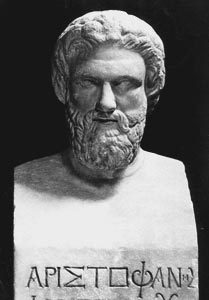
Aristophanes, son of Philippus, of the deme Kydathenaion, was a comic playwright of ancient Athens. Eleven of his forty plays survive virtually complete. These, together with fragments of some of his other plays, provide the only real examples of a genre of comic drama known as Old Comedy, and are used to define it.
Lysistrata
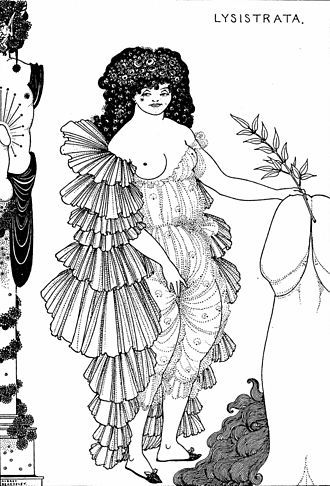
Lysistrata is a comedy by Aristophanes. Originally performed in classical Athens in 411 BC, it is a comic account of one woman's extraordinary mission to end the Peloponnesian War. Lysistrata persuades the women of Greece to withhold sexual privileges from their husbands and lovers as a means of forcing the men to negotiate peace—a strategy, however, that inflames the battle between the sexes. The play is notable for being an early exposé of sexual relations in a male-dominated society. Additionally, its dramatic structure represents a shift from the conventions of Old Comedy, a trend typical of the author's career. It was produced in the same year as the Thesmophoriazusae, just two years after Athens' catastrophic defeat in the Sicilian Expedition.
B. In-class notes
INRL cross (Crucifix)
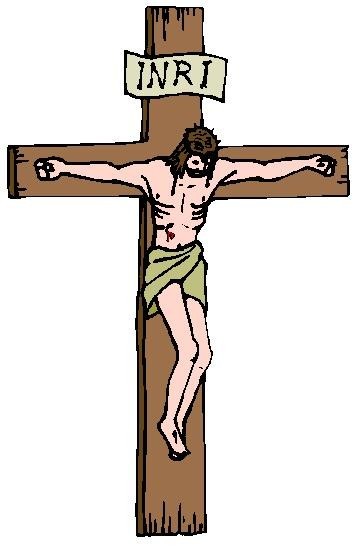
The letters “INRI” are initials for the Latin title that Pontius Pilate had written over the head of Jesus Christ on the cross (John 19:19). Latin was the official language of the Roman Empire. The words were “Iesvs Nazarenvs Rex Ivdaeorvm.” Latin uses “I” instead of the English “J”, and “V” instead of “U” (i.e., Jesus Nazarenus Rex Judaeorum). The English translation is "Jesus of Nazareth, the King of the Jews."
Read more at: http://christiananswers.net/q-eden/edn-t024.html
Protestant cross

Protestantism is a form of Christian faith and practice which originated with the Protestant Reformation, a movement against what its followers considered to be errors in the Roman Catholic Church. It is one of the three major divisions of Christendom, together with Roman Catholicism and Orthodoxy. The term derives from the letter of protestation from German Lutheran princes in 1529 against an edict condemning the teachings of Martin Luther as heretical.
Royal color- purple
The color purple has been associated with royalty, power and wealth for centuries. In fact, Queen Elizabeth I forbad anyone except close members of the royal family to wear it. Purple's elite status stems from the rarity and cost of the dye originally used to produce it.
Aristotle
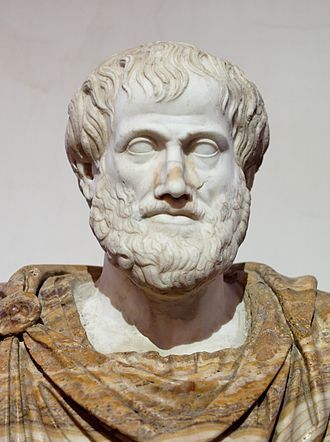
Aristotle was a Greek philosopher and scientist born in the city of Stagira, Chalkidice, on the northern periphery of Classical Greece. His father, Nicomachus, died when Aristotle was a child, whereafter Proxenus of Atarneus became his guardian. At seventeen or eighteen years of age, he joined Plato's Academy in Athens and remained there until the age of thirty-seven (c. 347 BC). His writings cover many subjects – including physics, biology, zoology, metaphysics, logic, ethics, aesthetics, poetry, theater, music, rhetoric, linguistics, politics and government – and constitute the first comprehensive system of Western philosophy. Shortly after Plato died, Aristotle left Athens and, at the request of Philip of Macedon, tutored Alexander the Great beginning in 343 BC.
Poetics
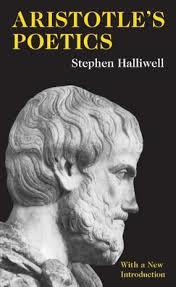
Aristotle's Poetics is the earliest surviving work of dramatic theory and the first extant philosophical treatise to focus on literary theory. This has been the traditional view for centuries. However, recent work is now challenging whether Aristotle focuses on literary theory per se (given that not one poem exists in the treatise) or whether he focuses instead on dramatic musical theory that only has language as one of the elements.
Tragic Flaw
A tragic flaw is a literary term that refers to a personality trait of a main character that leads to his or her downfall. In other words, a character with a tragic flaw is in need of some kind of attitude adjustment. The term usually comes up when you're studying a tragedy — that is, a piece of literature in which the main character ends up dead or otherwise defeated. In this kind of story, the main character is sometimes also called the tragic hero.
Hamartia
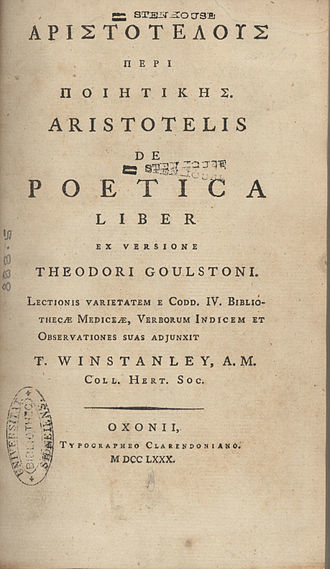
The term hamartia derives from the Greek ἁμαρτία, from ἁμαρτάνειν hamartánein, which means "to miss the mark" or "to err". It is most often associated with Greek tragedy, although it is also used in Christian theology. Hamartia as it pertains to dramatic literature was first used by Aristotle in his Poetics. In tragedy, hamartia is commonly understood to refer to the protagonist’s error or flaw that leads to a chain of plot actions culminating in a reversal from their good fortune to bad. What qualifies as the error or flaw can include an error resulting from ignorance, an error of judgment, a flaw in character, or sin. The spectrum of meanings has invited debate among critics and scholars, and different interpretations among dramatists.
限會員,要發表迴響,請先登入


