week 12
A.
Euripides
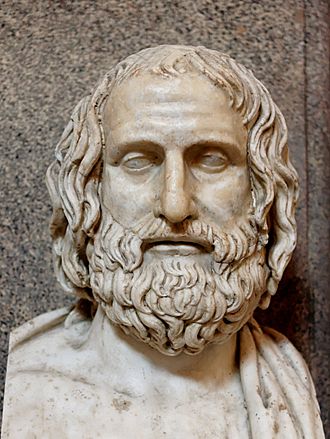
Euripides (c. 480 – c. 406 BC) was a tragedian of classical Athens. He is one of the few whose plays have survived, with the others being Aeschylus, Sophocles, and potentially Euphorion. Some ancient scholars attributed 95 plays to him but according to the Suda it was 92 at most. Of these, 18 or 19 have survived more or less complete (there has been debate about his authorship of Rhesus, largely on stylistic grounds) and there are also fragments, some substantial, of most of the other plays. More of his plays have survived intact than those of Aeschylus and Sophocles together, partly due to mere chance and partly because his popularity grew as theirs declined—he became, in the Hellenistic Age, a cornerstone of ancient literary education, along with Homer, Demosthenes and Menander.
Euphorion- a Greek poet and grammarian, born at Chalcis in Euboea about 275 BC.
Suda- a massive 10th-century Byzantine encyclopedia of the ancient Mediterranean world, formerly attributed to an author called Suidas.
Medea
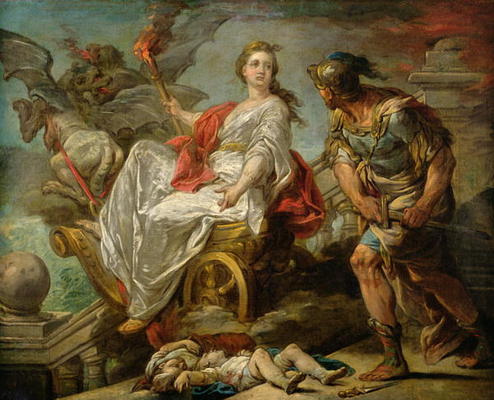
In Greek mythology, Medeais a sorceress who was the daughter of King Aeëtes of Colchis, niece of Circe, granddaughter of the sun god Helios, and later wife to the hero Jason. In Euripides's play Medea, Jason abandons Medea when Creon, king of Corinth, offers his daughter Glauce. The play tells of Medea avenging her husband's betrayal by killing their children.
Medea figures in the myth of Jason and the Argonauts, a myth known best from a late literary version worked up by Apollonius of Rhodes in the 3rd century BC and called the Argonautica. Medea is known in most stories as an enchantress and is often depicted as being a priestess of the goddess Hecate or a witch. The myth of Jason and Medea is very old, originally written around the time Hesiod wrote the Theogony.
B. Quiz
Quiz 7 from Norton
1.In addition to poisoning Creon and Glauce, what other deed does Medea decide to commit in order to exact her revenge?
(C)She will kill her children.
2.Why does Jason think that Medea sends gifts to Glauce?
(D)He thinks Medea wants a favor from Glauce.
3.What reason does Jason give to Medea for marrying Glauce?
(D)Marrying Glauce would provide for them all.
4.What method does Media decide on to murder Creon and Glauce?
(A)She will poison them.
5.How does Medea escape towards the end of the play?
(B)She flies off in a chariot.
6.What gossip has the tutor overheard near the beginning of the play?
(B)That Medea is to be banished.
7.Why is Medea so distraught as the play opens?
(A)Her husband has married another woman.
C. In-class notes
Aeschylus (Father of Tragedy)
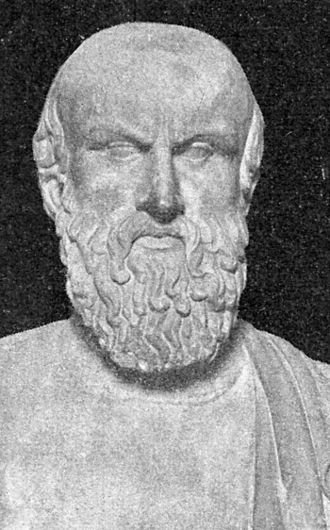
Aeschylus was an ancient Greek tragedian. He is often described as the father of tragedy. Critics' and scholars' knowledge of the genre begins with his work, and understanding of earlier tragedies is largely based on inferences from his surviving plays. According to Aristotle, he expanded the number of characters in theater allowing conflict among them; characters previously had interacted only with the chorus.
(Greek) Chorus
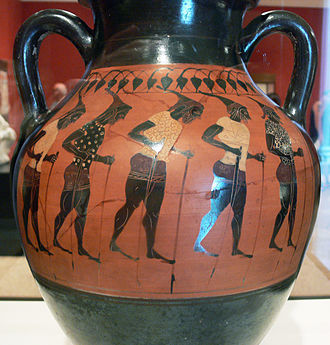
A chorus, in the context of Ancient Greek tragedy, comedy, and satyr plays, is a homogeneous, non-individualized group of performers, who comment with a collective voice on the dramatic action. The chorus consisted of between 12 and 50 players, who variously danced, sang or spoke their lines in unison and sometimes wore masks.
 Dramatist- a person who writes plays
Playwright- a person who writes plays
Fore- before in time, rank, position
Foreshadow- indicate beforehand
Foresee- have a premonition
Forecast- a statement of what is judged likely to happen in the future
限會員,要發表迴響,請先登入


