week 4
AR-augmented reality

It is a live direct or indirect view of a physical, real-world environment whose elements are augmented(or supplemented) by computer-generated sensory input such as sound, video, graphics or GPS data.
VR-virtual reality

It typically refers to computer technologies that use software to generate realistic images, sounds and other sensations that replicate a real environment (or create an imaginary setting), and simulate a user's physical presence in this environment, by enabling the user to interact with this space and any objects depicted therein using specialized display screensor projectors and other devices.
Aeneid
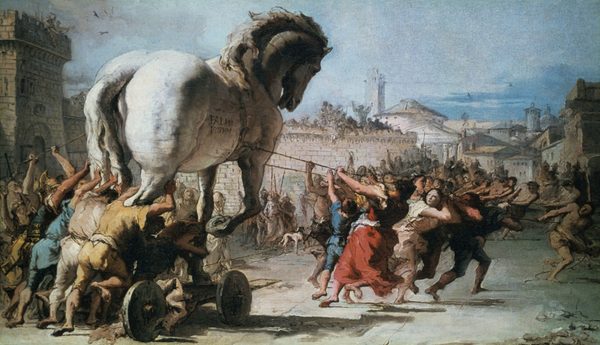
The Aeneid (/ᵻˈniːɪd/; Latin: Aeneis [ae̯ˈneːɪs]) is a Latin epic poem, written by Virgil between 29 and 19 BC, that tells the legendary story of Aeneas, a Trojan who travelled to Italy, where he became the ancestor of the Romans.
Twelve Olympians
In the ancient Greek religion and Greek mythology, the Twelve Olympians are the major deities of the Greek pantheon, commonly considered to be Zeus, Hera, Poseidon, Demeter, Athena, Apollo, Artemis, Ares, Aphrodite, Hephaestus, Hermes, and either Hestia or Dionysus.
| Greek name | Roman name | Image | Functions & attributes |
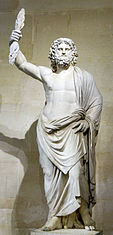
| Zeus | Jupiter |
|
King of the gods and ruler of Mount Olympus; god of the sky, lightning, thunder, law, order, justice. Youngest child of the Titans Cronus and Rhea. Symbols include the thunderbolt, eagle, oak tree, scepter, and scales. Brother and husband of Hera, although he had many lovers, also brother of Poseidon, Hades, Demeter, and Hestia. |
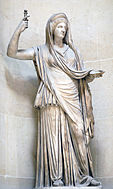
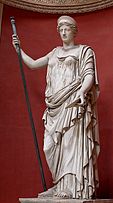
| Hera | Juno |
|
Queen of the gods and the goddess of marriage and family. Symbols include the peacock, cuckoo, and cow. Youngest daughter of Cronus and Rhea. Wife and sister of Zeus. Being the goddess of marriage, she frequently tried to get revenge on Zeus' lovers and their children. |
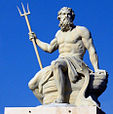
| Poseidon | Neptune |
|
God of the seas, earthquakes, and tidal wave. Symbols include the horse, bull, dolphin, and trident. Middle son of Cronus and Rhea. Brother of Zeus and Hades. Married to the Nereid Amphitrite, although, like most male Greek Gods, he had many lovers. |
| Demeter | Ceres |
|
Goddess of fertility, agriculture, nature, and the seasons. Symbols include the poppy, wheat, torch, cornucopia, and pig. Middle daughter of Cronus and Rhea. |
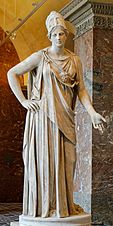
| Athena | Mineva |
|
Goddess of wisdom, reason, intelligent activity, literature, handicrafts and science, defense and strategic warfare. Symbols include the owl and the olive tree. Daughter of Zeus and the Oceanid Metis, she rose from her father's head fully grown and in full battle armor. |
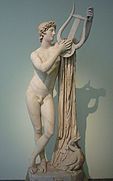
| Apollo | Apollo |
|
God of light, prophecy, inspiration, poetry, music and arts, medicine and healing. Son of Zeus and Leto. Symbols include the sun, lyre, swan, and mouse. Twin brother of Artemis. |
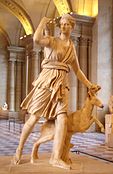
| Artemis | Diana |
|
Goddess of the hunt, virginity, archery, the moon, and all animals. Symbols include the moon, deer, hound, she-bear, snake, cypress tree, and bow and arrow. Daughter of Zeus and Leto and twin sister of Apollo. |
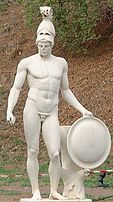
| Ares | Mars |
|
God of war, violence, and bloodshed. Symbols include the boar, serpent, dog, vulture, spear, and shield. Son of Zeus and Hera, all the other gods despised him. His Latin name, Mars, gave us the word "martial." |
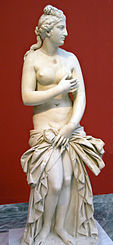
| Aphrodite | Venus |
|
Goddess of love, beauty, and desire. Symbols include the dove, bird, apple, bee, swan, myrtle, and rose. Daughter of Zeus and the Oceanid Dione, or perhaps born from the sea foam after Uranus' semen dripped into the sea after being castrated by his youngest son, Cronus, who then threw his father's genitals into the sea. Married to Hephaestus, although she had many adulterous affairs, most notably with Ares. Her name gave us the word "aphrodisiac", while her Latin name, Venus, gave us the word "venereal". |
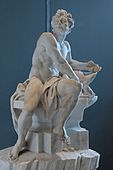
| Hephaestus | Vulcan |
|
Master blacksmith and craftsman of the gods; god of fire and the forge. Symbols include fire, anvil, axe, donkey, hammer, tongs, and quail. Son of Hera, either by Zeus or alone. Married to Aphrodite, though unlike most divine husbands, he was rarely ever licentious. His Latin name, Vulcan, gave us the word "volcano." |
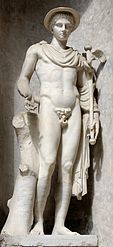
| Hermes | Mercury |
|
Messenger of the gods; god of commerce, communication, borders, eloquence, diplomacy, thieves and games. Symbols include the caduceus (staff entwined with two snakes), winged sandals and cap, stork, and tortoise (whose shell he used to invent the lyre). Son of Zeus and the nymph Maia. The second-youngest Olympian, just older than Dionysus. |
| Hestia | Vesta |
|
Goddess of the hearth and of the right ordering of domesticity and the family; she was born into the first Olympian generation and was one of the original twelve Olympians. Some lists of the Twelve Olympians omit her in favor of Dionysus, but the speculation that she gave her throne to him in order to keep the peace seems to be modern invention. She is the first child of Cronus and Rhea, eldest sister of Hades, Demeter, Poseidon, Hera, and Zeus. |
|
Dionysns or Bacchus |
Bacchus |
|
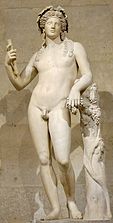
God of wine, celebrations, and ecstasy. Patron god of the art of theatre. Symbols include the grapevine, ivy, cup, tiger, panther, leopard, dolphin, goat, and pinecone. Son of Zeus and the mortal Theban princess Semele. Married to the Cretan princess Ariadne. The youngest Olympian god, as well as the only one to have a mortal mother. |
Penelope weaving
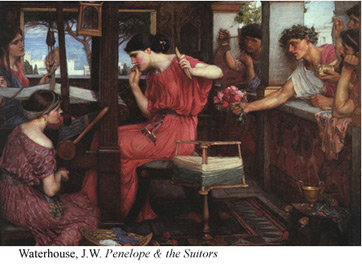
On Odysseus's return, disguised as an old beggar, he finds that Penelope has remained faithful. She has devised tricks to delay her suitors, one of which is to pretend to be weaving a burial shroud for Odysseus's elderly father Laertes and claiming that she will choose a suitor when she has finished. Every night for three years, she undoes part of the shroud, until Melantho, one of twelve unfaithful serving women, discovers her chicanery and reveals it to the suitors.
限會員,要發表迴響,請先登入


