★ Seven deadly sins

The seven deadly sins, also known as the capital vices or cardinal sins, is a Western religious grouping and classification of vices. This grouping emerged in the fourth century AD and was used for Christian ethical education and for confession. According to the Catechism of the Catholic Church, a mortal or deadly sin is believed to destroy the life of grace and charity within a person. Though the sins have fluctuated over time, the currently recognized list includes pride, greed, lust, envy, gluttony, wrath and sloth. There is a parallel tradition of seven virtues.
The tradition of seven deadly sins as we know it today originated with the desert fathers, specifically Evagrius Ponticus. Evagrius identified seven or eight evil thoughts or spirits that one needed to overcome. Evagrius' pupil John Cassian brought that tradition to Europe with his book The Institutes. The idea of seven basic vices or sins was fundamental to Catholic confessional practices as evidence in penitential manuals as well as sermons like "The Parson's Tale" from Chaucer's Canterbury Tales. This connection is also clear in how Dante's Purgatory is arranged according to the seven deadly sins. The concept of seven deadly sins was used throughout the medieval Christian world to teach young people how to avoid evil and embrace the good as is evident in treatises, paintings, sculpture decorations on churches. Works like Peter Brueghel the Elder's prints of the Seven Deadly Sins as well as Edmund Spencer's The Faerie Queene show the continuity of this tradition into the modern era. A commonly used mnemonic acronym to remember the seven deadly sins is "SALIGIA," based on the first letters in Latin of the seven deadly sins: superbia, avaritia, luxuria, invidia, gula, ira, acedia.
★ Divine Comedy
The Divine Comedy (Italian: Divina Commedia [diˈviːna komˈmɛːdja]) is an epic poem by Dante Alighieri, begun c. 1308 and completed 1320, a year before his death in 1321. It is widely considered the preeminent work of Italian literature and is seen as one of the greatest works of world literature. The poem's imaginative vision of the afterlife is representative of the medieval world-view as it had developed in the Western Church by the 14th century. It helped establish the Tuscan language, in which it is written, as the standardized Italian language. It is divided into three parts: Inferno, Purgatorio, and Paradiso.
On the surface, the poem describes Dante's travels through Hell, Purgatory, and Paradise or Heaven; but at a deeper level, it represents, allegorically, the soul's journey towards God. At this deeper level, Dante draws on medieval Christian theology and philosophy, especially Thomistic philosophy and the Summa Theologica of Thomas Aquinas. Consequently, the Divine Comedy has been called "the Summa in verse".
The work was originally simply titled Comedìa and the word Divina was added by Giovanni Boccaccio. The first printed edition to add the word divina to the title was that of the Venetian humanist Lodovico Dolce, published in 1555 by Gabriele Giolito de' Ferrari.
Ê Inferno

The poem begins on the night before Good Friday in the year 1300, "halfway along our life's path" (Nel mezzo del cammin di nostra vita). Dante is thirty-five years old, half of the biblical lifespan of 70 (Psalms 89:10, Vulgate), lost in a dark wood (understood as sin), assailed by beasts (a lion, a leopard, and a she-wolf) he cannot evade, and unable to find the "straight way" (diritta via) – also translatable as "right way" – to salvation (symbolized by the sun behind the mountain). Conscious that he is ruining himself and that he is falling into a "low place" (basso loco) where the sun is silent ('l sol tace), Dante is at last rescued by Virgil, and the two of them begin their journey to the underworld. Each sin's punishment in Inferno is a contrapasso, a symbolic instance of poetic justice; for example, fortune-tellers have to walk with their heads on backwards, unable to see what is ahead, because that was what they had tried to do in life:
they had their faces twisted toward their haunches
and found it necessary to walk backward,
because they could not see ahead of them.
... and since he wanted so to see ahead,
he looks behind and walks a backward path.
Allegorically, the Inferno represents the Christian soul seeing sin for what it really is, and the three beasts represent three types of sin: the self-indulgent, the violent, and the malicious. These three types of sin also provide the three main divisions of Dante's Hell: Upper Hell, outside the city of Dis, for the four sins of indulgence (lust, gluttony, avarice, anger); Circle 7 for the sins of violence; and Circles 8 and 9 for the sins of malice (fraud and treachery). Added to these are two unlike categories that are specifically spiritual: Limbo, in Circle 1, contains the virtuous pagans who were not sinful but were ignorant of Christ, and Circle 6 contains the heretics who contradicted the doctrine and confused the spirit of Christ. The circles number 9, with the addition of Satan completing the structure of 9 + 1 = 10.
Ê Paradiso

After an initial ascension, Beatrice guides Dante through the nine celestial spheres of Heaven. These are concentric and spherical, as in Aristotelian and Ptolemaic cosmology. While the structures of the Inferno and Purgatorio were based on different classifications of sin, the structure of the Paradiso is based on the four cardinal virtues and the three theological virtues.
The first seven spheres of Heaven deal solely with the cardinal virtues of Prudence, Fortitude, Justice and Temperance. The first three describe a deficiency of one of the cardinal virtues – the Moon, containing the inconstant, whose vows to God waned as the moon and thus lack fortitude; Mercury, containing the ambitious, who were virtuous for glory and thus lacked justice; and Venus, containing the lovers, whose love was directed towards another than God and thus lacked Temperance. The final four incidentally are positive examples of the cardinal virtues, all led on by the Sun, containing the prudent, whose wisdom lighted the way for the other virtues, to which the others are bound (constituting a category on its own). Mars contains the men of fortitude who died in the cause of Christianity; Jupiter contains the kings of Justice; and Saturn contains the temperate, the monks who abided by the contemplative lifestyle. The seven subdivided into three are raised further by two more categories: the eighth sphere of the fixed stars that contain those who achieved the theological virtues of faith, hope and love, and represent the Church Triumphant – the total perfection of humanity, cleansed of all the sins and carrying all the virtues of heaven; and the ninth circle, or Primum Mobile (corresponding to the Geocentricism of Medieval astronomy), which contains the angels, creatures never poisoned by original sin. Topping them all is the Empyrean, which contains the essence of God, completing the 9-fold division to 10.
Dante meets and converses with several great saints of the Church, including Thomas Aquinas, Bonaventure, Saint Peter, and St. John. The Paradiso is consequently more theological in nature than the Inferno and the Purgatorio. However, Dante admits that the vision of heaven he receives is merely the one his human eyes permit him to see, and thus the vision of heaven found in the Cantos is Dante's personal vision.
The Divine Comedy finishes with Dante seeing the Triune God. In a flash of understanding that he cannot express, Dante finally understands the mystery of Christ's divinity and humanity, and his soul becomes aligned with God's love:
But already my desire and my will
were being turned like a wheel, all at one speed,
by the Love which moves the sun and the other stars.
★ Exodus

The Book of Exodus or, simply, Exodus (from Greek ἔξοδος, exodos, meaning "going out"; Hebrew: שמות, Sh'mot, "Names"), is the second book of the Torah and the Hebrew Bible (the Old Testament).
The book tells how the Israelites leave slavery in Egypt through the strength of Yahweh, the God who has chosen Israel as his people. Led by their prophet Moses they journey through the wilderness to Mount Sinai, where Yahweh promises them the land of Canaan (the "Promised Land") in return for their faithfulness. Israel enters into a covenant with Yahweh who gives them their laws and instructions for the Tabernacle, the means by which he will dwell with them and lead them to the land, and give them peace.
Traditionally ascribed to Moses himself, modern scholarship sees the book as initially a product of the Babylonian exile (6th century BCE), with final revisions in the Persian post-exilic period (5th century BCE). Carol Meyers in her commentary on Exodus suggests that it is arguably the most important book in the Bible, as it presents the defining features of Israel's identity: memories of a past marked by hardship and escape, a binding covenant with God, who chooses Israel, and the establishment of the life of the community and the guidelines for sustaining it.

★ Jonah
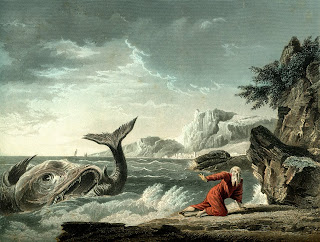
Jonah or Jonas is the name given in the Hebrew Bible (Tanakh/Old Testament) to a prophet of the northern kingdom of Israel in about the 8th century BC. He is the eponymous central character in the Book of Jonah, famous for being swallowed by a fish or a whale, depending on translation. The biblical story of Jonah is repeated, with a few notable differences, in the Qur'an.
★ Psalm 23

In the 23rd Psalm (Greek numbering: Psalm 22) in the Hebrew Bible/Old Testament, the writer describes God as his Shepherd. The text, beloved by Jews and Christians alike, is often alluded to in popular media and has been set to music many times.
For Christians the image of God as a shepherd evokes connections not only with David but with Jesus, described as "Good Shepherd" in the Gospel of John. The phrase about "the valley of the shadow of death" is often taken as an allusion to the eternal life given by Jesus.
Orthodox Christians typically include this Psalm in the prayers of preparation for receiving the Eucharist.
The Reformation inspired widespread efforts in western Europe to make biblical texts available in vernacular languages. One of the most popular early English versions was the Geneva Bible (1557). The most widely recognized version of the psalm in English today is undoubtedly the one drawn from the King James Bible (1611).
The psalm is a popular passage for memorization and is often used in sermons.
 George W. Bush's Post 9/11 Speech

★ Protestantism

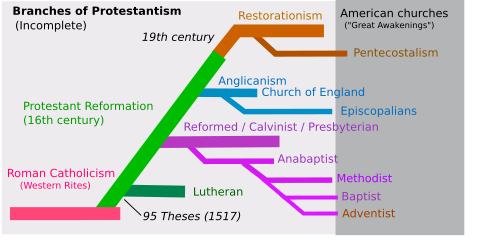
Protestantism is a form of Christian faith and practice which originated with the Protestant Reformation, a movement against what its followers considered to be errors in the Roman Catholic Church. It is one of the three major divisions of Christendom, together with Roman Catholicism and Eastern Orthodoxy. Anglicanism is sometimes considered to be independent from Protestantism. The term derives from the letter of protestation from Lutheran princes in 1529 against an edict condemning the teachings of Martin Luther as heretical.
All Protestant denominations reject the notion of papal supremacy over the Church universal and generally deny the Roman Catholic doctrine of transubstantiation, but they disagree among themselves regarding the real presence of Christ in the Eucharist. The various denominations generally emphasize the priesthood of all believers, the doctrine of justification by faith alone (sola fide) rather than by or with good works, and a belief in the Bible alone (rather than with Catholic tradition) as the highest authority in matters of faith and morals (sola scriptura). The "Five solae" summarize the reformers' basic differences in theological beliefs in opposition to the teaching of the Roman Catholic Church of the day.
★ Catholicism

Catholicism (from Greek καθολικισμός, katholikismos, "universal doctrine") and its adjectival form Catholic are used as broad terms for describing specific traditions in the Christian churches in theology, doctrine, liturgy, ethics, and spirituality.
"Catholicism" and "Catholic" in this sense refer to the practices of several Christian churches. This sense is to be distinguished from the use of these words to refer to the Roman Catholic Church, that which is in full communion with the Holy See, as well as the Orthodox Catholic Church (commonly called the "Orthodox Church" or the "Eastern Orthodox Church"), which also considers itself the universal and apostolic church.
In the sense of indicating historical continuity of faith and practice from the first millennium, the term "catholic" is employed by many other historic churches which claim to be "heirs of the apostolic faith". These consider themselves to be catholic, teaching that the term "designates the historic, orthodox mainstream of Christianity whose doctrine was defined by the ecumenical councils and creeds" and as such, most Reformers "appealed to this catholic tradition and believed they were in continuity with it."
Within the Anglican Communion, the Oxford Movement promoted Anglo-Catholicism, which reemphasized the importance of doctrines such as the Real presence of Christ in the Eucharist and apostolic succession.
The Roman Catholic church teaches that Protestant churches are not in fact churches, as they do not have apostolic tradition of ordinations, and therefore, do not have valid eucharist, nor are they in full communion with the successor of Saint Peter, the Pope. It does however recognise the shared apostolic tradition of the Eastern Orthodox church. Whilst it maintains that all salvation comes through the church, this leaves scope for the salvation of other Christians with an imperfect communion with the Roman Catholic church, i.e. Protestants.
Ê The dufference between Catholics and Protestants (click)

★ White Anglo-Saxon Protestant (WASP)
White Anglo-Saxon Protestant (WASP) is an informal, sometimes disparaging term for a group of high-status and influential White Americans of English Protestant ancestry. The term applies to a group believed to control disproportionate social, political, and financial power in the United States. It describes a group whose family wealth, education, status, and elite connections allow them a degree of opportunity held by few others.
Scholars agree that the group's influence has waned since the end of World War II, with the growing influence of other ethnic groups in the United States.[4] The term is also used in Canada and Australia for similar elites. The term is occasionally used by sociologists to include all Americans of North European ancestry regardless of their class or power. People rarely call themselves WASPs, except humorously. The acronym is typically used by non-WASPs.

★ Catholic Vulgate

The Vulgate (/ˈvʌlɡeɪt, -ɡɪt/) is a late fourth-century Latin translation of the Bible that became, during the 16th century, the Catholic Church's officially promulgated Latin version of the Bible.
The translation was largely the work of St. Jerome, who, in 382, was commissioned by Pope Damasus I to revise the Vetus Latina ("Old Latin") collection of biblical texts in Latin then in use by the Church. Once published, it was widely adopted and eventually eclipsed the Vetus Latina and, by the 13th century, was known as the "versio vulgata" (the "version commonly-used") or, more simply, in Latin as vulgata or in Greek as βουλγάτα ("Vulgate").
The Catholic Church made it its official Latin Bible as a consequence of the Council of Trent (1545–63).
★ King James Version

The King James Version (KJV), also known as the Authorized Version (AV) or King James Bible (KJB), is an English translation of the Christian Bible for the Church of England that begun in 1604 and completed in 1611.
First printed by the King's Printer Robert Barker, this was the third translation into English to be approved by the English Church authorities. The first was the Great Bible commissioned in the reign of King Henry VIII (1535), and the second was the Bishops' Bible of 1568. In January 1604, James I convened the Hampton Court Conference where a new English version was conceived in response to the perceived problems of the earlier translations as detected by the Puritans, a faction within the Church of England. The translation is widely considered a towering achievement in English literature, as both beautiful and scholarly.
By the first half of the 18th century, the Authorized Version had become effectively unchallenged as the English translation used in Anglican and English Protestant churches, other than for the Psalms and some short passages in the Book of Common Prayer of the Church of England. Over the course of the 18th century, the Authorized Version supplanted the Latin Vulgate as the standard version of scripture for English-speaking scholars. With the development of stereotype printing at the beginning of the 19th century, this version of the Bible became the most widely printed book in history, almost all such printings presenting the standard text of 1769 extensively re-edited by Benjamin Blayney at Oxford; and nearly always omitting the books of the Apocrypha. Today the unqualified title 'King James Version' commonly identifies this Oxford standard text.
★ Cain and Abel

Cain and Abel were, according to the Book of Genesis, two sons of Adam and Eve. Cain is described as a crop farmer and his younger brother Abel as a shepherd. Cain was the first human born and Abel was the first human to die. Cain committed the first murder by killing Abel. Interpretations of Genesis 4 by ancient and modern commentators have typically assumed that the motives were jealousy and anger. The story of Cain and Abel is found in the Christian Bible, Jewish Torah and Muslim Quran.
Ê Genesis narrative
Adam knew his wife Eve intimately, and she conceived and bore Cain. She said, "I have had a male child with the Lord's help."
Then she also gave birth to his brother Abel. Now Abel became a shepherd of a flock, but Cain cultivated the land. In the course of time Cain presented some of the land's produce as an offering to the Lord. And Abel also presented [an offering] – some of the firstborn of his flock and their fat portions. The Lord had regard for Abel and his offering, but He did not have regard for Cain and his offering. Cain was furious, and he was downcast.
Then the Lord said to Cain, "Why are you furious? And why are you downcast? If you do right, won't you be accepted? But if you do not do right, sin is crouching at the door. Its desire is for you, but you must master it."
Cain said to his brother Abel, "Let's go out to the field."
And while they were in the field, Cain attacked his brother Abel and killed him.
— Genesis 4:1–8 (Holman Christian Standard Bible)
The Septuagint, an early Greek translation of the Hebrew Bible, offers an alternative version of the seventh verse:
If you offer properly, but divide improperly, have you not sinned? Be still; to you shall he submit, and you shall rule over him.
Later in the narrative, God asks Cain, "Where is Abel thy brother?" Cain replies, "I know not: am I my brother's keeper?"
And he said, "What hast thou done? The voice of thy brother's blood crieth unto me from the ground. And now [art] thou cursed from the earth, which hath opened her mouth to receive thy brother's blood from thy hand; when thou tillest the ground, it shall not henceforth yield unto thee her strength; a fugitive and a vagabond shalt thou be in the earth." (Genesis 4:10–12)

★ Sodomy

Sodomy is generally anal or oral sex between people or sexual activity between a person and a non-human animal (bestiality), but may also include any non-procreative sexual activity. Originally the term sodomy, which is derived from the story of Sodom and Gomorrah in chapters 18 and 19 of the Book of Genesis in the Bible, was commonly restricted to anal sex. Sodomy laws in many countries criminalized these behaviors, and other disfavored sexual activities as well. In the Western world, many of these laws have been overturned or are not routinely enforced.
★ Orpheus

Orpheus was a legendary Thracian musician, poet, and prophet in ancient Greek religion and myth. The major stories about him are centered on his ability to charm all living things and even stones with his music, his attempt to retrieve his wife, Eurydice, from the underworld, and his death at the hands of those who could not hear his divine music. As an archetype of the inspired singer, Orpheus is one of the most significant figures in the reception of classical mythology in Western culture, portrayed or alluded to in countless forms of art and popular culture including poetry, film, opera, music, and painting.
For the Greeks, Orpheus was a founder and prophet of the so-called "Orphic" mysteries. He was credited with the composition of the Orphic Hymns, a collection of which survives. Shrines containing purported relics of Orpheus were regarded as oracles. Some ancient Greek sources note Orpheus' Thracian origins.
❀ Five people returned from the underworld
J Orpheus
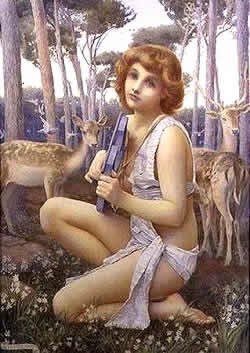
J Aeneas

J Odysseus
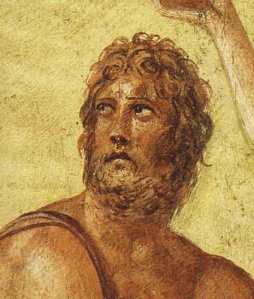
J Psyche

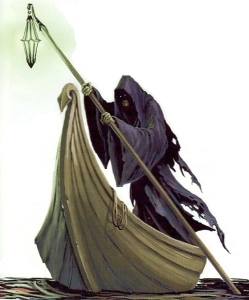
J Charon
★ Fall of man
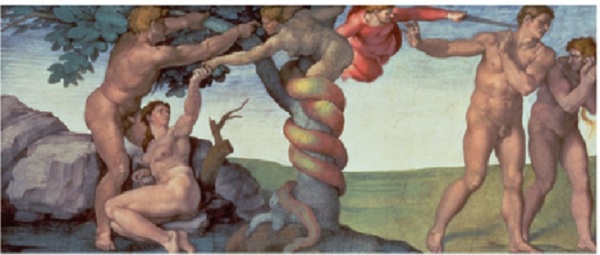
In Christian theology, the fall of man, or the fall, is a term used to describe the transition of the first man and woman from a state of innocent obedience to God to a state of guilty disobedience. Although not named in the Bible, the doctrine of the fall comes from a biblical interpretation of Genesis chapter 3. At first, Adam and Eve lived with God in the Garden of Eden, but the serpent tempted them into eating the fruit from the tree of knowledge of good and evil, which God had forbidden. After doing so, they became ashamed of their nakedness and God expelled them from the Garden to prevent them from eating from the tree of life and becoming immortal.
For many Christian denominations the doctrine of the fall is closely related to that of original sin. They believe that the fall brought sin into the world, corrupting the entire natural world, including human nature, causing all humans to be born into original sin, a state from which they cannot attain eternal life without the grace of God.
★ Prometheus

Prometheus (/prəˈmiːθiːəs/ prə-MEE-thee-əs; Greek: Προμηθεύς [promɛːtʰeús], meaning "forethought")[1] is a Titan in Greek mythology, best known as the deity in Greek mythology who was the creator of mankind and its greatest benefactor, who gave mankind fire stolen from Mount Olympus. Prometheus sided with Zeus and the ascending Olympian gods in the vast cosmological struggle against Cronus (Kronos) and the other Titans. Prometheus was therefore on the conquering side of the cataclysmic war of the Greek gods, the Titanomachy, where Zeus and the Olympian gods ultimately defeated Cronus and the other Titans.

★ Pandora

In Greek mythology, Pandora (Greek: Πανδώρα, derived from πᾶν, pān, i.e. "all" and δῶρον, dōron, i.e. "gift", thus "the all-endowed", "the all-gifted" or "the all-giving") was the first human woman created by the gods, specifically by Hephaestus and Athena on the instructions of Zeus. As Hesiod related it, each god helped create her by giving her unique gifts. Zeus ordered Hephaestus to mold her out of earth as part of the punishment of humanity for Prometheus' theft of the secret of fire, and all the gods joined in offering her "seductive gifts". Her other name—inscribed against her figure on a white-ground kylix in the British Museum—is Anesidora, "she who sends up gifts" (up implying "from below" within the earth).
According to the myth, Pandora opened a jar (pithos), in modern accounts sometimes mistranslated as "Pandora's box" (see below), releasing all the evils of humanity—although the particular evils, aside from plagues and diseases, are not specified in detail by Hesiod—leaving only Hope inside once she had closed it again.
The Pandora myth is a kind of theodicy, addressing the question of why there is evil in the world.
★ Frailty, thy name is woman
Hamlet:
Heaven and earth,
Must I remember? Why, she would hang on him
As if increase of appetite had grown
By what it fed on, and yet, within a month—
Let me not think on't—Frailty, thy name is woman!—
Hamlet Act 1, scene 2, 142–146
★ Tower of Babel
_-_Google_Art_Project_-_edited.jpg/350px-Pieter_Bruegel_the_Elder_-_The_Tower_of_Babel_(Vienna)_-_Google_Art_Project_-_edited.jpg)
The Tower of Babel is an etiological myth in the Book of Genesis of the Tanakh (also referred to as the Hebrew Bible or the Old Testament) meant to explain the origin of different languages. According to the story, a united humanity of the generations following the Great Flood, speaking a single language and migrating from the east, came to the land of Shinar (Hebrew: שנער). There they agreed to build a city and tower; seeing this, God confounded their speech so that they could no longer understand each other and scattered them around the world.
★ Fra- (打破)
✎ fragment
(n.)
(1.) A part broken off from a whole. 碎片。
(2.) An imperfect or unfinished part. 不完全之部分;未完工之片斷
➜ This building is but a fragment of the original plan.
(v.t.) (v.i.)
(1.) To break into fragments. 打破;破碎。
➜ The glasses were fragmented in shipment.
✎ frailty
(n.)
(1.) Weakness, physical, mental, or moral; liability to be deceived or misled.
(德智體之)孱弱;易被欺騙;易受誘惑。
(2.) A failing; a sin due to moral weakness. 缺點;因意志薄弱所犯之過失。
★ Mor- (死)
✎ morgue
(n.)
(1.) A place where the bodies of unknown persons found dead are left until recognized
and claimed. 無名屍陳列所。
(2.) Reference department of a newspaper. 【美】(報館的)資料室。
✎ mortician(n.)
(1.) An undertaker; one who prepares the dead for burial and conducts funerals.
【美】殯儀業者。
✎ mortify
(v.t.)
(1.) To subdue by self-denial. 克制;抑制。
(2.) To humble; humiliate; depress. 貶抑;屈辱;使消沉。
(3.) To cause ( a part of the body) to decay, or undergo gangrene. 使壞疽。
(v.i.)
(1.) To lose all living functions, as an injured part of the body; be affected with gangrene. 失去活動機能(如身體之受傷部分);生壞疽。
★ Breadwinner

The member of a family who earns the money to support the others.
★ scarecrow
A scarecrow or hay-man is a decoy or mannequin in the shape of a human. It is usually dressed in old clothes and placed in open fields to discourage birds such as crows or sparrows from disturbing and feeding on recently cast seed and growing crops.

★ American Eagle

★ Dove peace


