1.Today's Words
1) bene-: a combining form occurring in loanwords from Latin, where it meant “well”: benediction.
eg. benefactor, benediction, benefice

2) hydro-: before vowels hydr-, word-forming element in compounds of Greek origin, meaning "water," from Greek hydro-, comb. form of hydor "water" .
eg. hydro-electric, hydropower, hydrocortisone
3)ma-:1823, childish or colloquial shortening of mamma. Means mother.
4)anti-:word-forming element meaning "against, opposed to, opposite of, instead," from Old French anti- and directly from Latin anti-, from Greek anti "against, opposite, instead of," also used as a prefix, from PIE *anti- "against," also "in front of" . It appears in some words in Middle English but was not commonly used in word formations until modern times.
eg. antipope, antimetabole, antitheist
5)pro-: word-forming element meaning "forward, forth, toward the front" (as in proclaim, proceed); "beforehand, in advance" (prohibit, provide); "taking care of" (procure); "in place of, on behalf of" (proconsul, pronoun); from Latin pro "on behalf of, in place of, before, for, in exchange for, just as," which also was used as a prefix. Also in some cases from cognate Greek pro "before, in front of, sooner," which also was used in Greek as a prefix (as in problem). Both the Latin and Greek words are from PIE *pro- (source also of Sanskrit pra- "before, forward, forth;" Gothic faura "before," Old English fore "before, for, on account of," fram "forward, from;" Old Irish roar "enough"), extended form of root *per- (1) "forward, through" . The common modern sense "in favor of, favoring" (pro-independence, pro-fluoridation, pro-Soviet, etc.) was not in classical Latin and is attested in English from early 19c.
eg. prone, Procrustean, procrastination

6)re-: word-forming element meaning "back to the original place; again, anew, once more," also with a sense of "undoing," c. 1200, from Old French and directly from Latin re- "again, back, anew, against," "Latin combining form conceivably from Indo-European *wret-, metathetical variant of *wert- "to turn" [Watkins]. Often merely intensive, and in many of the older borrowings from French and Latin the precise sense of re- is lost in secondary senses or weakened beyond recognition. OED writes that it is "impossible to attempt a complete record of all the forms resulting from its use," and adds that "The number of these is practically infinite ...." The Latin prefix became red- before vowels and h-

2. Extra Words
1)prolific:1640s, from French prolifique (16c.), from Medieval Latin prolificus, from Latin proles "offspring" + root of facere "to make" . Latin proles is contracted from *pro-oles, from PIE *pro-al-, from *pro- "forth" + *al- "to grow, nourish" . Related: Prolifical (c. 1600).Prolific is in common use, but to make a satisfactory noun from it has passed the wit of man.
2)valor: c. 1300, "value, worth," from Old French valor, valour "valor, moral worth, merit, courage, virtue" (12c.), from Late Latin valorem (nominative valor) "value, worth" (in Medieval Latin "strength, valor"), from stem of Latin valere "be strong, be worth" . The meaning "courage" is first recorded 1580s, from Italian valore, from the same Late Latin word. (The Middle English word also had a sense of "worth or worthiness in respect of manly qualities").
3)megalomania: "delusions of greatness," 1866, from French mégalomanie; see megalo- + mania "madness."
4)understatement: the act or an instance of understating, or representing in a weak orrestrained
way that is not borne out by the facts.

3.Hark! The Herald Angels Sing
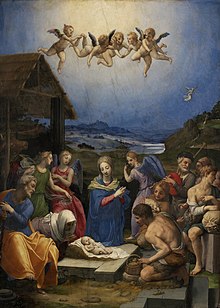 "Hark! The Herald Angels Sing" is a Christmas carol that first appeared in 1739 in the collection Hymns and Sacred Poems, having been written byCharles Wesley. Wesley had requested and received slow and solemn music for his lyrics, not the joyful tune expected today. Moreover, Wesley's original opening couplet is "Hark! how all the welkin rings / Glory to the King of Kings".
The popular version is the result of alterations by various hands, notably by Wesley's co-worker George Whitefield who changed the opening couplet to the familiar one, and by Felix Mendelssohn. In 1840—a hundred years after the publication of Hymns and Sacred Poems—Mendelssohn composed a cantata to commemorate Johann Gutenberg's invention of the printing press, and it is music from this cantata, adapted by the English musician William H. Cummingsto fit the lyrics of “Hark! The Herald Angels Sing”, that propels the carol known today.
4.King James Version
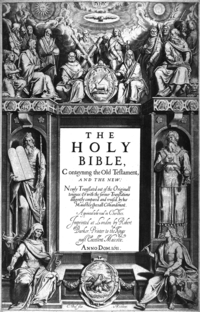 The King James Version (KJV), also known as the Authorized Version(AV) or the King James Bible (KJB), is an English translation of the ChristianBible for the Church of England begun in 1604 and completed in 1611. Thebooks of the King James Version include the 39 books of the Old Testament, an intertestamental section containing 14 books of the Apocrypha, and the 27 books of the New Testament.
It was first printed by the King's Printer Robert Barker and was the third translation into English, approved by the English Church authorities. The first had been the Great Bible, commissioned in the reign of King Henry VIII (1535), and the second had been the Bishops' Bible of 1568. In January 1604,James VI and I convened the Hampton Court Conference, where a new English version was conceived in response to the problems of the earlier translations perceived by the Puritans, a faction of the Church of England. The translation is noted for its "majesty of style", and has been described as one of the most important books in English culture.
5.Jane Eyre
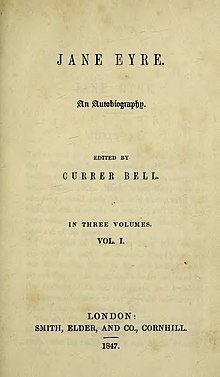 Jane Eyre /ˈɛər/ (originally published as Jane Eyre: An Autobiography) is a novel by English writer Charlotte Brontë. It was published on 16 October 1847, by Smith, Elder & Co. of London, England, under the pen name "Currer Bell." The first American edition was published the following year by Harper & Brothers of New York.
Primarily of the Bildungsroman genre, Jane Eyre follows the emotions and experiences of its eponymous heroine, including her growth to adulthood and her love for Mr. Rochester, the Byronic master of fictitious Thornfield Hall. In its internalisation of the action—the focus is on the gradual unfolding of Jane's moral and spiritual sensibility, and all the events are coloured by a heightened intensity that was previously the domain of poetry—Jane Eyre revolutionised the art of fiction. Charlotte Brontë has been called the 'first historian of the private consciousness' and the literary ancestor of writers like Joyce and Proust. The novel contains elements of social criticism, with a strong sense of morality at its core, but is nonetheless a novel many consider ahead of its time given the individualistic character of Jane and the novel's exploration of classism, sexuality, religion, and proto-feminism.

"The Raven" is a narrative poem by American writer Edgar Allan Poe. First published in January 1845, the poem is often noted for its musicality, stylized language, and supernatural atmosphere. It tells of a talking raven's mysterious visit to a distraught lover, tracing the man's slow fall into madness. The lover, often identified as being a student, is lamenting the loss of his love, Lenore. Sitting on a bust of Pallas, the raven seems to further instigate his distress with its constant repetition of the word "Nevermore". The poem makes use of a number of folk, mythological, religious, and classical references.
Poe claimed to have written the poem very logically and methodically, intending to create a poem that would appeal to both critical and popular tastes, as he explained in his 1846 follow-up essay, "The Philosophy of Composition". The poem was inspired in part by a talking raven in the novel Barnaby Rudge: A Tale of the Riots of 'Eighty by Charles Dickens. Poe borrows the complex rhythm and meter of Elizabeth Barrett's poem "Lady Geraldine's Courtship", and makes use of internal rhyme as well as alliteration throughout.
"The Raven" was first attributed to Poe in print in the New York Evening Mirror on January 29, 1845. Its publication made Poe widely popular in his lifetime, although it did not bring him much financial success. The poem was soon reprinted, parodied, and illustrated. Critical opinion is divided as to the poem's literary status, but it nevertheless remains one of the most famous poems ever written.

 No Strings Attached is a 2011 American romantic comedy film directed by Ivan Reitman and written by Elizabeth Meriwether. Starring Natalie Portman and Ashton Kutcher, the film is about two friends who decide to make a pact to have "no strings attached" casual sex without falling in love with each other. The film was released in the United States on January 21, 2011.
下一則: WEEK 15 字源筆記(Vocabulary and Etymology)


