1.It's The Most Wonderful Time Of The Year by Andy Williams
 p.s click to see
It's the most wonderful time of the year
With the kids jingle belling
And everyone telling you be of good cheer
It's the most wonderful time of the year
It's the hap-happiest season of all
With those holiday greetings and gay happy meetings
When friends come to call
It's the hap-happiest season of all
There'll be parties for hosting
Marshmallows for toasting
And caroling out in the snow
There'll be scary ghost stories
And tales of the glories of
Christmases long, long ago
It's the most wonderful time of the year
There'll be much mistltoeing
And hearts will be glowing
When love ones are near
It's the most wonderful time of the year
There'll be parties for hosting
Marshmallows for toasting
And caroling out in the snow
There'll be scary ghost stories
And tales of the glories of
Christmases long, long ago
It's the most wonderful time of the year
There'll be much mistltoeing
And hearts will be glowing
When love ones are near
It's the most wonderful time
Yes the most wonderful time
Oh the most wonderful time
Of the year
2.What Child Is This?
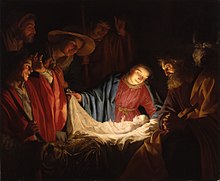 "What Child Is This?" is a Christmas carol whose lyrics were written by William Chatterton Dix, in 1865. At the time of composing the carol, Dix worked as an insurance company manager and had been struck by a severe illness. While recovering, he underwent a spiritual renewal that led him to write several hymns, including lyrics to this carol that was subsequently set to the tune of "Greensleeves", a traditional English folk song. Although it was written in Great Britain, the carol is more popular in the United States than in its country of origin today.

What child is this
Who lay to rest
On Mary's lap is sleeping
Whom angels greet with anthems sweet
While shepherds watch are keeping
So bring him incense, gold and myrrh
Come peasant king to own him
The King of Kings salvation brings
Let loving hearts enthrone him
This, this is Christ the King
Whom shepherds guard and angels sing
Haste, haste to bring him laud
The Babe, the Son of Mary
O raise, raise a song on high
His mother sings a lullaby
Joy, oh joy for Christ is born
The Babe, the son of Mary
This, this is Christ the King
Whom shepherds guard and angels sing
Haste, haste to bring him laud
The Babe, the Son of Mary
What child is this who lay to rest
On Mary's lap, on Mary's lap he is sleeping
This, this is Christ the King
Whom shepherds guard and angels sing
Haste, haste to bring him laud
The Babe, the Son of Mary
The Babe, the Son of Mary
The Son of Mary
3.Hark! The Herald Angels Sing
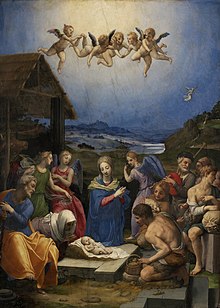 "Hark! The Herald Angels Sing" is a Christmas carol that first appeared in 1739 in the collection Hymns and Sacred Poems, having been written byCharles Wesley. Wesley had requested and received slow and solemn music for his lyrics, not the joyful tune expected today. Moreover, Wesley's original opening couplet is "Hark! how all the welkin rings / Glory to the King of Kings".
The popular version is the result of alterations by various hands, notably by Wesley's co-worker George Whitefield who changed the opening couplet to the familiar one, and by Felix Mendelssohn. In 1840—a hundred years after the publication of Hymns and Sacred Poems—Mendelssohn composed a cantata to commemorate Johann Gutenberg's invention of the printing press, and it is music from this cantata, adapted by the English musician William H. Cummingsto fit the lyrics of “Hark! The Herald Angels Sing”, that propels the carol known today.
Hark! the herald angels sing,
"Glory to the newborn King!"
Peace on earth, and mercy mild,
God and sinners reconciled
Joyful, all ye nations, rise,
Join the triumph of the skies;
With th' angelic host proclaim,
"Christ is born in Bethlehem."
Hark! the herald angels sing,
"Glory to the newborn King!"
Christ, by highest heav'n adored:
Christ, the everlasting Lord;
Late in time behold him come,
Offspring of the favored one.
Veil'd in flesh, the Godhead see;
Hail, th'incarnate Deity:
Pleased, as man, with men to dwell,
Jesus, our Emmanuel!
Hark! the herald angels sing,
"Glory to the newborn King!"
Hail! the heav'n born Prince of peace!
Hail! the Son of Righteousness!
Light and life to all he brings,
Risen with healing in his wings
Mild he lays his glory by,
Born that man no more may die:
Born to raise the sons of earth,
Born to give them second birth.
Hark! the herald angels sing,
"Glory to the newborn King!"
4.The Twelve Days of Christmas (song
 "The Twelve Days of Christmas" is an English Christmas carol that enumerates in the manner of a cumulative song a series of increasingly grand gifts given on each of the twelve days of Christmas (the twelve days that comprise the Christmas season starting with Christmas Day). The song, published in England in 1780 without music as a chant or rhyme, is thought to be French in origin. "The Twelve Days of Christmas" has a Roud Folk Song Index number of 68. The tunes of collected versions vary. The standard tune now associated with it is derived from a 1909 arrangement of a traditional folk melody by English composer Frederic Austin, who first introduced the now familiar prolongation of the verse "five gold rings".
On the first day of Christmas
my true love sent to me:
A Partridge in a Pear Tree
On the second day of Christmas
my true love sent to me:
2 Turtle Doves
and a Partridge in a Pear Tree
On the third day of Christmas
my true love sent to me:
3 French Hens
2 Turtle Doves
and a Partridge in a Pear Tree
On the fourth day of Christmas
my true love sent to me:
4 Calling Birds
3 French Hens
2 Turtle Doves
and a Partridge in a Pear Tree
On the fifth day of Christmas
my true love sent to me:
5 Golden Rings
4 Calling Birds
3 French Hens
2 Turtle Doves
and a Partridge in a Pear Tree
On the sixth day of Christmas
my true love sent to me:
6 Geese a Laying
5 Golden Rings
4 Calling Birds
3 French Hens
2 Turtle Doves
and a Partridge in a Pear Tree
On the seventh day of Christmas
my true love sent to me:
7 Swans a Swimming
6 Geese a Laying
5 Golden Rings
4 Calling Birds
3 French Hens
2 Turtle Doves
and a Partridge in a Pear Tree
On the eighth day of Christmas
my true love sent to me:
8 Maids a Milking
7 Swans a Swimming
6 Geese a Laying
5 Golden Rings
4 Calling Birds
3 French Hens
2 Turtle Doves
and a Partridge in a Pear Tree
On the ninth day of Christmas
my true love sent to me:
9 Ladies Dancing
8 Maids a Milking
7 Swans a Swimming
6 Geese a Laying
5 Golden Rings
4 Calling Birds
3 French Hens
2 Turtle Doves
and a Partridge in a Pear Tree
On the tenth day of Christmas
my true love sent to me:
10 Lords a Leaping
9 Ladies Dancing
8 Maids a Milking
7 Swans a Swimming
6 Geese a Laying
5 Golden Rings
4 Calling Birds
3 French Hens
2 Turtle Doves
and a Partridge in a Pear Tree
On the eleventh day of Christmas
my true love sent to me:
11 Pipers Piping
10 Lords a Leaping
9 Ladies Dancing
8 Maids a Milking
7 Swans a Swimming
6 Geese a Laying
5 Golden Rings
4 Calling Birds
3 French Hens
2 Turtle Doves
and a Partridge in a Pear Tree
On the twelfth day of Christmas
my true love sent to me:
12 Drummers Drumming
11 Pipers Piping
10 Lords a Leaping
9 Ladies Dancing
8 Maids a Milking
7 Swans a Swimming
6 Geese a Laying
5 Golden Rings
4 Calling Birds
3 French Hens
2 Turtle Doves
and a Partridge in a Pear Tree
5.Auld Lang Syne
 "Auld Lang Syne" (Scots pronunciation: [ˈɔːl(d) lɑŋˈsəin]: note "s" rather than "z") is a Scots poem written by Robert Burns in 1788 and set to the tune of a traditional folk song (Roud # 6294). It is well known in many countries, especially in the English-speaking world, its traditional use being to bid farewell to the old year at the stroke of midnight. By extension, it is also sung at funerals, graduations and as a farewell or ending to other occasions. The international Boy Scout youth movement, in many countries, uses it to close jamborees and other functions.
The song's Scots title may be translated into standard English as "old long since", or more idiomatically, "long long ago", "days gone by" or "old times". Consequently, "For auld lang syne", as it appears in the first line of the chorus, might be loosely translated as "for (the sake of) old times".
The phrase "Auld Lang Syne" is also used in similar poems by Robert Ayton (1570–1638), Allan Ramsay (1686–1757), and James Watson (1711) as well as older folk songs predating Burns. Matthew Fitt uses the phrase "In the days of auld lang syne" as the equivalent of "Once upon a time..." in his retelling of fairy tales in the Scots language.
Should auld acquaintance be forgot
And never brought to mind
Should auld acquaintance be forgot
And auld lang syne
For auld lang syne, my dear
For auld lang syne
We'll tak' a cup o' kindness yet
For auld lang syne
For auld lang syne
Should auld acquaintance be forgot
And never brought to mind
Should auld acquaintance be forgot
And auld lang syne
Auld lang syne, my dear
For auld lang syne
We'll tak' a cup o' kindness yet
For auld lang syne
For auld lang syne, my dear
For auld lang syne
We'll tak' a cup o' kindness yet
For auld lang syne
Ey, oh yeah, ey, ey, eh
Happy New Year baby, eh, oh
Should auld acquaintance be forgot
And never brought to mind
Should auld acquaintance be forgot
And auld lang syne
Does anybody really know the words
Might as well sing along
Happy New Year baby
Happy New Year baby
Should auld acquaintance be forgot
And never brought to mind
Should auld acquaintance be forgot
And auld lang syne
Happy New Year
To you and your friends
And have a drink on me
Happy New Year
To you
And have a drink on me
Ten, night, eight, seven, six, five, four, three, two, one
Happy new year
6.Beowulf
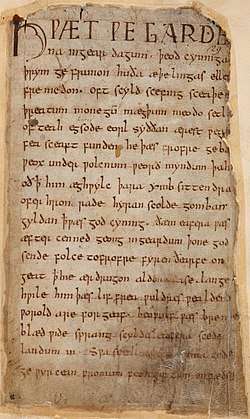 Beowulf (/ˈbeɪoʊwʊlf, ˈbiːoʊ-/; Old English: [ˈbeːo̯ˌwulf]) is an Old English epic poem consisting of 3182 alliterative lines. It may be the oldest surviving long poem in Old English and is commonly cited as one of the most important works of Old English literature. A date of composition is a matter of contention among scholars; the only certain dating pertains to the manuscript, which was produced between 975 and 1025. The author was an anonymous Anglo-Saxon poet, referred to by scholars as the "Beowulf poet".
The poem is set in Scandinavia. Beowulf, a hero of the Geats, comes to the aid of Hrothgar, the king of the Danes, whose mead hall in Heorot has been under attack by a monster known as Grendel. After Beowulf slays him, Grendel's mother attacks the hall and is then also defeated. Victorious, Beowulf goes home to Geatland (Götaland in modern Sweden) and later becomes king of the Geats. After a period of fifty years has passed, Beowulf defeats a dragon, but is fatally wounded in the battle. After his death, his attendants cremate his body and erect a tower on a headland in his memory.
The full poem survives in the manuscript known as the Nowell Codex, located in the British Library. It has no title in the original manuscript, but has become known by the name of the story's protagonist. In 1731, the manuscript was badly damaged by a fire that swept through Ashburnham House in London that had a collection of medieval manuscripts assembled by Sir Robert Bruce Cotton.
7.The Canterbury Tales
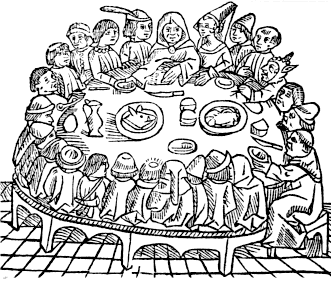 The Canterbury Tales (Middle English: Tales of Caunterbury) is a collection of 24 stories that runs to over 17,000 lines written in Middle English by Geoffrey Chaucer. In 1386, Chaucer became Controller of Customs and Justice of Peace and, three years later, Clerk of the King's work in 1389. It was during these years that Chaucer began working on his most famous text, The Canterbury Tales. The tales (mostly written in verse, although some are in prose) are presented as part of a story-telling contest by a group of pilgrims as they travel together on a journey from London to Canterbury to visit the shrine of Saint Thomas Becket at Canterbury Cathedral. The prize for this contest is a free meal at the Tabard Inn at Southwark on their return.
After a long list of works written earlier in his career, including Troilus and Criseyde, House of Fame, and Parliament of Fowls, The Canterbury Tales is near-unanimously seen as Chaucer's magnum opus. He uses the tales and descriptions of its characters to paint an ironic and critical portrait of English society at the time, and particularly of the Church. Chaucer's use of such a wide range of classes and types of people was without precedent in English. Although the characters are fictional, they still offer a variety of insights into customs and practices of the time. Often, such insight leads to a variety of discussions and disagreements among people in the 14th century. For example, although various social classes are represented in these stories and all of the pilgrims are on a spiritual quest, it is apparent that they are more concerned with worldly things than spiritual. Structurally, the collection resembles The Decameron, which Chaucer may have read during his first diplomatic mission to Italy in 1372.
8.The Decameron
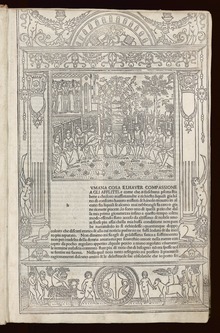 The Decameron (Italian: Decameron [deˈkaːmeron; dekameˈrɔn; dekameˈron] or Decamerone [dekameˈroːne]), subtitled Prince Galehaut (Old Italian: Prencipe Galeotto [ˈprentʃipe ɡaleˈɔtto; ˈprɛntʃipe]), is a collection of novellas by the 14th-century Italian author Giovanni Boccaccio (1313–1375). The book is structured as a frame story containing 100 tales told by a group of seven young women and three young men sheltering in a secluded villa just outside Florence to escape the Black Death, which was afflicting the city. Boccaccio probably conceived the Decameron after the epidemic of 1348, and completed it by 1353. The various tales of love in The Decameron range from the erotic to the tragic. Tales of wit, practical jokes, and life lessons contribute to the mosaic. In addition to its literary value and widespread influence (for example on Chaucer's The Canterbury Tales), it provides a document of life at the time. Written in the vernacular of the Florentine language, it is considered a masterpiece of classical early Italian prose.
9.Utopia
A utopia is an imagined community or society that possesses highly desirable or nearly perfect qualities.
Utopian ideals often place emphasis on egalitarian principles of equality in economics, government and justice, though by no means exclusively, with the method and structure of proposed implementation varying based on ideology. According to Lyman Tower Sargent "[t]here are socialist, capitalist, monarchical, democratic, anarchist, ecological, feminist, patriarchal, egalitarian, hierarchical, racist, left-wing, right-wing, reformist, free love, nuclear family, extended family, gay, lesbian, and many more utopias".

The Hunger Games is a 2012 American science fiction action film directed by Gary Ross and based on the novel of the same name by Suzanne Collins. It is the first installment in The Hunger Games film series and was produced by Nina Jacobson and Jon Kilik, with a screenplay by Ross, Collins, and Billy Ray. The film stars Jennifer Lawrence, Josh Hutcherson, Liam Hemsworth, Woody Harrelson, Elizabeth Banks, Lenny Kravitz, Stanley Tucci, and Donald Sutherland. The story takes place in a dystopian post-apocalyptic future in the nation of Panem, where boys and girls between the ages of 12 and 18 must take part in the Hunger Games, a televised annual event in which the "tributes" are required to fight to the death until there is only one survivor. Katniss Everdeen (Lawrence) volunteers to take her younger sister's place. Joined by her district's male tribute, Peeta Mellark (Hutcherson), Katniss travels to the Capitol to train for the Hunger Games under the guidance of former victor Haymitch Abernathy (Harrelson).
下一則: WEEK 14 字源筆記(Vocabulary and Etymology)


