1.Penelope
 In Homer's Odyssey, Penelope (/pəˈnɛləpiː/ pə-nel-ə-pee; Greek:Πηνελόπεια, Pēnelópeia, or Πηνελόπη, Pēnelópē) is the wife ofOdysseus, who is known for her faithfulness to Odysseus while he is absent, despite having many suitors.
Her name has traditionally been associated with marital faithfulness, and so it was with the Greeks and Romans, but some recent feminist readings offer a more ambiguous interpretation.Her character is beyond what was available to most women at the time, and she is considered a match for Odysseus due to her immense strength, warmth and intelligence.
2.Epithets in Homer
 A characteristic of Homer's style is the use of epithets, as in "rosy-fingered" dawn or "swift-footed" Achilles. Epithets are used because of the constraints of the dactylic hexameter (i.e., it is convenient to have a stockpile of metrically fitting phrases to add to a name) and because of the oral transmission of the poems; they are mnemonic aids to the singer and the audience alike.
3.Hubris
Hubris describes a personality quality of extreme or foolish pride or dangerous over-confidence. In its ancient Greek context, it typically describes behavior that defies the norms of behavior or challenges the gods, and which in turn brings about the downfall, or nemesis, of the perpetrator of hubris.

4.
 |
Demeter (Δημήτηρ, Dēmētēr)
Goddess of grain, agriculture, harvest, growth, and nourishment. Demeter is a daughter of Cronus and Rhea, and a sister of Zeus, by whom she bore Persephone. Demeter is one of the main deities of the Eleusinian Mysteries, in which her power over the life cycle of plants symbolizes the passage of the human soul through life and into the afterlife. She is depicted as a mature woman, often crowned and holding sheafs of wheat and a torch. Her symbols are the cornucopia, wheat-ears, the winged serpent, and the lotus staff. Her sacred animals include pigs and snakes. Her Roman counterpart is Ceres. |
5.Poseidon
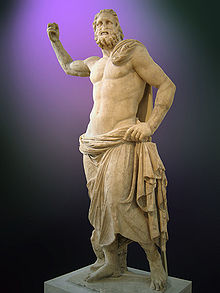 Poseidon (/pəˈsaɪdən, pɒ-, poʊ-/; Greek: Ποσειδῶν,pronounced [pose͜edɔ́͜ɔn]) was one of the twelve Olympian deities of thepantheon in Greek mythology. His main domain was the ocean, and he is called the "God of the Sea". Additionally, he is referred to as "Earth-Shaker"due to his role in causing earthquakes, and has been called the "tamer of horses". He is usually depicted as an older male with curly hair and a beard.
The name of the sea-god Nethuns in Etruscan was adopted in Latin forNeptune in Roman mythology; both were sea gods analogous to Poseidon.Linear B tablets show that Poseidon was venerated at Pylos and Thebes in pre-Olympian Bronze Age Greece as a chief deity, but he was integrated into the Olympian gods as the brother of Zeus and Hades. According to some folklore, he was saved by his mother Rhea, who concealed him among a flock of lambs and pretended to have given birth to a colt, which was devoured byCronus.
6.Ithaca


7.Eurydice
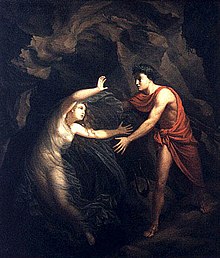 In Greek mythology, Eurydice (/jʊˈrɪdᵻsiː/; Greek: Εὐρυδίκη, Eurydikē) was an oaknymph or one of the daughters of Apollo (the god of music, prophecy, and light, who also drove the sun chariot, "adopting" the power as god of the Sun from the primordial god Helios). She was the wife of Orpheus, who tried to bring her back from the dead with his enchanting music.

8.Catharsis
 Catharsis (from Greek κάθαρσις katharsis meaning "purification" or "cleansing") is the purification and purgation of emotions—especially pity and fear—through art or any extreme change in emotion that results in renewal and restoration. It is a metaphor originally used by Aristotle in the Poetics,comparing the effects of tragedy on the mind of a spectator to the effect of acathartic on the body.


