1.Extra Words
1)sadist:1892, from sadism + -ist.
1.a person who has the condition ofsadism, in which one receives sexual gratificationfrom causing pain and degradation to another.

2.Quills
Quills is a 2000 American-British-German period film directed by Philip Kaufman and adapted from the Obie award-winning play by Doug Wright, who also wrote the original screenplay. Inspired by the life and work of theMarquis de Sade, Quills re-imagines the last years of the Marquis' incarceration in the insane asylum at Charenton. It stars Geoffrey Rush as de Sade, Joaquin Phoenix as the Abbé du Coulmier, Michael Caine as Dr. Royer-Collard, and Kate Winslet as laundress Madeleine "Maddie" LeClerc.

3.Oedipus rex (opera)
 Oedipus rex is an "Opera-oratorio after Sophocles" by Igor Stravinsky, scored for orchestra, speaker, soloists, and male chorus. The libretto, based on Sophocles's tragedy, was written by Jean Cocteau in French and then translated by Abbé Jean Daniélou into Latin; the narration, however, is performed in the language of the audience.

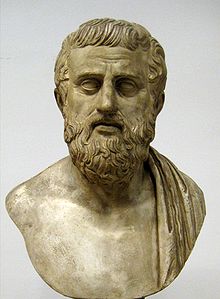 Sophocles (/ˈsɒfəkliːz/; Greek: Σοφοκλῆς, Sophoklēs, Ancient Greek: [so.pʰo.klɛ̂ːs]; c. 497/6 – winter 406/5 BC) is one of three ancient Greek tragedians whose plays have survived. His first plays were written later than those of Aeschylus, and earlier than or contemporary with those ofEuripides. Sophocles wrote 120 plays during the course of his life, but only seven have survived in a complete form: Ajax, Antigone, The Women of Trachis, Oedipus the King, Electra, Philoctetes and Oedipus at Colonus. For almost 50 years, Sophocles was the most celebrated playwright in the dramatic competitions of the city-state of Athens that took place during the religious festivals of the Lenaea and the Dionysia. He competed in 30 competitions, won 18, and was never judged lower than second place. Aeschylus won 14 competitions, and was sometimes defeated by Sophocles, while Euripides won 5 competitions.
 The School of Athens (Italian: Scuola di Atene) is one of the most famous frescoes by the Italian Renaissance artist Raphael. It was painted between 1509 and 1511 as a part of Raphael's commission to decorate the rooms now known as the Stanze di Raffaello, in theApostolic Palace in the Vatican. The Stanza della Segnatura was the first of the rooms to be decorated, and The School of Athens, representing Philosophy, was probably the second painting to be finished there, after La Disputa (Theology) on the opposite wall, and the Parnassus (Literature). The picture has long been seen as "Raphael's masterpiece and the perfect embodiment of the classical spirit of the Renaissance".
 Dionysus (/daɪ.əˈnaɪsəs/; Greek: Διόνυσος, Dionysos) is the god of the grape harvest, winemaking and wine, of ritual madness, fertility, theatre andreligious ecstasy in ancient Greek religion and myth. Wine played an important role in Greek culture, and the cult of Dionysus was the main religious focus for its unrestrained consumption. He may have been worshipped as early as c. 1500–1100 BC by Mycenean Greeks; traces of Dionysian-type cult have also been found in ancient Minoan Crete. His origins are uncertain, and his cults took many forms; some are described by ancient sources as Thracian, others as Greek. In some cults, he arrives from the east, as an Asiatic foreigner; in others, from Ethiopia in the South. He is a god of epiphany, "the god that comes", and his "foreignness" as an arriving outsider-god may be inherent and essential to his cults. He is a major, popular figure of Greek mythology and religion, becoming increasingly important over time, and included in some lists of the twelve Olympians, as the last of their number, and the only god born from a mortal mother. His festivals were the driving force behind the development of Greek theatre.
 Semele (/ˈsɛməli/; Greek: Σεμέλη Semelē), in Greek mythology, daughter of theBoeotian hero Cadmus and Harmonia, was the mortal mother of Dionysus by Zeus in one of his many origin myths.
Certain elements of the cult of Dionysus and Semele came from the Phrygians. These were modified, expanded and elaborated by the Ionian Greek invaders and colonists.Herodotus, who gives the account of Cadmus, estimates that Semele lived sixteen hundred years before his time, or around 2000 BCE. In Rome, the goddess Stimulawas identified as Semele.
 In Greek mythology, Iphigenia (/ɪfᵻdʒᵻˈnaɪ.ə/; Ancient Greek: Ἰφιγένεια, Iphigeneia) was a daughter of King Agamemnon and Queen Clytemnestra, and thus a princess of Argos.Agamemnon offends the goddess Artemis, who retaliates by commanding him to kill Iphigenia as a sacrifice so his ships can sail to Troy. In some versions, Iphigenia is sacrificed at Aulis, but in others, Artemis rescues her. In the version where she is saved, she goes to the Taurians and meets her brother Orestes.
 Clytemnestra (Greek: Κλυταιμνήστρα, Klytaimnḗstra, [klytai̯mnɛ̌ːstra]) was the wife of Agamemnon and queen of Mycenae (or sometimes Argos) in ancient Greek legend. In the Oresteia by Aeschylus, she murdered Agamemnon – said by Euripides to be her second husband – and the Trojan princess Cassandra, whom he had taken as war prize following the sack of Troy; however, in Homer'sOdyssey, her role in Agamemnon's death is unclear and her character is significantly more subdued.
 Aegisthus (/ᵻˈdʒɪsθəs/; Ancient Greek: Αἴγισθος; also transliterated asAigisthos) is a figure in Greek mythology. He was the son of Thyestes and his daughter, Pelopia. The product of an incestuous union motivated by his father's rivalry with the house of Atreus for the throne of Mycenae, Aegisthus murdered Atreus to restore his father to power. Later, he lost the throne to Atreus's sonAgamemnon.
 In Greek mythology, Atreus (/ˈeɪtriəs/, /ˈeɪtruːs/; Greek: Ἀτρεύς) was a king of Mycenae in the Peloponnese, the son ofPelops and Hippodamia, and the father of Agamemnon and Menelaus. Collectively, his descendants are known as Atreidaior Atreidae.
Atreus and his twin brother Thyestes were exiled by their father for murdering their half-brother Chrysippus in their desire for the throne of Olympia. They took refuge in Mycenae, where they ascended to the throne in the absence of King Eurystheus, who was fighting the Heracleidae. Eurystheus had meant for their stewardship to be temporary, but it became permanent after his death in battle.

 Delphi (/ˈdɛlfaɪ/ or /ˈdɛlfi/; Greek: Δελφοί, [ðelˈfi]) is famous as the ancient sanctuary that grew rich as the seat of the oracle that was consulted on important decisions throughout the ancient classical world. Moreover, it was considered as the navel (or centre) of the world by the Greeks as represented by the Omphalos.


