1.Aeschylus
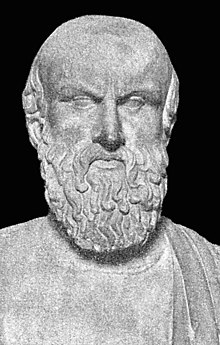 Aeschylus (/ˈiːskᵻləs/ or /ˈɛskᵻləs/; Greek: Αἰσχύλος Aiskhulos; Ancient Greek: [ai̯s.kʰý.los]; c. 525/524 – c. 456/455 BC) was an ancient Greek tragedian. He is often described as the father of tragedy. Critics' and scholars' knowledge of the genre begins with his work, and understanding of earlier tragedies is largely based on inferences from his surviving plays.According to Aristotle, he expanded the number of characters in theater allowing conflict among them; characters previously had interacted only with the chorus.
2.Extra Words
1)dramatist: 1670s, see drama (Greek stem dramat-) + -ist.

2)playwright:1680s (Ben Jonson used it 1610s as a mock-name), from play (n.) + wright (n.).

3.Tragedy
Tragedy (from the Greek: τραγῳδία, tragōidia) is a form of drama based on human suffering that invokes an accompanying catharsis or pleasure in audiences. While many cultures have developed forms that provoke thisparadoxical response, the term tragedy often refers to a specific tradition of drama that has played a unique and important role historically in the self-definition of Western civilisation. That tradition has been multiple and discontinuous, yet the term has often been used to invoke a powerful effect ofcultural identity and historical continuity—"the Greeks and the Elizabethans, in one cultural form; Hellenes and Christians, in a common activity," as Raymond Williams puts it.
4.Foreshadowing
 Foreshadowing is a literary device by which an author hints what is to come. Foreshadowing is a dramatic device in which an important plot-point is mentioned early in the story and will return in a more significant way. It is used to avoid disappointment. It is also sometimes used to arouse the reader.
5.In medias res

A narrative work beginning in medias res (Classical Latin: [ɪn mɛdiaːs reːs], lit. "into the middle things") opens in the midst of action (cf. ab ovo, ab initio). Often, exposition is bypassed and filled in gradually, either through dialogue, flashbacks or description of past events. For example, Hamlet begins after the death of Hamlet's father. Characters make reference to King Hamlet's death without the plot's first establishment of said fact. Since the play focuses on Hamlet and the revenge itself more so than the motivation, Shakespeare utilizes in medias res to bypass superfluous exposition.
6.Electra complex
 In Neo-Freudian psychology, the Electra complex, as proposed by Carl Gustav Jung, is a girl's psychosexual competition with her mother for possession of her father. In the course of her psychosexual development, the complex is the girl's phallic stage; formation of a discrete sexual identity, a boy's analogous experience is the Oedipus complex. The Electra complex occurs in the third—phallic stage (ages 3–6)—of five psychosexual development stages: (i) the Oral, (ii) the Anal, (iii) the Phallic, (iv) the Latent, and (v) the Genital—in which the source libido pleasure is in a different erogenous zone of the infant’s body.
7.Oedipus complex
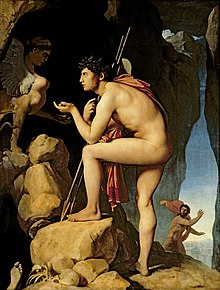 In psychoanalysis, the Oedipus complex (or, less commonly, Oedipal complex) is a child's desire, that the mind keeps in the unconscious via dynamic repression, to have sexual relations with the parent of the opposite sex (i.e. males attracted to their mothers, and females attracted to their fathers).
8.Agamemnon
 In Greek mythology, Agamemnon (/æɡəˈmɛmnɒn/; Greek: Ἀγαμέμνων from *Ἀγαμέδμων [from ἄγαν, "very much" and μέδομαι, "think on"],[1] "very steadfast") was the son of King Atreus and Queen Aerope of Mycenae, the brother of Menelaus, the husband of Clytemnestra and the father of Iphigenia, Electra or Laodike (Λαοδίκη), Orestes and Chrysothemis.Mythical legends make him the king of Mycenae or Argos, thought to be different names for the same area. When Helen, the wife of Menelaus, was taken to Troy by Paris, Agamemnoncommanded the united Greek armed forces in the ensuing Trojan War.
9.Oresteia
The Oresteia (Ancient Greek: Ὀρέστεια) is a trilogy of Greek tragedies written by Aeschylus concerning the murder of Agamemnon by Clytaemnestra, the murder of Clytaemnestra by Orestes, the trial of Orestes, and end of the curse on theHouse of Atreus. This trilogy also shows how the Greek gods interacted with the characters and influenced their decisions pertaining to events and disputes. The only extant example of an ancient Greek theater trilogy, the Oresteia won first prize at the Dionysia festival in 458 BC. Many consider the Oresteia to be Aeschylus' finest work. The principal themes of the trilogy include the contrast between revenge and justice, as well as the transition from personal vendetta to organizedlitigation.


