1.Today's Words
1)a-:
1.word-forming element which in English is characteristic of fem. nouns and adjectives of Latin or Greek origin (such as idea, coma, mania, basilica, arena, formula, nebula). From Latin -a (plural -ae) and Greek -a, -ē (plural -ai, Latinized as -ae). The Latin suffix also became Italian -a (plural -e), Spanish -a (plural -as). It is represented in Old English by -u, -e, but even then the suffix was fading and by the time of modern English was totally lost or swallowed into silent final -e-.
It also appears in Romanic words from Latin that have been borrowed into English, such as opera, plaza, armada. It figures in scientific names coined in Modern Latin (amoeba, soda, magnolia, etc.) and is common in geographical names formed according to Latin or Greek models (Asia, Africa, America, Arabia, Florida, etc.)
In English it marks sex only in personal names (Julia, Maria, Alberta) and in a few words from Italian or Spanish where a corresponding male form also is in use (donna, senora).
2.prefix or inseparable particle, a relic of various Germanic and Latin elements.
In words derived from Old English, it commonly represents Old English an "on" , as in alive, above, asleep, aback, abroad, afoot, ashore, ahead, abed, aside, apart, etc., forming adjectives and adverbs from nouns, with the notion "in, at; engaged in." In this use it is identical to a (2).
It also can represent Middle English of (prep.) "off, from," as in anew, afresh, akin, abreast. Or it can be a reduced form of the Old English past participle prefix ge-, as in aware.
Or it can be the Old English intensive a-, originally ar- (cognate with German er- and probably implying originally "motion away from"), as in abide, arise, awake, ashamed, marking a verb as momentary, a single event. Such words sometimes were refashioned in early modern English as though the prefix were Latin (accursed, allay, affright are examples).
In words from Romanic languages, often it represents reduced forms of Latin ad "to, toward; for", or ab "from, away, off" ; both of which by about 7c. had been reduced to a in the ancestor of Old French. In a few cases it represents Latin ex.
[I]t naturally happened that all these a- prefixes were at length confusedly lumped together in idea, and the resultant a- looked upon as vaguely intensive, rhetorical, euphonic, or even archaic, and wholly otiose. [OED]

3.prefix meaning "not, without," from Greek a-, an- "not" (the "alpha privative"), from PIE root *ne "not" (source also of Latin nil, English un- (q.v.)). In words from Greek, such as abyssmal, adamant, amethyst; also partly nativized as a prefix of negation (asexual, amoral, agnostic).
The ancient alpha privatum, denoting want or absence; Greek also had an alpha copulativum expressing union or likeness, which is the a- in acolyte, acoustic, Adelphi.
2)-in: "that is within, internal," 1590s, from in (adv.). Sense of "holding power" (the in party) first recorded c. 1600; that of "exclusive" (the in-crowd, an in-joke) is from 1907 (in-group); that of "stylish, fashionable" (the in thing) is from 1960.
3)en-: word-forming element meaning "near, at, in, on, within," from Greek en "in," cognate with Latin in (see in), and thus with en- . Typically assimilated to em- before -p-, -b-, -m-, -l-, and -r-.
eg. enrapt, enthalpy, embrasure

4)se-: word-forming element, from Latin se-, collateral form of sed- "without, apart, aside, on one's own," related to sed, Latin reflexive pronoun (accusative and ablative), from PIE *sed-, extended form of root *s(w)e-, pronoun of the third person and reflexive (source also of German sich)
5)ver-: German prefix "denoting destruction, reversal, or completion" [Watkins], from Proto-Germanic *fer-, *far-

6)contra-:word-forming element meaning "against, in opposition," from Latin adverb and preposition contra "against" . The Latin word was used as a prefix in Late Latin. In French, it became contre- and passed into English as counter-. The Old English equivalent was wiðer (surviving in withers and widdershins), from wið "with, against."
eg. contraception
7)ad-: word-forming element expressing direction toward or in addition to, from Latin ad "to, toward" in space or time; "with regard to, in relation to," as a prefix, sometimes merely emphatic, from PIE *ad- "to, near, at" (cognate with Old English æt). Simplified to a- before sc-, sp- and st-; modified to ac- before many consonants and then re-spelled af-, ag-, al-, etc., in conformity with the following consonant (as in affection, aggression). In Old French, reduced to a- in all cases (an evolution already underway in Merovingian Latin), but written forms in French were refashioned after Latin in 14c. and English did likewise 15c. in words it had picked up from Old French. In many cases pronunciation followed the shift. Over-correction at the end of the Middle Ages in French and then English "restored" the -d- or a doubled consonant to some words that never had it (accurse, afford). The process went further in England than in France, where the vernacular sometimes resisted the pedantic, resulting in English adjourn, advance, address, advertisement (Modern French ajourner, avancer, adresser, avertissement). In modern word-formation sometimes ad- and ab- are regarded as opposites, but this was not in classical Latin.
eg. advertisement, adage, adagio
2.Extra Words
1)stir:Old English styrian "to stir, move; rouse, agitate, incite, urge" (transitive and intransitive), from Proto-Germanic *sturjan (source also of Middle Dutch stoeren, Dutch storen "to disturb," Old High German storan "to scatter, destroy," German stören "to disturb"), from PIE *(s)twer- (1) "to turn, whirl". Related: Stirred; stirring. Stir-fry (v.) is attested from 1959.

3.The Road Not Taken

4.Aesop
Aesop (/ˈiːsɒp/ ee-sop; Ancient Greek: Αἴσωπος, Aisōpos; c. 620 – 564 BCE) was an Ancient Greek fabulist or story teller credited with a number of fables now collectively known as Aesop's Fables. Although his existence remains uncertain and no writings by him survive, numerous tales credited to him were gathered across the centuries and in many languages in a storytelling tradition that continues to this day. Many of the tales are characterized by animals and inanimate objects that speak, solve problems, and generally have human characteristics.
Scattered details of Aesop's life can be found in ancient sources, including Aristotle, Herodotus, and Plutarch. An ancient literary work called The Aesop Romance tells an episodic, probably highly fictional version of his life, including the traditional description of him as a strikingly ugly slave (δοῦλος) who by his cleverness acquires freedom and becomes an adviser to kings and city-states. Older spellings of his name have included Esop(e) and Isope. Depictions of Aesop in popular culture over the last 2500 years have included many works of art and his appearance as a character in numerous books, films, plays, and television programs.
5.Petite size
 Regular female sized clothing is designed for a woman at least 165 cm (5 ft 5 in) tall (without shoes) and will not fit a woman of significantly shorter height well. Even if the bust, waist and hip circumferences are appropriate, the sleeve lengths, leg inseam lengths and vertical torso measurements (such as the back length and bust-waist length) must be altered significantly to fit well. Non-petite size dresses cannot be easily altered to produce the equivalent petite size, since, in general, these lengths (particularly the critical torso measurements) cannot be altered without introducing an unsightly seam. Significant errors in the torso measurements will make a well-fitted look impossible, e.g., if the bust-point darts are off by three inches.
In addition to its measurements, a petite-size garment may have a different design from those intended for taller women. For example, style elements may be added to give a longer, slimmer look, e.g., vertical stripes, princess seams, short skirts, large patterns or patterns arranged helically around the whole body. Unfortunately, many modern "petite" sizes are actually renamed half sizes intended for large women and, as a result, tend to be boxy and unfashionable for small-framed women. Designs for taller women may also have style lines that appear to shorten the figure, such as horizontal lines (e.g., clamdigger pants or midcalf skirts); hence, even if the measurements are adjusted correctly, a petite-size version of a regular-size garment may be unflattering.
6.Parable of the Prodigal Son
The Parable of the Prodigal Son (also known as the Lost Son, Running Son, Loving Father, or Lovesick Father) is one of the parables of Jesus . Jesus Christ shares it with his disciples, the Pharisees and others.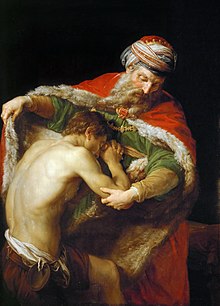
In the story, a father has two sons. The younger son asks for his inheritance and after wasting his fortune (the word "prodigal" means "wastefully extravagant"), becomes destitute. He returns home with the intention of begging his father to be made one of his hired servants, expecting his relationship with his father is likely severed. The father welcomes him back and celebrates his return. The older son refuses to participate. The father reminds the older son that one day he will inherit everything. But, they should still celebrate the return of the younger son because he was lost and is now found.
It is the third and final part of a cycle on redemption, following the Parable of the Lost Sheep and the Parable of the Lost Coin. In Revised Common Lectionary and Latin Rite Catholic Lectionary, this parable is read on the fourth Sunday of Lent (in Year C),;[3] in the latter it is also included in the long form of the Gospel on the 24th Sunday of Ordinary Time in Year C, along with the preceding two parables of the cycle.[4] In the Eastern Orthodox Church it is read on the Sunday of the Prodigal Son.
下一則: WEEK 18 字源筆記(Vocabulary and Etymology)


