1.Job (biblical figure)
 Job (/ˈdʒoʊb/ jowb; Hebrew: אִיּוֹב, Modern Iyyov, Tiberian ʾIyyôḇ) is the central figure of the Book of Job in the Bible. Job (Arabic: أيّوب, Ayyūb) is a prophet in the Abrahamic religions: Judaism, Christianity, and Islam. In rabbinical literature, Iyov (אִיּוֹב) is called one of the prophets of the Gentiles.
Job is presented as a good and prosperous family man who is beset with horrendous disasters that take away all that he holds dear, including his offspring, his health, and his property. He struggles to understand his situation and begins a search for the answers to his difficulties.
2.Original Sin
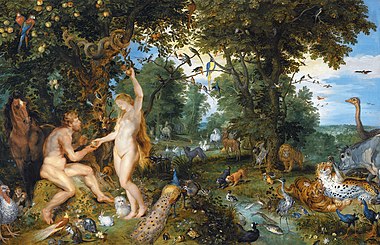 Original sin, also called ancestral sin, is the Christiandoctrine of humanity's state of sin resulting from the fall of man, stemming from Adam and Eve's rebellion in Eden, namely the sin of disobedience in consuming from the tree of knowledge of good and evil. This condition has been characterized in many ways, ranging from something as insignificant as a slight deficiency, or a tendency toward sin yet without collective guilt, referred to as a "sin nature", to something as drastic as total depravity or automatic guilt of all humans through collective guilt.
The concept of original sin was first alluded to in the 2nd century by Irenaeus, Bishop of Lyon in his controversy with certain dualist Gnostics. Other church fathers such asAugustine also developed the doctrine, seeing it as based on the New Testament teaching of Paul the Apostle(Romans and 1 Corinthians ) and the Old Testament verse of Psalms Tertullian,Cyprian, Ambrose and Ambrosiaster considered that humanity shares in Adam's sin, transmitted by human generation.Augustine's formulation of original sin was popular among Protestant reformers, such as Martin Luther and John Calvin, who equated original sin with concupiscence, affirming that it persisted even after baptism and completely destroyed freedom.The Jansenist movement, which the Catholic Church declared to be heretical, also maintained that original sin destroyedfreedom of will.
The story of the Garden of Eden and the Fall of Man represents a tradition among the Abrahamic peoples, with a presentation more or less symbolical of certain moral and religious truths.
3.Adam
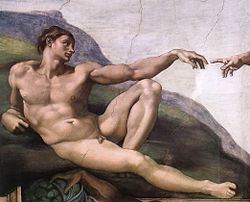 Adam (Hebrew: אָדָם; Greek: Αδάμ Aramaic/Syriac: ܐܕܡ; Arabic: آدم) is a figure from the Book of Genesis who is also mentioned in the New Testament, thedeuterocanonical books, the Quran, the Book of Mormon, and the Book of Iqan. According to the creation myth of the Abrahamic religions, he was thefirst human.
In the Genesis creation narratives, he was created by God. Christian churches differ on how they view Adam's subsequent behavior of disobeying God (often called the Fall of man), and to the consequences that those actions had on the rest of humanity. Christian and Jewish teachings sometimes hold Adam andEve (the first woman) to a different level of responsibility for the Fall, thoughIslamic teaching holds both equally responsible. In addition, Islam holds that Adam was eventually forgiven, while Christianity holds that redemption occurred only later through the sacrifice of Jesus. The Bahá'í Faith, Islam and some Christian denominations consider Adam to be the first prophet.
4.Extra Words
1)lock:
1."means of fastening," Old English loc "bolt, appliance for fastening a door, lid, etc.; barrier, enclosure; bargain, agreement, settlement, conclusion," from Proto-Germanic *lukan, a verbal root meaning "to close" (source also of Old Frisian lok "enclosure, prison, concealed place," Old Norse lok "fastening, lock," Gothic usluks "opening," Old High German loh "dungeon," German Loch"opening, hole," Dutch luik "shutter, trapdoor").
Ordinary mechanical locks work by means of an internal bolt or bar which slides and catches in an opening made to receive it. "The great diversity of meaning in the Teut. words seems to indicate two or more independent but formally identical substantival formations from the root" [OED]. The Old English sense "barrier, enclosure" led to the specific meaning "barrier on a stream or canal" (c. 1300), and the more specific sense "gate and sluice system on a water channel used as a means of raising and lowering boats" (1570s). From 1540s as "a fastening together," hence "a grappling in wrestling" (c. 1600). In firearms, the part of the mechanism which explodes the charge (1540s), hence lock, stock, and barrel (which add up to the whole firearm) "the whole of something" (1842). Phrase under lock and key attested from early 14c.
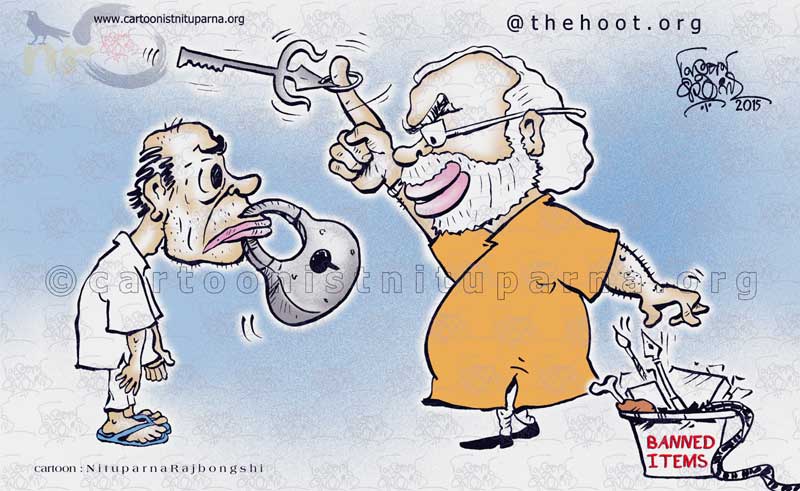
2."tress of hair," Old English locc "lock of hair, curl" (plural loccas), from Proto-Germanic *lukkoz (source also of Old Norse lokkr, Old Saxon, Old Frisian, Dutch lok, Old High German loc, German Locke "lock of hair"), a word of uncertain origin. According to OED, perhaps from a PIE *lugnos- and related to Greek lygos "pliant twig, withe," Lithuanian lugnas "flexible."
2)auld: variant of old that more accurately preserves the Anglo-Saxon vowel. Surviving in northern English and Scottish; distinctly Scottish after late 14c.
3)wasp: Old English wæps, wæsp "wasp," altered (probably by influence of Latin vespa) from Proto-Germanic *wabis- (source also of Old Saxon waspa, Middle Dutch wespe, Dutch wesp, Old High German wafsa, German Wespe, Danish hveps), from PIE*wopsa-/*wospa- "wasp" (source also of Latin vespa, Lithuanian vapsa, Old Church Slavonic vosa "wasp," Old Irish foich"drone"), perhaps from *webh- "weave" . If that is the correct derivation, the insect would be so called for the shape of its nest. Of persons with wasp-like tendencies, from c. 1500. Wasp-waist in reference to women's figures is recorded from 1870 (wasp-waisted is from 1775).
5.Whirlwind
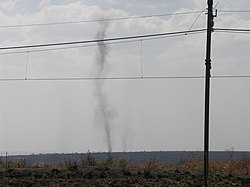 A whirlwind is a weather phenomenon in which a vortex of wind (a vertically oriented rotating column of air) forms due to instabilities and turbulence created by heating and flow (current) gradients. Whirlwinds occur all over the world and in any season.
6.Whirlpool
 A whirlpool is a body of swirling water produced by the meeting of opposing currents. The vast majority of whirlpools are not very powerful and very small whirlpools can easily be seen when a bath or a sink is draining. More powerful ones in seas or oceans may be termedmaelstroms. Vortex is the proper term for any whirlpool that has adowndraft.
In oceans, in narrow straits, with fast flowing water, whirlpools are normally caused by tides; there are few stories of large ships ever being sucked into such a maelstrom, although smaller craft are in danger. Smaller whirlpools also appear at the base of manywaterfalls and can also be observed downstream from manmade structures such as weirs and dams. In the case of powerful waterfalls, like Niagara Falls, these whirlpools can be quite strong.
7.Hark! The Herald Angels Sing
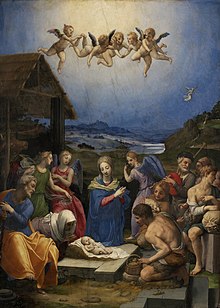 "Hark! The Herald Angels Sing" is a Christmas carol that first appeared in 1739 in the collection Hymns and Sacred Poems, having been written byCharles Wesley. Wesley had requested and received slow and solemn music for his lyrics, not the joyful tune expected today. Moreover, Wesley's original opening couplet is "Hark! how all the welkin rings / Glory to the King of Kings".
The popular version is the result of alterations by various hands, notably by Wesley's co-worker George Whitefield who changed the opening couplet to the familiar one, and by Felix Mendelssohn. In 1840—a hundred years after the publication of Hymns and Sacred Poems—Mendelssohn composed a cantata to commemorate Johann Gutenberg's invention of the printing press, and it is music from this cantata, adapted by the English musician William H. Cummingsto fit the lyrics of “Hark! The Herald Angels Sing”, that propels the carol known today.
8.Sodom and Gomorrah
 Sodom and Gomorrah (/ˈsɒd.əm/; /ɡə.ˈmɔːr.ə/) were cities mentioned in the Book of Genesis and throughout the Hebrew Bible, the New Testament and in the deuterocanonical books, as well as in theQuran and the hadith.
According to the Torah, the kingdoms of Sodom and Gomorrah were allied with the cities of Admah, Zeboim and Bela. These five cities, also known as the "cities of the plain", (from Genesis in the Authorized Version) were situated on the Jordan River plain in the southern region of the land of Canaan. The plain, which corresponds to the area just north of the modern-day Dead Sea, was compared to the garden of Eden as being a land well-watered and green, suitable for grazing livestock.
9.King James Version
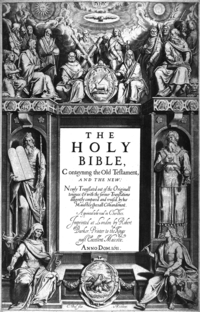 The King James Version (KJV), also known as the Authorized Version(AV) or the King James Bible (KJB), is an English translation of the ChristianBible for the Church of England begun in 1604 and completed in 1611. Thebooks of the King James Version include the 39 books of the Old Testament, an intertestamental section containing 14 books of the Apocrypha, and the 27 books of the New Testament.
It was first printed by the King's Printer Robert Barker and was the third translation into English, approved by the English Church authorities. The first had been the Great Bible, commissioned in the reign of King Henry VIII (1535), and the second had been the Bishops' Bible of 1568. In January 1604,James VI and I convened the Hampton Court Conference, where a new English version was conceived in response to the problems of the earlier translations perceived by the Puritans, a faction of the Church of England. The translation is noted for its "majesty of style", and has been described as one of the most important books in English culture.
10.Lord's Prayer
The Lord's Prayer, also called the Our Father, Pater Noster, and the Model Prayer is a venerated Christianprayer originally recorded in Aramaic that, according to the New Testament, was taught by Jesus to his disciples. Two forms of it are recorded in the New Testament: a longer form in the Gospel of Matthe was part of the Sermon on the Mount, and a shorter form in the Gospel of Luke as a response by Jesus to a request by "one of his disciples" to teach them "to pray as John taught his disciples."
11.Protestantism
 Protestantism is a form of Christian faith and practice which originated with theProtestant Reformation, a movement against what its followers considered to be errorsin the Roman Catholic Church. It is one of the three major divisions of Christendom, together with Roman Catholicism and Orthodoxy. The term derives from the letter of protestation from German Lutheran princes in 1529 against an edict condemning the teachings of Martin Luther as heretical.
With its origins in Germany, the modern movement is popularly considered to have begun in 1517 when Luther published his Ninety-five Theses as a reaction against abuses in the sale of indulgences, which purported to offer remission of sin to their purchasers.Although there were earlier breaks from or attempts to reform the Roman Catholic Church—notably by Peter Waldo, John Wycliffe, and Jan Hus—only Luther succeeded in sparking a wider, lasting movement.
12.Sermon on the Mount
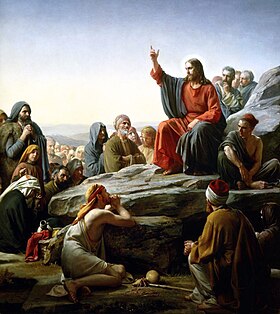 The Sermon on the Mount (anglicized from the Matthean Vulgate Latin section title: Sermo in monte) is a collection of sayings and teachings ofJesus, which emphasizes his moral teaching found in the Gospel of Matthew (chapters 5, 6, and 7). It is the first of the Five Discourses of Matthew and takes place relatively early in the Ministry of Jesus after he has been baptized by John the Baptist and preached in Galilee.
The Sermon is the longest continuous section of Jesus speaking found in the New Testament, and has been one of the most widely quoted elements of the Canonical Gospels. It includes some of the best known teachings of Jesus, such as the Beatitudes, and the widely recited Lord's Prayer. To most believers in Jesus, the Sermon on the Mount contains the central tenets of Christian discipleship.
The last verse of chapter 5 is considered by some to be a focal point which summarizes the teaching of the sermon: "be perfect, as your heavenly Father is perfect", advising his disciples and followers to seek the path towards perfection and the Kingdom of Heaven.


