1.Midas
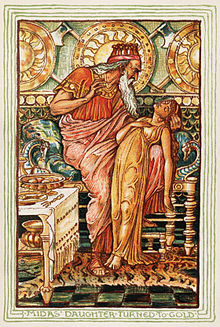 The most famous King Midas is popularly remembered in Greek mythology for his ability to turn everything he touched into gold. This came to be called the golden touch, or the Midas touch. The Phrygian city Midaeum was presumably named after this Midas, and this is probably also the Midas that according to Pausanias founded Ancyra.According to Aristotle, legend held that Midas died of starvation as a result of his "vain prayer" for the gold touch. The legends told about this Midas and his father Gordias, credited with founding the Phrygian capital city Gordium and tying the Gordian Knot, indicate that they were believed to have lived sometime in the 2nd millennium BC, well before the Trojan War. However, Homer does not mention Midas or Gordias, while instead mentioning two other Phrygian kings, Mygdon and Otreus.
2.Orpheus
 Orpheus (/ˈɔːrfiəs, ˈɔːrfjuːs/; Greek: Ὀρφεύς) was a legendary musician, poet, and prophet in ancient Greek religion and myth. The major stories about him are centered on his ability to charm all living things and even stones with his music, his attempt to retrieve his wife, Eurydice, from the underworld, and his death at the hands of those who could not hear his divine music. As an archetype of the inspired singer, Orpheus is one of the most significant figures in the reception of classical mythology in Western culture, portrayed or alluded to in countless forms of art and popular culture including poetry, film, opera, music, and painting.
3.Tiresias
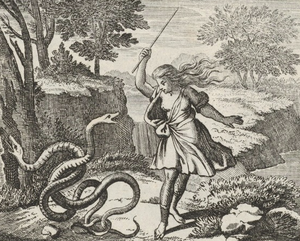 In Greek mythology, Tiresias (/taɪˈriːsiəs/; Greek: Τειρεσίας, Teiresias) was a blind prophet of Apollo in Thebes, famous for clairvoyance and for being transformed into a woman for seven years. He was the son of the shepherd Everes and the nymph Chariclo. Tiresias participated fully in seven generations at Thebes, beginning as advisor to Cadmus himself.
4.Today's Words
1)ami-: "friend, lover," c. 1300, from Old French amy, ami "friend, lover, beloved; kinsman" (11c.), from Latin amicus

2)re-: word-forming element meaning "back to the original place; again, anew, once more," also with a sense of "undoing," c. 1200, from Old French and directly from Latin re- "again, back, anew, against," "Latin combining form conceivably from Indo-European *wret-, metathetical variant of *wert- "to turn" [Watkins]. Often merely intensive, and in many of the older borrowings from French and Latin the precise sense of re- is lost in secondary senses or weakened beyond recognition. OED writes that it is "impossible to attempt a complete record of all the forms resulting from its use," and adds that "The number of these is practically infinite ...." The Latin prefix became red- before vowels and h-

3)alter-:late 14c., "to change (something), make different in some way," from Old French alterer "to change, alter," from Medieval Latin alterare "to change," from Latin alter "the other (of the two)," from PIE *al- (1) "beyond" + comparative suffix -ter (as in other). Intransitive sense "to become otherwise" first recorded 1580s. Related: Altered; altering.
eg. alternative, altercation, alternate

4)de-: active word-forming element in English and in many words inherited from French and Latin, from Latin de "down, down from, from, off; concerning" , also used as a prefix in Latin usually meaning "down, off, away, from among, down from," but also "down to the bottom, totally" hence "completely" (intensive or completive), which is its sense in many English words. As a Latin prefix it also had the function of undoing or reversing a verb's action, and hence it came to be used as a pure privative -- "not, do the opposite of, undo" -- which is its primary function as a living prefix in English, as in defrost (1895), defuse (1943), etc. Compare also dis-.
eg. deceleration, demulcent, detergent
5)arch-: also archi-, word-forming element meaning "chief, principal; extreme, ultra; early, primitive," from Latinized form of Greek arkh-, arkhi- "first, chief, primeval," comb. form of arkhos "chief" .
eg. archenemy, archfiend, archdiocese
p.s. -arch:word-forming element meaning "a ruler," from Greek arkhos "leader, chief, ruler," from arkhe "beginning, origin, first place" .
6)-mortal: "mortal thing or substance," 1520s, from mortal (adj.). Latin mortalis also was used as a noun, "a man, mortal, human being.''
eg. immortal, amortize, mortify


