What are the maintenance tips for stepper motor drivers?
2025/04/30 17:26
瀏覽108
迴響0
推薦0
引用0
1. Definition of stepper motor drivers
A stepper motor driver is a power amplifier that converts the pulse signal from the controller into a drive current signal to control the angular displacement, speed and acceleration of the stepper motor. Stepper motor drivers are usually used in conjunction with stepper motors to form an open-loop control system that does not require a feedback circuit to return the position and speed information of the rotating shaft.
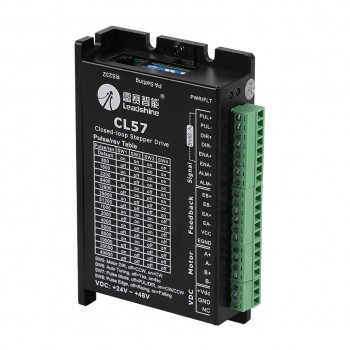
2. Working principle of stepper motor drivers
The working principle of stepper motor drivers is based on the control of electrical pulse signals. For each input pulse signal, the stepper motor will rotate a fixed angle. By controlling the number of pulses, the angular displacement of the motor can be controlled to achieve accurate positioning; by controlling the frequency of the pulses, the speed and acceleration of the motor can be controlled to achieve speed regulation. The stepper motor driver achieves precise control of the stepper motor's direction, speed and rotation angle by carefully controlling the order, frequency and number of electrical pulses applied to the motor coil.
3. Optimization design of stepper motor drivers
1. Subdivision control technology: Fine control of the stepper motor's rotation angle is achieved by finely regulating the current in the stator winding. This method can change the change law of the synthetic magnetic field inside the stepper motor, thereby achieving a fine division of the step angle. Ideally, the amplitude of the synthetic magnetic field vector should remain constant to produce an approximately uniform circular rotating magnetic field.
2. Space vector pulse width modulation (SVPWM) technology: This technology can effectively optimize the current waveform and reduce noise and vibration during motor operation. By integrating subdivision drive technology and SVPWM technology, the performance of stepper motors has been significantly improved.
3. Power supply and filter design: Select a regulated power supply, and reasonably configure filter capacitors and common mode inductors to reduce power supply ripple and electromagnetic interference. This helps ensure that the driver chip and stepper motor operate under a stable voltage.
4. Driver chip selection: Select a suitable driver chip based on the motor specifications, operating current and drive mode, and consider the micro-step accuracy, heat dissipation performance and protection functions supported by the chip.
5. Current control and PWM modulation: Use constant current control and use current sensing resistors to accurately adjust the output current; achieve smooth control through PWM modulation, reduce the impact of pulse fluctuations on the motor, and optimize the micro-step operation effect.
6. Heat dissipation and electromagnetic compatibility design: Design a reasonable heat dissipation solution to prevent chip overheating; optimize PCB layout, shorten signal routing, increase ground plane, and reduce radiation and interference risks.
7. Software algorithm and control strategy: Improve the stability of the motor during start-up, operation and stop by adjusting the pulse frequency, duty cycle and acceleration and deceleration algorithm; realize real-time monitoring and feedback adjustment to improve the robustness and dynamic response capability of the system.
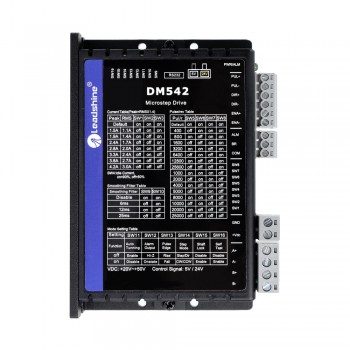
4. Maintenance skills of stepper motor driver
1. Regular inspection and cleaning: Regularly check the cooling system of the stepper motor driver, clean the dust on the heat sink, and ensure the normal operation of the cooling system. At the same time, keep the driver clean to avoid dust accumulation affecting its performance.
2. Correct connection and fixation: Make sure all connecting wires (such as power cord, signal wire, etc.) are firmly connected and there is no circuit breakage. Check whether the power cord is oxidized or the screws are not clamped. If necessary, replace the severely oxidized power cord and ensure that the screws are clamped.
3. Reasonable setting of current and voltage: Adjust the current setting of the driver according to the rated current of the motor to ensure that the current is set within a reasonable range to avoid problems caused by excessive or insufficient current. At the same time, check whether the voltage of the power supply system is normal and ensure that the working voltage of the power supply system is stable.
4. Avoid overload and overheating: Avoid long-term overload operation, appropriately reduce the load or increase the rest time. Ensure that the driver has enough heat dissipation space, and add equipment such as fans or heat sinks when necessary to ensure that the working environment temperature does not exceed the specified range.
5. Regular inspection and replacement of parts: Regularly check the circuits and components inside the driver, and replace aging components in time to ensure the normal operation of the driver. Check whether the motor bearings are damaged and replace them if necessary.
6. Prevent electromagnetic interference: Ensure that the motor and driver are well grounded to prevent electromagnetic interference from affecting the normal operation of the driver. Check whether the shielding wire is loose or poorly grounded to ensure stable signal transmission.
7. Reasonable storage and transportation: During storage and transportation, avoid severe vibration and high temperature environment to prevent damage to internal components. Use shockproof packaging materials to ensure the safety of the driver during transportation.
自訂分類:不分類
上一則: Performance characteristics and selection principles of hollow rotary actuators下一則: What kinds of applications are best for closed loop stepper motors?
你可能會有興趣的文章:
限會員,要發表迴響,請先登入


