Structural features and selection principles of planetary gearboxes
2025/03/19 17:16
瀏覽120
迴響0
推薦0
引用0
1.Working principle of planetary gearboxes
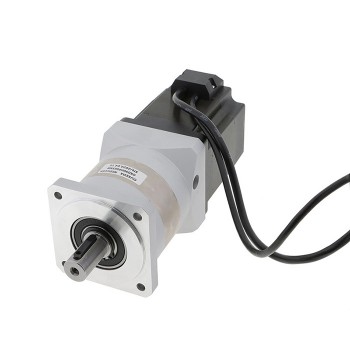
The working principle of planetary gearboxes is based on planetary gear mechanisms, which are similar in structure to the solar system. The core of the planetary gear mechanism is a sun gear, around which several planetary gears rotate, and these planetary gears are connected by a common planet carrier. In addition, there is a large ring gear surrounding the outside of the planetary gears. The planetary gears not only rotate around their own axes (rotation), but also rotate around the axis of the sun gear with the planet carrier (revolution).
2.Transmission mode of planetary gearboxes
1.The outer ring gear is fixed, and the sun gear and the planet carrier rotate in the same direction: in this case, the sun gear is the high-speed shaft, the planet carrier is the low-speed shaft, and the transmission ratio ranges from 3:1 to 12:1.
2.The planet carrier is fixed, and the sun gear and the ring gear rotate in opposite directions: in this case, the sun gear is the high-speed shaft, the ring gear is the low-speed shaft, and the transmission ratio ranges from 2:1 to 11:1.
3.The sun gear is fixed, and the planet carrier and ring gear rotate in the same direction: In this case, the ring gear is the high-speed shaft, the planet carrier is the low-speed shaft, and the transmission ratio ranges from 1.1:1 to 1.7:1.
3.Structural features of planetary gearboxes
1.Multi-axis rotation: The planetary gearbox has multiple rotating shafts, including the sun gear, planet gears, and ring gear. The sun gear is located in the center, and the planet gears revolve around the sun gear while rotating, while the ring gear is fixed or rotating. This structure allows the planetary gearbox to achieve complex transmission ratios and multiple motion modes.
2.Wide transmission ratio range: The planetary gearbox has a wide range of transmission ratios, and the transmission ratio can be changed by adjusting the fixed state of the sun gear, planet carrier, and ring gear. For example, when the outer ring gear is fixed, the sun gear and the planet carrier rotate in the same direction, and the transmission ratio is between 3:1 and 12:1; when the planet carrier is fixed, the sun gear and the inner ring gear rotate in the opposite direction, and the transmission ratio is between 2:1 and 11:1.
3.Efficient transmission: The planetary gearbox shares the load through multiple planetary gears, making it smaller, lighter and more compact under the same power load. In addition, the planetary gearbox has high transmission efficiency, low friction and wear, and long service life.
4.Multiple transmission modes: By fixing different components, the planetary gearbox can achieve functions such as differential, deceleration, speed increase and reversal. For example, when the planet carrier is fixed, the input power drives the planetary gears to rotate and revolve around itself through the sun gear, thereby driving the ring gear output; conversely, when the ring gear is fixed, the input power is transmitted through the opposite movement.
5.Wide application: Planetary gearboxes are widely used in many fields, including automotive automatic transmissions, hybrid power systems, engineering machinery, wind power transmission, etc. For example, AT transmissions and Toyota hybrid systems both use planetary gear sets.
4.Selection principles of planetary gearboxes
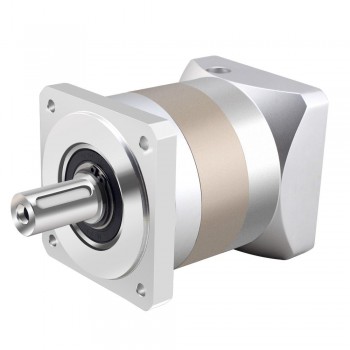
1.Selection of reduction ratio: First, the reduction ratio needs to be determined. Multiply the rated torque of the servo motor by the reduction ratio. The value obtained should be less than the rated output torque of the similar reducer. At the same time, the overload capacity of the motor and the actual maximum working torque required should be considered. The maximum working torque should be less than 2 times the rated output torque.
2.Volume and weight: Under the premise of meeting the reduction ratio and torque requirements, select the reducer with the smallest volume, which can reduce costs. If space is limited, you can choose a right-angle reducer to turn the torque 90 degrees.
3.Accuracy requirements: The smaller the return clearance, the higher the accuracy, but the higher the cost. Users should choose a reducer that meets the accuracy requirements according to actual needs.
4.Service life: Consider axial and radial forces and average life. Usually the average life of the reducer far exceeds the life of the servo motor.
5.Economy: Although planetary gear transmission has a series of advantages, it has a complex structure and high manufacturing costs. Therefore, when selecting, it is necessary to carefully weigh the reasonable unity of technical indicators and economy.
6.Materials and processing technology: Under high load scenarios, it is recommended to use high-strength carburizing steel such as 20CrMnTi and 17CrNiMo6, and improve the fatigue life of gears through deep carburizing and secondary quenching processes. Precision processing such as gear hobbing, gear grinding and surface strengthening technology can ensure the basic dimensional accuracy and tooth shape accuracy of gears, and improve transmission efficiency and accuracy.
7.Assembly accuracy control: Accurate alignment and appropriate clearance between gears are the key to ensuring smooth operation and extending service life.
自訂分類:不分類
上一則: What kinds of applications are best for closed loop stepper motors?下一則: Common types of failures of linear stepper motors
你可能會有興趣的文章:
限會員,要發表迴響,請先登入


