Importance and application of stepper motor encoders
2025/06/13 17:24
瀏覽157
迴響0
推薦0
引用0
1. Working principle of stepper motor encoders
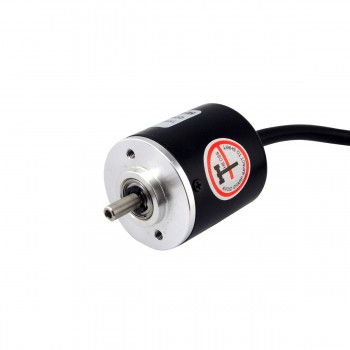
The working principle of stepper motor encoders is based on photoelectric sensors and grating disks. When the stepper motor rotates, the light-transmitting slots on the grating disk are periodically blocked by the rotating light, causing the photoelectric sensor to output pulse signals. These signals are usually divided into phase A and phase B, with a phase difference of 90° between the two. The direction of the motor can be determined by detecting the phase difference of these two signals. In addition, some encoders provide an additional Z-phase signal to output one pulse per revolution to help position calibration.
2. Main types of stepper motor encoders
1. Incremental encoders work by measuring the relative displacement (speed and direction) of the motor. Its working principle is to convert the displacement change into a periodic electrical signal, which is then converted into counting pulses, and the number of pulses reflects the size of the displacement. Incremental encoders are widely used in servo drive systems for their real-time performance and relatively low cost.
2. Absolute encoders directly output the absolute position of the motor, and each position corresponds to a unique digital code. This encoder does not need to memorize or find reference points, and the position information is not lost after power failure, and there is no need to return to zero. Absolute encoders are divided into single-turn and multi-turn types. Single-turn absolute encoders are suitable for measurements within 360 degrees, while multi-turn absolute encoders expand the measurement range by increasing the number of turns, and are suitable for occasions where the rotation exceeds 360 degrees.
3. The importance of stepper motor encoders
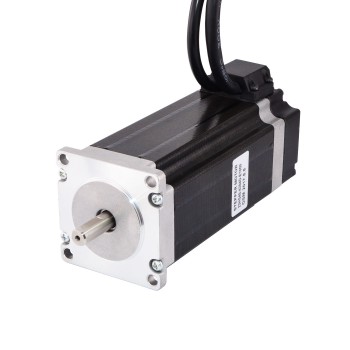
1. Improve accuracy and stability: The encoder can feed back the actual position information of the motor to the controller, so that the controller can compare and calculate based on the preset target position and the actual position, thereby outputting a more accurate control signal to drive the motor. In addition, the encoder can also provide the speed and acceleration information of the motor to help the controller control the motor more effectively, avoid loss of step and oscillation, and thus improve the stability of the system.
2. Achieve precise control: The position feedback information provided by the encoder enables the controller to adjust the control strategy according to the actual situation and achieve precise stopping, starting, and commutation operations. This is very important for application scenarios that require high precision and fast response, such as robots, CNC machine tools, etc. The encoder can also prevent the motor from overshooting or undershooting during operation, further improving the systems operating performance.
3. Achieve closed-loop control: Combining the encoder with the motor can achieve closed-loop control. This control method can improve the response speed, stability and accuracy of the system, so that the system can maintain stable operation in various complex environments. Closed-loop control ensures that the motor always runs according to the preset instructions by constantly adjusting the operating state of the motor.
4. Convenient system integration: Stepper motors with encoders are usually used in conjunction with devices such as motion controllers or PLCs, which can achieve precise control of the motor through the position information provided by the encoder. At the same time, the encoder can also be integrated with other sensors, actuators and other devices to form a complete automation control system.
5. Improve system performance: The encoder can monitor the operating status of the motor in real time, such as speed, torque and other parameters. When the motor is abnormal, the controller can take timely measures, such as reducing the speed, stopping operation, etc., to protect the motor from damage. In addition, encoders can also help monitor the operating status of the motor, detect potential problems in advance, and improve the reliability and safety of the equipment.
4. Application areas of stepper motor encoders
1. Automation equipment: Stepper motor encoders are often used in automation equipment such as CNC machine tools, 3D printers, and engraving machines. These devices require precise control of the position and movement of the motor. The encoder helps achieve high-precision motion control by feeding back the actual position information of the motor.
2. Robotics: In robotics, stepper motor encoders are used to control the joint movement of the robot. With the position information fed back by the encoder, the robot can accurately perform various complex actions and tasks, such as positioning, trajectory tracking, etc.
3. Precision instruments: In precision instrument manufacturing, stepper motor encoders are used to ensure stable operation and high-precision measurement of equipment. For example, in microscopes, measuring instruments, and automated test systems, encoders help achieve high-precision position control and data recording.
4. Intelligent manufacturing: In intelligent manufacturing systems, stepper motor encoders are used to coordinate the movement of multiple mechanical parts to ensure efficient operation of production lines and quality control of products. Through the feedback of the encoder, the system can adjust and control various parameters in the production process in real time.
5. Aerospace: Although the application of stepper motors in aerospace is relatively small, encoders still play an important role in the testing and calibration of aerospace equipment. By accurately measuring the rotational position and speed, encoders help ensure the stability and reliability of the equipment.
自訂分類:不分類
上一則: How to choose a suitable variable frequency drive?下一則: Performance characteristics and selection principles of hollow rotary actuators
你可能會有興趣的文章:
限會員,要發表迴響,請先登入


