Common faults and solutions of servo motors
2024/11/13 17:21
瀏覽100
迴響0
推薦0
引用0
1.Simple definition of servo motors
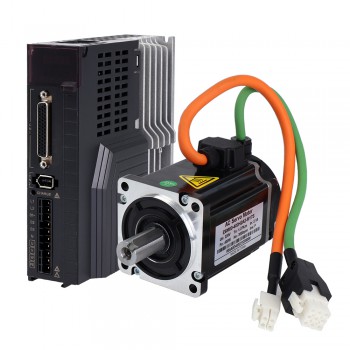
Servo motors are motors used to control the operation of mechanical components in servo systems, with high-precision position control and fast response characteristics. Servo motors can convert the received electrical signals into angular displacement or angular velocity output on the motor shaft, and are usually used in automatic control systems. According to the voltage signal, the servo motor can accurately control the speed and position, and has the characteristics of small electromechanical time constant and high linearity.
2.Main classifications of servo motors
1.DC servo motors
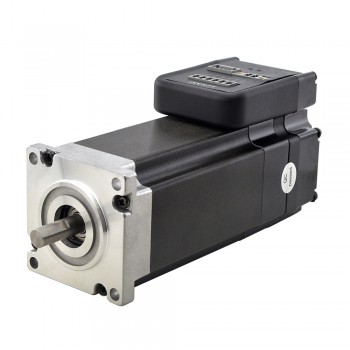
DC servo motors are the earliest servo motors, powered by DC power. It achieves precise control of the motor by controlling the magnitude and direction of the current. DC servo motors are usually composed of armatures, poles, permanent magnets or windings. DC servo motors have high speed and torque, fast response speed, high control accuracy, and are suitable for industrial automation fields that require high-precision control, such as CNC machine tools, printing machines, packaging machines, etc.
2.AC servo motors
AC servo motors are powered by AC power, and have the advantages of high reliability, good heat dissipation, and small moment of inertia. AC servo motors are divided into asynchronous servo motors and synchronous servo motors. Asynchronous servo motors control motor speed by changing the power supply frequency, while synchronous servo motors control by changing the power supply phase. AC servo motors are suitable for areas with high-precision control and high-power output, such as wind turbines, ship power systems, rail transit, etc.
3.Common faults and solutions for servo motors
1.No rotation: The reason may be that the power supply is not connected or the contact is poor, and the connection line between the driver and the motor is broken or in poor contact. The solution is to check and repair the power supply problem, reconnect or replace the connection line.
2.Too slow speed: The reasons include the current limit setting of the driver is too low, the motor load is too large, and the encoder is faulty. The solution is to adjust the current limit setting of the driver, reduce the motor load, and check and replace the encoder.
3.Excessive vibration: The reason may be unstable motor installation, encoder failure, and improper driver parameter settings. The solution is to reinstall the motor, check and replace the encoder, and adjust the driver parameters.
4.Overheating: The reasons include excessive motor load, activation of the driver overheating protection function, and poor heat dissipation. The solution is to reduce the motor load, check the drive cooling system, and improve the cooling conditions.
5.Alarm: The cause may be drive failure, motor failure, or abnormal control signal. The solution is to check and repair the drive, check and replace the motor, and check and repair the control signal.
6.Inaccurate positioning: The cause may be encoder failure, improper drive parameter setting, or mechanical structure problem. The solution is to check and replace the encoder, adjust the drive parameters, and check and repair the mechanical structure problem.
7.Noise and instability: The cause may be that the transmission time of the mechanical connection device limits the system response effect. The solution is to check the transmission mechanism and adjust the controller parameters.
4.Application areas of servo motors
1.Industrial automation
Servo motors are widely used in the field of industrial automation. For example, in CNC machine tools, servo motors drive each axis to achieve precise cutting and processing, improve processing efficiency and product quality. In automated production lines, servo motors are often used to drive conveyor belts, transmission mechanisms, robotic arms and other equipment to achieve precise material transportation, product positioning and assembly operations, and improve production efficiency and stability.
2.Robotics
Servo motors are the core driving devices of robotics and are widely used in industrial robots and service robots. Industrial robots complete complex movements and tasks such as assembly, handling, welding, etc. by precisely controlling the speed and position of servo motors. Service robots use servo motors to achieve functions such as navigation, grasping, and interaction, improving the level of intelligence and humanization.
3.Aerospace
In the field of aerospace, servo motors are widely used in the navigation and control systems of aircraft to precisely control the attitude, speed, and direction of aircraft to ensure flight safety. In addition, servo motors are also used to control actuators such as solar panels, steering gears, and thrusters to achieve precise attitude adjustment and stable control.
4.Medical equipment
Servo motors also have important applications in medical equipment. For example, in surgical robots, servo motors control the precise movement and force adjustment of surgical instruments to improve the success rate and safety of surgery. In addition, servo motors are also used in equipment such as scanners and X-ray machines to achieve precise movements and image reconstruction.
5.Transportation
In the field of transportation, servo motors are used in automated assembly lines and test equipment in the automobile manufacturing process to improve production efficiency and assembly accuracy. In electric vehicles and hybrid vehicles, servo motors are used as drive motors to achieve power output and energy recovery.
6.Other precision equipment
Servo motors are also widely used in other precision equipment. For example, in precision electronic equipment such as semiconductor manufacturing equipment and display equipment, servo motors achieve high-precision motion control. In addition, in the field of renewable energy such as wind power generation and solar power generation, servo motors are used to control actuators such as variable pitch systems and tracking systems to improve energy conversion efficiency.
In general, servo motors play an important role in modern industrial production and automated control with their high precision, high response speed and stability. With the continuous advancement of technology and the continuous expansion of application fields, the application prospects of servo motors will be broader.
自訂分類:不分類
上一則: Temperature regulation principle and application places of high temperature stepper motors下一則: Introduction to the Selection Criteria of Brushless DC Motors
你可能會有興趣的文章:
限會員,要發表迴響,請先登入


