西洋文學概論Week14
The content of the course
1. Lysistrata
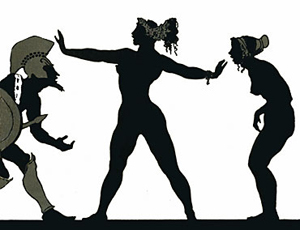
Lysistrata (/laɪˈsɪstrətə/ or /ˌlɪsəˈstrɑːtə/) is a comedy by Aristophanes.
Originally performed in classical Athens in 411 BC, it is a comic account
of one woman's extraordinary mission to end the Peloponnesian War.
Lysistrata persuades the women of Greece to withhold sexual privileges
from their husbands and lovers as a means of forcing the men to negotiate
peace—a strategy, however, that inflames the battle between the sexes. The
play is notable for being an early exposé of sexual relations in a male-dominated
society. Additionally, its dramatic structure represents a shift from the conventions
of Old Comedy, a trend typical of the author's career. It was produced in the same
year as the Thesmophoriazusae, another play with a focus on gender-based issues,
just two years after Athens' catastrophic defeat in the Sicilian Expedition.
LYSISTRATA
There are a lot of things about us women
That sadden me, considering how men
See us as rascals.
CALONICE
As indeed we are!
These lines, spoken by Lysistrata and her friend Calonice at the beginning
of the play, set the scene for the action that follows.
2. Socrates
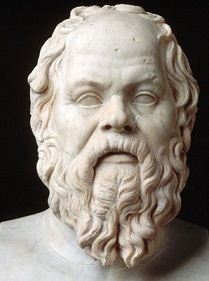
Socrates (/ˈsɒkrətiːz/) was a classical Greek (Athenian) philosopher credited
as one of the founders of Western philosophy. He is an enigmatic figure known
chiefly through the accounts of classical writers, especially the writings of his
students Plato and Xenophon and the plays of his contemporary Aristophanes.
Plato's dialogues are among the most comprehensive accounts of Socrates to
survive from antiquity, though it is unclear the degree to which Socrates himself
is "hidden behind his 'best disciple', Plato".
The Socratic problem
Nothing written by Socrates remains extant. As a result, all first-hand information
about him and his philosophies depend upon secondary sources. Furthermore,
close comparison between the contents of these sources reveals contradictions,
thus creating concerns about the possibility of knowing in-depth the real Socrates.
This issue is known as the Socratic problem, or the Socratic question.
To understand Socrates and his thought, one must turn primarily to the works of
Plato, whose dialogues are thought the most informative source about Socrates'
life and philosophy, and also Xenophon. These writings are the Sokratikoi logoi,
or Socratic dialogues, which consist of reports of conversations apparently involving
Socrates.
Short film: Socrates(連結)
3.Plato
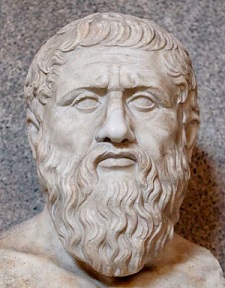
Plato was a philosopher and mathematician in Classical Greece, and the founder
of the Academy in Athens, the first institution of higher learning in the Western
world. He is widely considered the most pivotal figure in the development of
philosophy, especially the Western tradition. Unlike nearly all of his philosophical
contemporaries, Plato's entire œuvre is believed to have survived intact for over
2,400 years.
Plato was the innovator of the dialogue and dialectic forms in philosophy, which
originate with him. Plato appears to have been the founder of Western political
philosophy, with his Republic, and Laws among other dialogues, providing some
of the earliest extant treatments of political questions from a philosophical
perspective. Plato's own most decisive philosophical influences are usually thought
to have been Socrates, Parmenides, Heraclitus and Pythagoras, although few of his
predecessors' works remain extant and much of what we know about these figures
today derives from Plato himself.
4.Mimesis
Mimesis (/maɪˈmiːsəs/) is a critical and philosophical term that carries a wide
range of meanings, which include imitation, representation, mimicry, imitatio,
receptivity, nonsensuous similarity, the act of resembling, the act of expression,
and the presentation of the self.
In ancient Greece, mimesis was an idea that governed the creation of works of art,
in particular, with correspondence to the physical world understood as a model for
beauty, truth, and the good. Plato contrasted mimesis, or imitation, with diegesis,
or narrative. After Plato, the meaning of mimesis eventually shifted toward a
specifically literary function in ancient Greek society, and its use has changed
and been reinterpreted many times since then.
5. farce
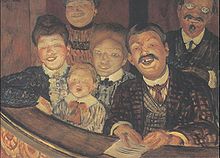
In theatre, a farce is a comedy that aims at entertaining the audience through
situations that are highly exaggerated, extravagant, and thus improbable.
Farces are often highly incomprehensible plot-wise (due to the many plot twists
and random events that occur), but viewers are encouraged not to try to follow
the plot in order to avoid becoming confused and overwhelmed. Farce is also
characterized by physical humor, the use of deliberate absurdity or nonsense,
and broadly stylized performances. Farces have been written for the stage and
film. Furthermore, a farce is also often set in one particular location, where all
events occur.
6. three unities
The classical unities, Aristotelian unities, or three unities are rules for dram
derived from a passage in Aristotle's Poetics. In their neoclassical form they are
as follows:
1. unity of action: a play should have one action that it follows, with minimal
subplots.
2. unity of time: the action in a play should occur over a period of no more than
24 hours.
3. unity of place: a play should exist in a single physical space and should not
attempt to compress geography, nor should the stage represent
more than one place.
7. vocabulary
python (n.)

any of several Old World boa constrictors of the subfamily Pythoninae, often
growing to a length of more than 20 feet (6 meters): the Indian python,
Python molurus, is endangered.
Strike(n.)
a concerted stopping of work or withdrawal of workers' services, as to compel an employer to accede to workers' demands or in protest against terms or conditions imposed by an employer.
Self-abuse(n.)
1. reproach or blame of oneself.
2. abuse of one's health.
3. masturbation.
Omni-
a combining form meaning “all,” used in the formation of compound words.
For example: omnifarious, omnipotence, omniscient.
reference website
Lysistrata
(圖)https://www.bing.com/images/search?q=lysistrata&view=detailv2&qft=+filterui
%3aimagesize-medium&id=86E9C7850EB46A9E6AE374F48CBEC6BC2146B188
&selectedIndex=6&ccid=gWRVKTvK&simid=608002095333903063&thid=OIP.M8
16455293bcaa6eace7c9ba9e5068455o0&ajaxhist=0
Socrates
(圖)https://www.bing.com/images/search?q=socrates&view=detailv2&qft=+filterui%3a
imagesize-medium&id=0107E7AA2F412E5F854AC033FCC38CD992A723D3&se
lectedIndex=1&ccid=3TYiDoC8&simid=608041003439492676&thid=OIP.Mdd362
20e80bc65ac663bc819650cf5a8o1&ajaxhist=0
Plato
(圖)https://www.bing.com/images/search?q=plato&view=detailv2&qft=+filterui%3aima
gesize-medium&id=FF5D941BD5C3D19BF5FFEFB14A3DE338B5173014&selecte
dIndex=1&ccid=To69z%2b%2bM&simid=608021375443799837&thid=OIP.M4e8eb
dcfef8c612b34f422b4330475fcH1&ajaxhist=0
farce
(圖)https://www.bing.com/images/search?q=farce&view=detailv2&qft=+filterui%3aima
gesize-medium&id=8FC1015B5D57AC1B387D31394A6477C28B725E1D&selected
Index=11&ccid=1xFDm0H%2f&simid=607994235539623872&thid=OIP.Md711439b4
1ff76d2619e670c83463efco0&ajaxhist=0
python
(圖)https://www.bing.com/images/search?q=python&view=detailv2&&id=D006D6A433E6
B6DEDC5C6227AEC842E897C1DB7D&selectedIndex=11&ccid=MwamOl2x&simid=
608033560257955540&thid=OIP.M3306a63a5db1b5cd56a3852c41d1c1caH0&ajaxhist=0
限會員,要發表迴響,請先登入


