The RK3566 is a practical application processor for industrial HMIs, data terminals, equipment gateways, and light edge-computing tasks. Its value lies in combining Linux or Android, modern display support, networking, multimedia, and general-purpose interfaces on a relatively compact platform.
The Rockchip RK3566 is often introduced through its consumer applications, including tablets, media devices, and smart displays. Those origins do not prevent it from being useful in industrial equipment. In fact, many control products need the same basic capabilities: a responsive graphical interface, Ethernet, local storage, USB peripherals, camera support, and enough processing power to run a full operating system.
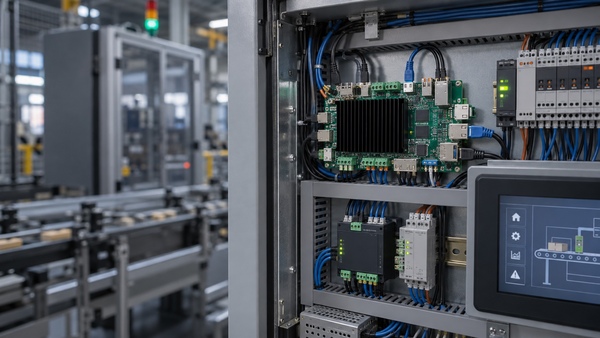
What the RK3566 should not be mistaken for is a PLC or a hard real-time controller. It can supervise equipment, collect data, run an HMI, and coordinate higher-level operations. Safety interlocks, precise motor timing, and deterministic control loops usually belong on a dedicated microcontroller, PLC, or motion controller.
When this boundary is respected, the RK3566 can provide a good balance of performance, power consumption, integration cost, and software capability.
RK3566 Hardware Overview
The RK3566 contains four 64-bit Arm Cortex-A55 CPU cores and a Mali-G52-2EE GPU. It also integrates a neural processing unit rated at up to 1 TOPS for supported inference workloads. Memory options include DDR3, DDR3L, DDR4, LPDDR3, LPDDR4, and LPDDR4X, although the actual memory type and capacity are determined by the board design.
For storage, the processor supports eMMC 5.1, SD storage, NAND-related options, and serial flash. Its multimedia hardware includes 4K video decoding, 1080p video encoding, JPEG processing, a 2D graphics engine, and an image signal processor for camera input.
| RK3566 function | Key capability | Industrial relevance |
|---|---|---|
| CPU | Four Cortex-A55 64-bit cores | Runs Linux, Android, application services, and graphical interfaces |
| GPU | Mali-G52-2EE | Accelerates HMI graphics, transitions, charts, and video rendering |
| NPU | Up to 1 TOPS | Supports modest local inference when models fit the vendor toolchain |
| Memory | 32-bit DDR controller with several DDR and LPDDR options | Allows board vendors to balance bandwidth, capacity, and cost |
| Storage | eMMC 5.1, SD, NAND, and serial flash support | Provides space for the OS, logs, databases, and recovery images |
| Display | HDMI, eDP, MIPI-DSI, LVDS, RGB, and e-paper interfaces | Supports a wide range of industrial panels and operator terminals |
| Networking | Single Gigabit Ethernet MAC | Suitable for plant networks, equipment data, and remote management |
| Expansion | USB 3.0, USB 2.0, PCIe 2.1, and SATA-related capability | Connects storage, wireless modules, cameras, and external controllers |
Where the RK3566 Fits in a Control Architecture
An RK3566 board works best as the application layer of a control system. It can run an operator interface, record production information, communicate with a PLC, and provide remote access. The PLC remains responsible for deterministic machine behavior.
Consider a packaging machine. A PLC controls conveyors, sensors, actuators, and interlocks. The RK3566 displays operating status, stores recipes, records alarm history, and communicates with a production server. If the RK3566 reboots, the PLC can continue a safe sequence or stop the machine in a controlled manner.
This separation makes failure behavior easier to understand. It also prevents a graphical application, database operation, or network update from delaying an important control task.
| System responsibility | Preferred platform | Reason |
|---|---|---|
| Emergency stop | Certified safety circuit or safety PLC | Must not depend on a general-purpose operating system |
| Motor timing | PLC, MCU, or motion controller | Requires predictable execution |
| Operator interface | RK3566 board | Benefits from GPU acceleration and display interfaces |
| Production database | RK3566 board | Linux provides mature storage and database software |
| Machine vision preview | RK3566 board | Uses camera, graphics, and video hardware |
| Cloud or MES connection | RK3566 board | Supports modern networking and encryption libraries |
Industrial HMI Applications
The RK3566 is particularly well suited to screen-oriented equipment. It offers HDMI 2.0, eDP, MIPI-DSI, LVDS-related output, parallel RGB, and an e-paper controller. The exact connections exposed by an Rockchip RK3566 SBC or system-on-module depend on its PCB design.
Android is useful when the product requires a touch-first interface, multimedia, or an application workflow similar to a tablet. Linux is often preferred when the equipment needs background services, database access, industrial protocols, containers, or tighter control of the system image.
The GPU can improve interface responsiveness, but hardware acceleration must be confirmed in the intended operating-system build. A demonstration image may include a working graphics driver while a different Linux distribution falls back to software rendering.
Display compatibility also requires more than matching resolution. An LVDS panel needs the correct channel configuration, bit mapping, voltage, clock, and backlight circuit. MIPI-DSI panels may require a model-specific initialization sequence. Touch input normally arrives through I2C or USB and needs its own driver.
The production LCD, touch controller, cover glass, and cable should be tested with the production BSP. A panel that works with an engineering adapter is not yet a qualified display system.
Connecting Industrial Equipment
The RK3566 includes multiple UART, SPI, I2C, PWM, ADC, and GPIO resources at the silicon level. A board manufacturer decides how many of them are physically available and whether they include protection or transceivers.
A processor UART is not an industrial RS-485 port. RS-485 requires a suitable transceiver and may need termination, biasing, surge protection, and galvanic isolation. The same principle applies to CAN: the controller interface alone is not enough without the physical-layer transceiver.
GPIO pins should not be connected directly to 24 V sensors or solenoids. Industrial digital inputs need voltage conversion, filtering, and protection. Outputs require drivers appropriate for the load.
In many products, the safest arrangement is to use a separate I/O controller. A microcontroller or remote I/O module handles field signals and communicates with the RK3566 over Ethernet, CAN, or an isolated serial link. This protects the application processor and keeps time-sensitive I/O independent of Linux.
Ethernet and Network Topology
The RK3566 provides one Gigabit Ethernet MAC through an RGMII interface. This is adequate for many HMIs and equipment gateways, but it differs from processors designed around multiple industrial network ports.
If a product requires two physically independent Ethernet interfaces, the board will need an additional controller through USB or PCIe. Engineers should verify driver quality, boot behavior, throughput, and recovery after cable reconnection.
Using two connectors attached to an Ethernet switch does not produce the same architecture as two independent network interfaces. A built-in switch may be useful for daisy-chain wiring, but it does not automatically isolate the machine network from the factory or cloud network.
The intended topology should therefore be defined before choosing the SBC. If dual independent Ethernet, time-sensitive networking, or a specialized industrial Ethernet protocol is central to the product, another processor or external communication module may be more appropriate.
Storage and Sudden Power Loss
Industrial equipment is commonly powered off without an orderly Linux shutdown. During that moment, the RK3566 may be writing logs, a database journal, filesystem metadata, or an application update.
Soldered eMMC is generally more suitable than a removable consumer microSD card, but it is not immune to corruption or wear. The software architecture must control unnecessary writes.
A robust design may use a read-only root filesystem, a separate writable data partition, log rotation, transactional database settings, and an A/B update layout. Critical data can be written atomically or stored with a validated backup copy.
Hardware can provide additional protection. A power-failure input may warn the system that the external supply is disappearing. A supercapacitor or small backup supply can provide enough energy to finish important writes. The hold-up time must be measured under maximum load rather than estimated from nominal power consumption.
Repeated power-interruption testing is essential. Removing power once and successfully rebooting proves very little. The system should be interrupted during database activity, file copying, logging, and firmware updates.
Thermal Design and Sustained Performance
The RK3566 is relatively power-efficient, but an enclosed industrial product still requires thermal analysis. The processor may share a sealed compartment with a display backlight, power converter, wireless module, and other heat sources.
When the silicon reaches its thermal limit, the operating system reduces CPU or GPU frequency. The board may continue running without an obvious error, while the interface becomes slow or an image-processing task misses its expected timing.
Testing should use the final enclosure or a mechanically representative version. CPU, GPU, storage, Ethernet, and display activity should run together until the internal temperature stabilizes.
A small heatsink improves surface area, but heat still needs a path out of the enclosure. A thermal pad and metal chassis can provide more predictable conduction than relying on trapped air. Pad thickness, compression, flatness, and assembly tolerance all affect performance.
Using the NPU in Industrial Products
The integrated NPU is rated at up to 1 TOPS and supports several numerical formats through Rockchip’s software stack. It can be useful for modest inference tasks such as basic image classification, object detection, or anomaly screening.
The performance figure alone does not indicate whether a particular model will run efficiently. Model conversion, supported operators, quantization, input resolution, memory traffic, and preprocessing time influence the final result.
A network that contains unsupported operations may partly execute on the CPU, reducing performance. Engineers should convert and benchmark the actual model before selecting hardware around the advertised TOPS number.
The RK3566 is better considered a light edge-AI platform than a high-end vision processor. A demanding multi-camera inspection system or large neural network may require a more capable SoC or a dedicated accelerator.
Linux, Android, and BSP Ownership
Rockchip has published SDK support around Linux and Android, but the software delivered with an actual board comes from the board vendor or system integrator. BSP quality varies considerably.
The production team should be able to rebuild the bootloader, kernel, device tree, and root filesystem from a clean environment. A downloadable binary image is useful for evaluation but is not a complete maintenance plan.
Before approving an SBC, check whether the following are available:
- Bootloader and kernel source code
- Device-tree files for the exact board revision
- Graphics and multimedia drivers
- NPU runtime and model-conversion tools
- Image-building instructions
- Factory flashing and recovery utilities
- Update procedures and partition documentation
- A policy for security fixes and BSP maintenance
A vendor kernel may provide the best support for display, video, camera, and NPU functions. A kernel closer to mainline Linux may be easier to maintain over time but may not support every multimedia block. The correct choice depends on which hardware functions the product actually uses.
Security and Remote Updates
The RK3566 includes security-related capabilities such as secure boot, TrustZone support, cryptographic functions, OTP storage, and controlled debugging. These features provide building blocks; they do not secure a product automatically.
A deployed system should use signed firmware, unique device credentials, encrypted communication, disabled test services, and a controlled recovery procedure. Debug interfaces should not remain openly accessible in field equipment.
Remote updates should tolerate lost power and network interruption. An A/B partition design allows the device to write a new system image without destroying the running version. The boot process can return to the previous image if the update fails to start correctly.
Signing keys must be protected and backed up. Enabling secure boot without planning factory programming and service recovery can create a product that is secure but impossible to repair.
RK3566 Versus RK3568 for Control Equipment
The RK3566 and RK3568 share a similar Cortex-A55 computing foundation, but they are not identical from an industrial integration perspective. The RK3568 is commonly chosen when its additional interface and industrial-oriented capabilities better match the carrier design.
The RK3566 can be the more economical choice for a display-focused controller, single-Ethernet HMI, smart appliance, or compact gateway. If the project needs extensive native networking, specialized industrial interfaces, or a broader external bus architecture, the RK3568 or another processor may reduce the amount of external hardware.
The comparison should be made at board level. A well-designed RK3566 SBC with protected RS-485, reliable power, eMMC, RTC, and a supported BSP may be more useful than a minimal RK3568 development board.
Production Evaluation Checklist
| Evaluation area | Questions to answer |
|---|---|
| Processing | Does the real workload run continuously without thermal throttling? |
| Display | Are graphics acceleration, touch, brightness, and sleep recovery stable? |
| Industrial I/O | Are field interfaces protected, isolated, and fully documented? |
| Ethernet | Does the board recover correctly after cable and switch interruptions? |
| Storage | Can eMMC endurance support the expected database and logging load? |
| Power | Does the system survive low voltage, brief interruptions, and sudden shutdown? |
| BSP | Can the complete production image be reproduced from archived sources? |
| Updates | Can the device recover from an interrupted or invalid update? |
| Lifecycle | Will the exact board configuration remain available for the product lifetime? |
| Support | Can the supplier investigate hardware, kernel, and driver-level failures? |
Final Engineering Perspective
The RK3566 is a capable platform for industrial displays, equipment interfaces, data terminals, and light edge gateways. Its quad-core CPU, graphics engine, broad display support, multimedia blocks, Ethernet, storage interfaces, and small NPU provide enough functionality for many connected machines.
Its limitations should guide the architecture. It is not a safety controller, it does not guarantee hard real-time Linux behavior, and its single native Ethernet MAC may not suit every gateway. Some high-speed interfaces also share internal resources, so the final board configuration must be checked carefully.
The strongest RK3566 products use the SoC where a full operating system creates real value. They leave precise control and safety functions to dedicated hardware, protect field interfaces externally, manage flash writes, provide thermal paths, and retain a recoverable software image.
Choosing the processor is only the beginning. The industrial result depends on the SBC design, power supply, eMMC, interface protection, Linux or Android BSP, enclosure, and supplier support. When those pieces are developed as one system, the RK3566 can provide a practical and cost-effective foundation for long-running control equipment.
限會員,要發表迴響,請先登入


