
初看日期:1970年前後
初看地點:台北國賓戲院
重看地點:中壢國際戲院
忘記在國賓看什麼電影了
只記得先演預告片時:
飛天的魔馬,六隻手臂的女神像,吃人的大蜘蛛
還有飛越過巴格達城池的魔毯
等到再出現一個大巨人從寶瓶中跑了出來
正要踩死又瘦又小的小小男孩時.................
我回過頭跟我媽說:我一定一定要看這部片,不然我就死給你看..........
那部預告片的電影片名就叫【月宮寶盒】
當年我不過七、八歲
事實上在1924年就已經有默片版本
可惜的是那部大明星范朋克主演的默片版本
至今無緣欣賞
【月宮寶盒】的首映在1941年
那是個蛇麼年代?
日本人還在侵佔中國
那時候大部分的中國人還在受苦受難
然後馮小剛【1942】裡頭描寫的大飢荒還沒開始
這部充滿魔幻色彩的MGM電影就上市了
所謂的MGM,正是當年專出鉅片的米高梅公司
MGM片子開始時,都會有隻獅子在唉唉叫
以當時(甚至是我重看的1970年)的特技來看
只能說是【驚人】二字
那真的只有是好萊塢的夢工廠才能創造的奇蹟
尤其是它那濃郁到誇張的色彩
即令現在重看dvd
那些復古又樸拙的映象畫面
反而成為現代欣賞【月】片的特色
我童年的阿拉伯印象
完全是出自本片
直到幾年後
有機會看到另一種詮釋的【一千0一夜】(1961,巴索里尼)
那已經是本人開始邁入成人神秘世界的探索。
我真正看過【月宮寶盒】全片的印象
是在中壢國際戲院的記憶
那是一個舊型大銀幕的老戲院
巨人從神燈跑出來的畫面的確震撼
當年不少好萊塢的鉅片
如【暴君焚城錄】【桂河大橋】【第三類接觸】
都是在那裡觀賞的
戲院一度淪為放色情片的大本營
某年的農曆春節,居然是演3d的A片
後來經營不善
整個戲院淹沒在大樓重建的齒輪下
但在七0年代,
國際戲院的確是中壢的五星級戲院
當年【月】片應該是大賣
因為接著出來一堆【天宮魔盒】【飛天魔毯】之類的姊妹作
弄得銀幕都是巴格達城,異國公主,或是阿拉伯王子
印象裡頭,應該是台灣片商買斷了版權
所以沒隔幾年又重映
但這一次的重放就沒完沒了
當年一部西片不過是一、兩個拷貝
台北放完,輪到中壢,
起碼要3-6個月上下
如果真的有幸輪到我們龍岡介壽堂這種三流戲院放演
很多都是要一年以上
那一年,我不知是錯覺還是怎麼樣
幾乎一整年的時間
在台灣的大街小巷幾乎都看到它的海報
這對一部西片而言,是很不可思議的事
通常來說鄉下戲院不太放映洋片
因為鄉下的觀眾群,好像水準沒那ㄇ高
但這部片真的是例外
或許是它的通俗性夠強吧
也就是說片商真是一網打盡
連山子頂那樣的小戲院,
都有它的痕跡
然後,它就此在台灣消失殆盡
就真的不見了好幾十年
不但不見再次重映,
老三台時也不見影子
甚至後來興起的第四台也不見其蹤跡
如果不是後來有賣一張29元公視版(超過年限)的dvd
它應該是徹底在我的記憶裡失蹤
某日,
在戲院裡看李安的【色戒】
湯唯演的王佳芝走到上海戲院看電影
片中戲院牆壁張貼的居然就是【月宮寶盒】
我一下被吸引住
重新上網尋找本片的資料
才發現原來它也算影響深遠
早年香港張瑛的同名粵劇片
就是改編此劇本
馮寶寶的【夜光杯】也應該算
連同迪士尼的動畫【阿拉丁】也深受本片的影響
好容易再找到該片的dvd
雖然效果不佳,但也別有風味
果然是懷舊的驚喜
依然看的趣味橫生
感謝好萊塢的夢幻世界
讓我即使相隔近30-40年欣賞
還是不減的童稚樂趣
片中的王子、公主、巫師應該都不在人世了吧
而全片最搶鋒頭的那位巴格達小偷—SABU
片中的他應該不過十七、八歲
我對他印象極為深刻
好多年前,我還在電視上看過還他演的版本【森林王子】
就算活到今天也應該90好幾了吧
但是鏡頭可能記錄下他這一生中
最發光發熱的一刻
這就是電影的無敵魅力
一名印度人在30-40年代的好萊塢打混
不但在洋片裡頭操英文,而且當主角
這背後又是一個怎樣的辛酸故事?
2012-11-11


The Thief of Bagdad (1940 film)
.jpg) Film poster for 1947 Film Classics re-release | |
| Michael Powell Ludwig Berger Tim Whelan Uncredited: Alexander Korda Zoltan Korda William Cameron Menzies | |
| Alexander Korda | |
| Lajos Biró Miles Malleson | |
| Conrad Veidt Sabu John Justin June Duprez | |
| Miklós Rózsa | |
| George Perinal | |
| Charles Crichton | |
| London Films | |
| United Artists (UK/US) | |
| 5 December 1940 (USA) 25 December 1940 (UK) | |
| 106 minutes | |
| United Kingdom | |
| English | |
The Thief of Bagdad (1940) is a British Technicolor fantasy film produced by Alexander Korda, and directed by Michael Powell, Ludwig Berger, and Tim Whelan, with contributions by Korda's brothers Vincent and Zoltán, and William Cameron Menzies. The film starred child actor Sabu, also Conrad Veidt, John Justin, and June Duprez.
Although the film was produced by Alexander Korda's company London Films in England, due to the outbreak of World War II, filming was completed in California. The film won the Academy Awards for Cinematography, Art Direction (Vincent Korda) and Special Effects. It was also nominated for Original Music Score.[1]
Although a remake of the 1924 version, the two films also have significant differences. The most notable is that, in the 1940 version, the thief and the prince are separate characters.
Plot
The film's backstory is told in flashback, mimicking the style of the Arabian Nights.
Ahmad (John Justin), the naive King of Bagdad, is convinced by his evil Grand Vizier, Jaffar (Conrad Veidt), to go out into the city disguised as a poor man to get to know his subjects (in the manner of his grandfather Harun al-Rashid). Jaffar then has Ahmad thrown into a dungeon, where he is joined by the young thief Abu (Sabu), who arranges their escape. They flee to Basra, where Ahmad becomes acquainted with its Princess (June Duprez). However, Jaffar also journeys to Basra, for he desires the Princess. Her father, the Sultan (Miles Malleson), is fascinated by the magical mechanical flying horse Jaffar offers and agrees to the proposed marriage. Upon hearing the news, the Princess, by now deeply in love with Ahmad, runs away. Confronted by Ahmad, Jaffar magically blinds him and turns Abu into a dog; the spell can only be broken if Jaffar holds the Princess in his arms.
The Princess is eventually captured (but not recognized) and sold in the slave market. She is bought secretly by Jaffar and taken to his mansion, but falls into a deep sleep from which he cannot rouse her. Ahmad is tricked by Jaffar's servant Halima (Mary Morris) into awaking the Princess. Halima then lures the Princess onto Jaffar's ship by telling her that there is a doctor aboard who can cure Ahmad's blindness. The ship immediately sets sail. Jaffar informs the Princess about the spell; she allows herself to be embraced, whereupon Ahmad's sight is restored and Abu is returned to human form. They chase after the ship in a small boat, but Jaffar conjures up a storm to shipwreck them.
Abu wakes up alone on a deserted beach and finds a bottle. When he opens it, an enormous Djinn or genie (Rex Ingram) appears. Embittered by his long imprisonment, the genie informs Abu that he is going to kill his rescuer, but Abu tricks him back into the bottle. The genie then offers to grant Abu three wishes if he will let him out again. The hungry boy uses his first wish to ask for sausages. When Abu demands to know where Ahmad is, the genie flies Abu to the top of the highest mountain in the world. On it sits a temple, and in the temple there is an enormous statue with a large jewel, the All-Seeing Eye, set in its forehead. The genie tells Abu that the Eye will show him where to find Ahmad. Abu fights off a giant guardian spider while climbing the statue and steals the gem.
The genie then takes Abu to Ahmad. When Ahmad asks to see the Princess, Abu has him gaze into the All-Seeing Eye. Ahmad despairs when he sees Jaffar arranging for the Princess to inhale the fragrance of the Blue Rose of Forgetfulness, which makes her forget her love. In agony, Ahmad lashes out at Abu for showing him the scene. During the ensuing argument, Abu unthinkingly wishes Ahmad to Baghdad. The genie, freed after granting the last wish, departs, leaving Abu alone in the wilderness.
Ahmad appears in Jaffar's castle and is quickly captured, but seeing him restores the Princess's memory. The furious usurper sentences them both to death. Abu, unable to watch his friend's impending doom, shatters the All-Seeing Eye and as a result is transported to the "land of legend," where he is greeted by the Old King (Morton Selten) and thanked for freeing the inhabitants, who had been turned to stone. As a reward, he is given a magic crossbow and is named the king's successor. However, in order to save Ahmad, Abu steals the king's magic flying carpet and rushes to the rescue.
Abu's marvellous aerial arrival in Bagdad (which fulfils a prophecy cited in the course of the story) sparks a revolt against Jaffar. Abu kills the fleeing Jaffar with his crossbow, and Ahmad regains his kingdom and his love. However, when Abu hears (with growing alarm) Ahmad telling the people of his plan to send him to school to train to become his new Grand Vizier, Abu instead flies away on the carpet to find his own fun and adventure.
[edit] Cast
- Conrad Veidt as Jaffar
- Sabu as Abu
- June Duprez as the Princess
- John Justin as Ahmad
- Rex Ingram as the Djinn
- Miles Malleson as the Sultan of Basra
- Morton Selten as the Old King
- Mary Morris as Halima, Jaffar's agent
- Bruce Winston as the Merchant
- Hay Petrie as the Astrologer
- Adelaide Hall as the Singer
- Roy Emerton as the Jailor
- Allan Jeayes as the Story Teller
Alexander Korda had intended to cast Vivien Leigh as the Princess, but she went to Hollywood to be with Laurence Olivier.[2]
[edit] Reception
New York Times reviewer Bosley Crowther enthused that the film "ranks next to Fantasia as the most beguiling and wondrous film of this troubled season."[3] Crowther praised "its truly magnificent color"[3] and the performances of all five main actors.
Roger Ebert has rated The Thief of Bagdad among his great movies, "on a level with The Wizard of Oz."[4] According to Ebert, "it maintains a consistent spirit, and that spirit is one of headlong joy in storytelling."[4] He praised the performances of Sabu and Veidt ("perfectly pitched to the needs of the screenplay"), though he was less impressed with the chemistry between Duprez and Justin ("rather bloodless").[4]
Like its 1924 predecessor, The Thief of Bagdad has a 100% fresh rating from Rotten Tomatoes.[5]
[edit] Influence
Although it was a remake of the earlier silent version, this film has been highly influential on later movies based on The Book of One Thousand and One Nights setting. For example, the Disney film Aladdin borrows freely from it, particularly the characters of the evil Vizier and the Sultan, both drawn with a marked similarity to the characters in The Thief of Bagdad. The thieving monkey Abu in the Disney cartoon is obviously based on the boy played by Sabu.[6] Richard Williams, speaking about his film The Thief and the Cobbler, said that one of his interests was in creating an Oriental fantasy that did not copy from it. The Prince of Persia franchise also shares similar characteristics with the film.
Likewise, various plot elements of The Thief of Bagdad—most notably, the theft of the ruby from a high place and the battle with the giant spider—derive from the 1928 short story, The Tower of the Elephant, by Robert E. Howard[citation needed].
[edit] Home media
The film was released on DVD by MGM on 3 December 2002. That version is now out of print. The Criterion Collection released a two-disc DVD release on 27 May 2008 that includes a commentary track by filmmakers Martin Scorsese and Francis Ford Coppola, who are both longtime fans of the film (their comments were recorded separately and then edited together).

圖. 1924年的版本【月宮寶盒】海報1

圖. 1924年的版本【月宮寶盒】海報2

圖. 1924年的版本【月宮寶盒】海報3
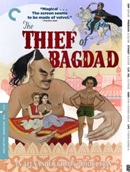
【重裝經典】 《月宮寶盒》(The Thief of Bagdad) 文 / 林蕙君 我想大多數人會同意好的電影特效絕絕對對是掏錢買票進電影院的一大誘因。遠在劇情片壟斷電影市場之前,甚至遠在劇情片尚未發展成固定的類型之前,作為別於盧米埃兄弟紀實影片的另一條傳統,梅里葉(George Melies)早在二十世紀初的《月球之旅》(Le Voyage dans la lune, 1902)就實驗了現行許多電影特效的基本原型。電影特效原是為了讓現實中不可能發生的事情,在電影裡完成。但是何謂好的電影特效,卻有令人難以捉摸的標準。『擬真』是電影特效的目的,要讓看來不可能發生的事情像真的一樣,照理說隨著科技的發展,電影特效應該會愈來愈『真』才對。然而事情卻不是這麼一回事。電腦繪圖(CGI, computer generated imagery)可以創造出像《魔戒》(The Lord of the Rings)中的咕嚕(Gollum)那樣栩栩如生的幻想生物,但《蜘蛛人3》(Spider-Man 3, 2007)當中已經接近液化的柔軟人體和被速度感模糊了邊界的城市形體,幻想失去了與之相對的具體現實作為著力點,讓整部電影失去了現實與奇幻並置才能達到的『真實感』。 The Criterion Collection於2008年製作發行的《月宮寶盒》(The Thief of Bagdad,中文片名非常神奇地和劇情完全沒關係)便是影史上公認的電影特效經典。 於1940年完成的《月宮寶盒》不但以設計精巧的特效驚豔當時的觀眾,勇奪奧斯卡特效獎,在今日看來也不會因為技巧原始而喪失了好的特效電影應有的『幻想感』與『真實感』。匈牙利裔的電影製作人Alexander Korda掌控了這部歷經六個導演的奇幻歷險片,將片子的風格戲劇化地從浪漫愛情片轉化為史詩格局的冒險片。(1939年的《亂世佳人》也同樣地擁有一個掌控大局的製作人以及屢換導演的命運)《月宮寶盒》鬆散地改編自阿拉伯民間神話《一千零一夜》,更精確的說其實是改編自1924年由默片時代的巨星范朋克(Douglas Fairbanks Sr.)所主演的同名電影。Korda的版本與前作有兩個決定性的不同,一是特藝彩色(Technicolor),另外一個則是由印度童星Sabu飾演的Abu。 無聲到有聲、黑白到彩色是電影史上兩個重要的轉捩點,但是彩色卻不像聲音一樣幾乎毫無阻礙的馬上被廣為接受以及應用。在技術上來說,1930年代的特藝彩色電影呈現出來的色彩都異常地飽和與鮮艷,對比於在觀眾的認知當中累積了幾十年的黑白電影經驗,彩色非但不是電影邁向寫實的助力,反倒帶領電影闖向另外一個古老的電影傳統—奇幻。於是我們有了巧妙配置彩色與黑白來隱喻奇幻與現實的《綠野仙蹤》(The Wizard of the Oz, 1939),於是我們有了《月宮寶盒》中的魔法東方。因為彩色本身就是一種魔法。 劇情我就不贅述了,任何一個看過迪士尼卡通《阿拉丁》(Aladdin, 1992)的人,都會覺得故事十分眼熟。然而若將此片放在當時的時空背景下來看,則很多看來無心的設計,竟有了複雜的政治意涵。Korda將原本由范朋克飾演的小偷一分為二,讓落難王子Ahmad專心和公主談情說愛,冒險犯難的工作則交給少年小偷Abu。這個分裂讓Abu有如小飛俠彼得潘一樣,永遠充滿活力、熱愛冒險、不會長大,特別是與『性』無關,提供了籠罩於世界大戰中徬徨受苦的人們最好的精神寄託。演員的種族和角色之間的巧妙連結也一樣充滿政治性。根據隨片附贈的小手冊的文章,印度裔的Sabu其實背負了英國殖民印度的歷史,而小偷角色的兒童化,以及隨之而來的除罪化,都在想像層面解決了神秘東方的威脅感。而飾演神燈巨人的黑人演員更具有象徵意義:美國的黑奴歷史在影片中象徵性的展演了從禁錮到解放的過程。想像層次的表演固然有其力量,但是若我們對照Sabu在現實中的演員生涯,我們會瞭解社會中,乃至電影產業中的種族隔閡與歧視實在巨大地難以被跨越。 正片除了一般的對白和配樂之外,尚有多種音軌選擇可供資深影迷欣賞。電影配樂迷可以選擇除去對白的純配樂音效音軌來欣賞由Miklos Rozsa製作的電影配樂名盤。隨片評論分為兩種,一個是由同是本片資深影迷的導演Francis Ford Coppola和Martin Scorsese聊天式的談小時候觀看本片的回憶等等,另外還有電影學者Bruce Eder比較專業的評論,從宏觀的電影工業到Korda個人的電影生涯和許多電影的細節,資深影迷絕不能錯過。隨片附贈的花絮也極為精彩珍貴:一段關於電影特效的紀錄片,詳細地說明了本片的各種魔法實際上是怎麼運作的,還附上了淺顯易懂的藍幕特效示意動畫,讓一般觀眾也可以輕鬆理解;導演之一的Michael Powell和配樂家Miklos Rozsa的珍貴錄音;珍貴的電影劇照和現場照片,包括一些被刪減的鏡頭。另外,還附上由Korda製作的戰時宣傳電影《The Lion Has Wings》完整片段。 |

限會員,要發表迴響,請先登入


