Revisiting this piece of history in 2026, it becomes clear that the horror of an authoritarian regime lies not in its clamor, but in its silent, elegant, and bureaucratically efficient "parasitism." In the film The Big Mist, the spy chief Fan Chun, played by Chen Yi-wen, exhibits a chillingly calm rapacity that leaves the audience goosebumps. He leisurely lies in the bed of the doctor he personally destroyed, listening to classical music while caressing the victim’s child. This is more than mere malice; it is a profound layer of power parasitism—I did not just destroy you; I will sleep in your bed, listen to your music, and nominally become a "benevolent father" to your child.
This sickening elegance was not invented by the director. In Taiwan's declassified archives, we find a historical prototype whose soul deeply overlaps with Fan Chun: Liu Chueh-sheng, the mastermind entrenched in the Green Island "New Life Correction Center" who drove Su Su-hsia—the "Green Island Lily"—to her death. If Fan Chun is a phantom on the silver screen, Liu Chueh-sheng was the real-world perpetrator in that historical "big mist." Utilizing the surveillance power endowed by the state, he staged a cruel drama of usurping another's home and confiscating their soul.
The Parasitic Aesthetics of Power: Invasion from the Mail Censorship Room to the Bedroom
The most striking similarity between Liu Chueh-sheng and Fan Chun lies in their morbid pleasure of "turning the privacy of others into war trophies." In The Big Mist, Fan Chun achieves plunder by invading physical spaces (the bedroom, vinyl records); in reality, Liu Chueh-sheng achieved destruction by invading spiritual spaces. As a political warfare officer commanding the privilege of "postal censorship," Liu thoroughly privatized a public power originally intended for national security. Sitting behind a dim desk, he pried open letters to spy on the intimate vows shared between Su Su-hsia and political prisoner Tseng Kuo-ying.
This act of "voyeurism" is, in essence, an assault. To Liu Chueh-sheng, that letter was not evidence; it was a "permit" to break into Su Su-hsia’s life and subsequently possess her body and future. This mirrors Fan Chun's psychology as he lay in the doctor's bed: Because I hold the power over your life and death, your love, your dignity, and your future flesh naturally fall under my jurisdiction. When violence becomes this "exquisite," its humiliation of the victim reaches its peak. Liu Chueh-sheng was no mere bandit; he was like an elegant parasite, nesting in the most vulnerable crevices of a suffering soul.
Extrajudicial Torture in the Bunker: Sadism Shielded by Bureaucracy
When this parasitic power faced resistance, Liu Chueh-sheng would drop his bureaucratic mask to reveal his savage nature. In the movie, Fan Chun’s threats are implicit in his tender caresses; in reality, Liu’s threats materialized directly as that dark, damp concrete bunker on the shores of Green Island, crawling with rats and reeking of saltwater rice.
Liu's evil manifested in his arbitrary "amplification" of suffering beyond institutional punishments. According to the tearful testimony of veteran Zhang Jia-lin, Liu once personally shackled a victim over a verbal dispute and maliciously added "ten extra days of solitary confinement" beyond the legal limit. This appetite for abuse, thriving within institutional loopholes, formed the psychological bedrock for his later ultimatum forcing Su Su-hsia into a "life-for-marriage" trade. He plunged Tseng Kuo-ying into a hellish bunker, then stood on his surveillance high ground to deliver an ultimatum to the Su family: Either watch your lover wither away in a round hole filled with excrement and rats, or agree to this blood-stained marriage. This brand of "administrative terrorism" transformed Liu Chueh-sheng from a law enforcer into a blackmailer operating under the cover of public office.
The Double Life of a Professional Bureaucrat: Tallying Inheritances and Auditing Souls
On July 16, 1964, Su Su-hsia committed suicide by taking poison at the Chihben Hotel. It was this fragile woman's most absolute and tragic defiance against the plunderer of power. With her death, she declared the failure of Liu’s parasitic logic: You can occupy my bed, but you will never possess my soul. Yet, Liu’s most chilling trait was his "astounding resilience and disregard," much like Fan Chun.
Less than three years after Su Su-hsia’s death, instead of being investigated, Liu Chueh-sheng climbed the ranks and was promoted to Captain of the Taiwan Garrison Command. In the military archives of the Deng He Case declassified in 1967, we see Liu’s most defining trait—the pinnacle of professional coldness. Serving as the recorder for the investigation interrogation transcripts, he meticulously listed the belongings left behind by the deceased Deng He in neat handwriting: "Military savings bonds worth 500 NTD, a porcelain bowl, a washbasin, and a set of white underwear."
This psychological capacity to tally a dead man's belongings while effortlessly enjoying promotions is the ultimate manifestation of the "banality of evil." To Liu Chueh-sheng, Su Su-hsia’s corpse and Deng He’s white underwear were merely sets of numbers on an administrative spreadsheet. He used this veneer of "professionalism" to wash the blood from his hands, repackaging himself as a decent, responsible bureaucrat trusted by the system.
The Lost Soul of the Su Family: The Ultimate Tragedy of Taiwanese Misapplying "Return a Bucket for a Mouthful"
The most heartbreaking historical irony of this entire case lies in the assimilation of the Su family after Su Su-hsia's death. Liu Chueh-sheng swiftly married the eldest daughter, Su Wang-shi, and secured public sector jobs for Su's younger brother. This scene is a real-life reenactment of Fan Chun caressing a child’s head in The Big Mist, treating them "as his own." Shockingly, the reactions of the Su parents, the eldest sister, and the brother became the ultimate negative example of Taiwanese people misapplying the virtue: "If someone feeds you a mouthful, return them a bucket" (食人一口,還人一斗).
There is a rustic sense of moral duty in the Taiwanese character to repay kindness multifold. Under Liu’s manipulation, however, this virtue mutated into a most ironic self-imposed shackle:
•The Eldest Sister, Su Wang-shi: Her "returning a bucket" meant sacrificing her entire life to the man who drove her younger sister to death. She married in her sister's stead, using her docility and service to stitch up the bloody wounds in Liu's blueprint of power.
•The Younger Brother: His "returning a bucket" meant accepting a paycheck from the job Liu secured for him, viewing it as a guarantee of political safety. This payslip became a shackle that locked away his resentment, rendering him unable and unwilling to ever investigate his sister’s death.
•The Parents: Their "returning a bucket" came in a 1997 interview, where they publicly praised Liu’s "care" and turned to blame Su Su-hsia for being "stubborn and infatuated" back then.
This is political "stockholm syndrome"—recognizing a thief as one's father. Amidst the payslips and the son-in-law's favors, the Su family forgot that this "mouthful" was originally flesh carved from their own bodies. Liu Chueh-sheng first robbed them of their daughter and dignity (taking a mouthful), then threw back one percent of it as charity (arranging jobs), yet the Su family repaid him with a lifetime of silence and gratitude (returning a bucket). This mindset of gratitude reduced the victims' families to accomplices, using "morality" to whitewash the perpetrator. This is precisely how the authoritarian ghost achieves its most perfect parasitism.
An Awakening of History: Pushing the Thief Out of Our Bed
In the film, the spy character played by Tsai Chang-hsien ultimately fails, but he sees through the malice behind Fan Chun's "paternal hand." Today in 2026, we must be clearer than the Su family ever were. We must realize that the powerful figures who control resources, smile at us, and even sustain our livelihoods may very well be the exact individuals who tore down our homes and took away our "fathers" decades ago.
The neat handwriting of Liu Chueh-sheng in those official documents is the historical equivalent of Fan Chun’s sneer from that bed. If we still cannot distinguish the perpetrator from the benefactor; if we still bow to power for a loaf of bread or a job description, comforting ourselves with "return a bucket for a mouthful," then Su Su-hsia’s death loses all meaning.
True justice does not mean repaying the person sitting in our bed. It means recognizing our true identity, reclaiming the whitewashed truth of our memories, and thoroughly evicting the "Fan Chuns" who assume they have the right to lie in the beds of our souls. Let us not allow goodness to become an excuse for assimilation. Only through awakening can we hope to dispel the mists of history and embrace that unblemished, truly free Green Island Lily of Taiwan.
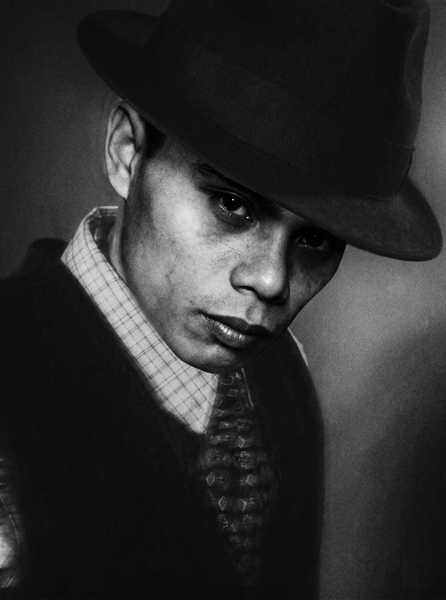
[Image Caption: AI Historical Simulation and Artistic Deconstruction]
This image was created with the assistance of Generative AI technology. The composition combines the facial characteristics of Liu Chueh-sheng found in historical documents with the somber visual style of the villain "Fan Chun" from the movie The Big Mist.
•Purpose: It aims to present the "professional yet cold" psychological profile of authoritarian bureaucrats through visual metaphor and image reconstruction.
•Nature of Work: This image is an AI-simulated artistic design. It is not an authentic historical photograph of Liu Chueh-sheng, nor is it a personal portrait of actor Mr. Chen Yi-wen or an official movie still.
[References]
1.National Declassified Archives: Military Justice Bureau of the Taiwan Garrison Command, Deng He Death Inquest Case (1967), Archive No. 0056/1574.4/1/1. Officially declassified and opened by the Ministry of National Defense in 2007.
2.Oral History Records: National Human Rights Museum, White Memory: Oral History Project Report on Green Island Residents' Impressions of Political Victims (2015).
3.Witness Testimony: Oral account by political victim Zhang Jia-lin, "Survivors Under the White Terror," published in Want Daily (November 27, 2010).
4.Human Rights Research Monograph: National Human Rights Museum, Toward the Light, Issue 8, "The Wu Tai-an Incident and the Taitung Haishan Temple Miscarriage of Justice" (2018).
5.Film Review Reference: Author's film review, "Taiwanese People Should Not Misapply 'Return a Bucket for a Mouthful'—A Review of The Big Mist" (2026).
[Disclaimer & Legal Notice]
This commentary is based on a synthesis of the aforementioned public historical archives, oral records from national institutions, victim testimonies, and contemporary cinematic works.
•Figures and Historical Facts: The mention of "Liu Chueh-sheng" is based on specific public offices held as documented in declassified official papers and historical texts. The descriptions of related actions are fully cited (see References) and are intended for public discussion on transitional justice, rather than groundless speculation into private life.
•Artistic Analogy: The analogy drawn between historical figure Liu Chueh-sheng and the character "Fan Chun" in the movie The Big Mist belongs to the realm of literary criticism and artistic interpretation in film sociology. The descriptions aim to explore abstract psychological structures such as "power parasitism" and the "banality of evil," and do not represent the political stance of the film producers, director, or the actor himself.
•Portrait Rights Statement: The AI-generated image used in this article is a fictional artistic creation and does not possess the portrait rights of any specific natural person. It should not be interpreted as defamation or infringement against any real individual.
•Educational and Commentary Purposes: This article complies with the fair use principles of copyright law for the purposes of "criticism, research, and education." Readers are advised to consult multiple official sources for an objective and comprehensive understanding when reviewing relevant historical data.
下一則: 你不知道的:台東海山寺蘇素霞靈位背後藏鏡人「劉覺生」深度解密檔案(長文版)
限會員,要發表迴響,請先登入


