
https://youtu.be/XCox5HNMomc?si=g85ebdqhS36PEB4e
.
The Pinglu Canal (simplified Chinese: 平陆运河; traditional Chinese: 平陸運河; pinyin: Pínglù yùnhé; Jyutping: Peng4 luk6 wan6 ho4), is a 134.2-kilometer inland river I-class waterway under construction between Xijin reservoir on the Yu river in Hengzhou and the lower part of the Qin River, allowing access to the Gulf of Tonkin. The canal will shorten the route between inland Guangxi and the sea by up to 560 km (350 mi).] It is Chinas first river-to-sea canal since the founding of the Peoples Republic
| Pinglu Canal | |
|---|---|

Interactive map of Pinglu Canal
| |
| Location | Guangxi |
| Country | China |
| Specifications | |
| Length | 134.2 km (83.4 miles) |
| Maximum boat beam | 15.8 metres (52 ft) |
| Maximum boat draft | 5 metres (16 ft) |
| Locks | 3 |
| Maximum height above sea level | 65 |
| History | |
| Construction began | August 2022 |
| Date completed | December 2026 (planned) |
| Geography | |
| Start point | Xijin reservoir, Hengzhou, Guangxi |
| End point | Qinzhou (Gulf of Tonkin) |
 時隔千餘年 中國再增新運河:廣西「平陸運河」全線通水.全長134.2公里,北起廣西橫州市平塘江口,經靈山縣陸屋鎮,沿欽江進入北部灣的「平陸運河」,20260603日上午全線通水。
平陸運河不只是中國當代,首條連通江海的大型運河工程,也是中國自隋朝「京杭大運河」後,1,000多年來的第一條運河。平陸運河可通航5,000噸級船舶,預計202609月通航。
平陸運河建成後將成為中國西南地區最短出海通道,5,000噸級江海直達船可從西江內河港口直通中國沿海港口和東南亞主要港口,較從廣州出海航程縮短560公里,估計每年可節省運輸成本餘人民幣52億元。.
. .
.
 .
.
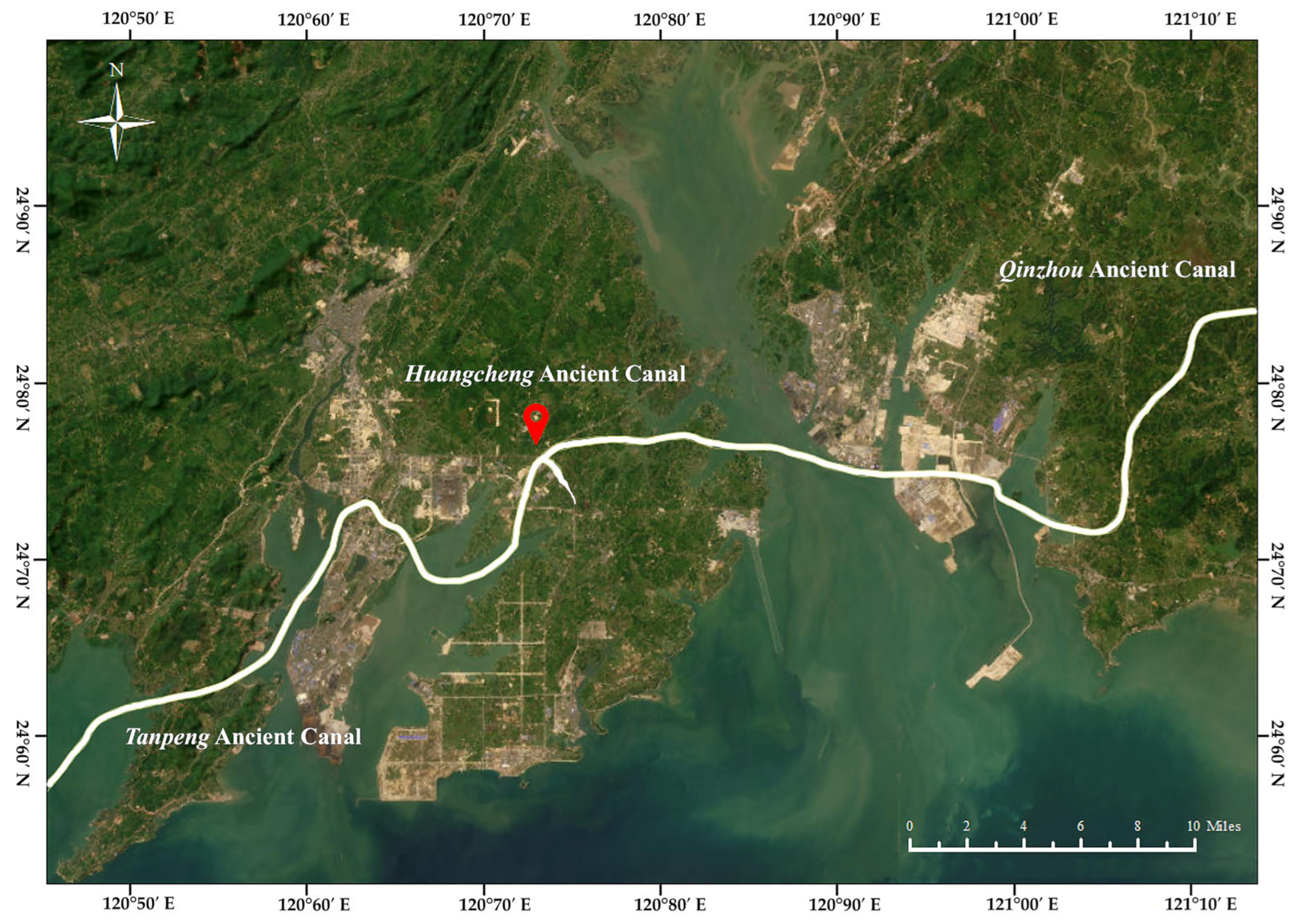
「平陸運河」是中國在廣西壯族自治區興建的世紀級水運工程,起於南寧橫州市西津水庫平塘江口,跨分水嶺經欽州靈山縣,沿欽江匯入北部灣欽州港。全長 134.2 公里,耗資約 727 億人民幣,是中國隋朝自京杭大運河後 1,000 多年來首條連通江海的大型運河。
該運河於 2022 年動工,並於 2026 年 6 月初實現全線通水,預計同年 9 月正式通航。
.關鍵工程亮點與規格
- 通航能力: 屬於內河 1 級航道,設計可通航 5,000 噸級船舶。
- 水位調節: 運河落差達 65 公尺(約 20 層樓高),沿途設有馬道、企石、青年三大梯級樞紐與船閘來克服落差。
- 工期目標: 自 2022 年立項開工後,主體工程與跨河橋樑皆迅速推進,並於 2026 年 6 月 3 日正式通水並展開有水調試,朝 2026 年 9 月投入營運的目標邁進。
 .
.
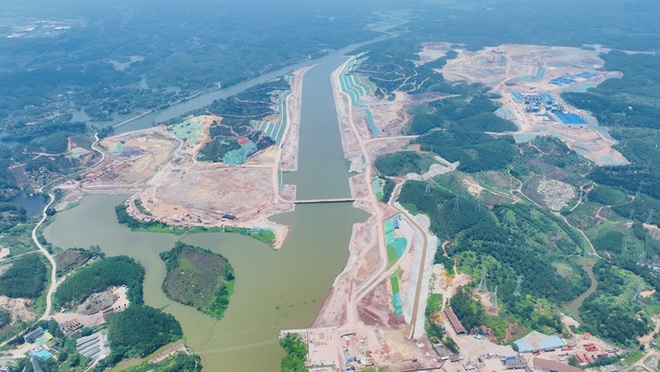
China close to opening US$10 billion canal linking heartlands to Southeast Asia:The vast waterway in China’s southern Guangxi region is set to open before the end of 2026.China is expected to finish construction on the landmark Pinglu Canal before the end of this year, taking just four years to complete the 72.7 billion yuan (US$10.4 billion) project to boost trade links with the country’s top export destination: Southeast Asia.
The mega-project will provide China’s landlocked southwestern provinces with direct access to global shipping lanes, making it faster and cheaper to transport goods between the Chinese interior and neighbouring countries.

-
- 縮短航程: 建成後,西南地區的貨物可直接從西江內河經由運河直達北部灣,相較於過去必須繞道廣州等珠三角港口,航程縮短約 560 公里。
- 經濟效益: 預估將成為中國西南地區運距最短、最經濟的出海水運通道,每年可節省龐大的物流運輸成本。
The Pinglu Canal, the first river-to-sea canal built since the founding of the Peoples Republic of China, is nearing completion after over three years of intensive construction. As a backbone project of the New International Land-Sea Trade Corridor in western China, the canal spans 134.2 kilometers, linking the Pingtang River estuary in Nanning, Guangxi Zhuang autonomous region, to the Beibu Gulf via the Qinjiang River.
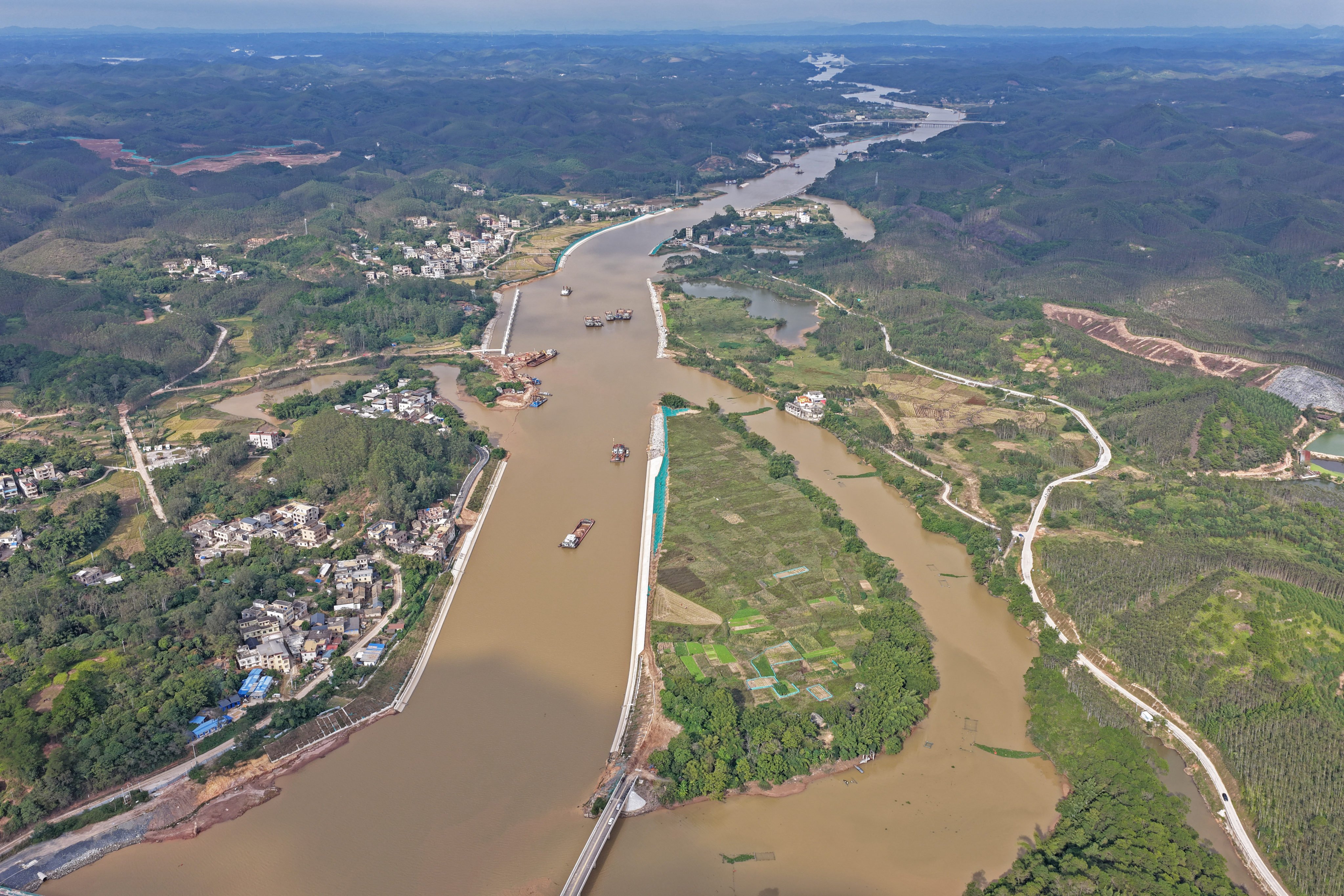
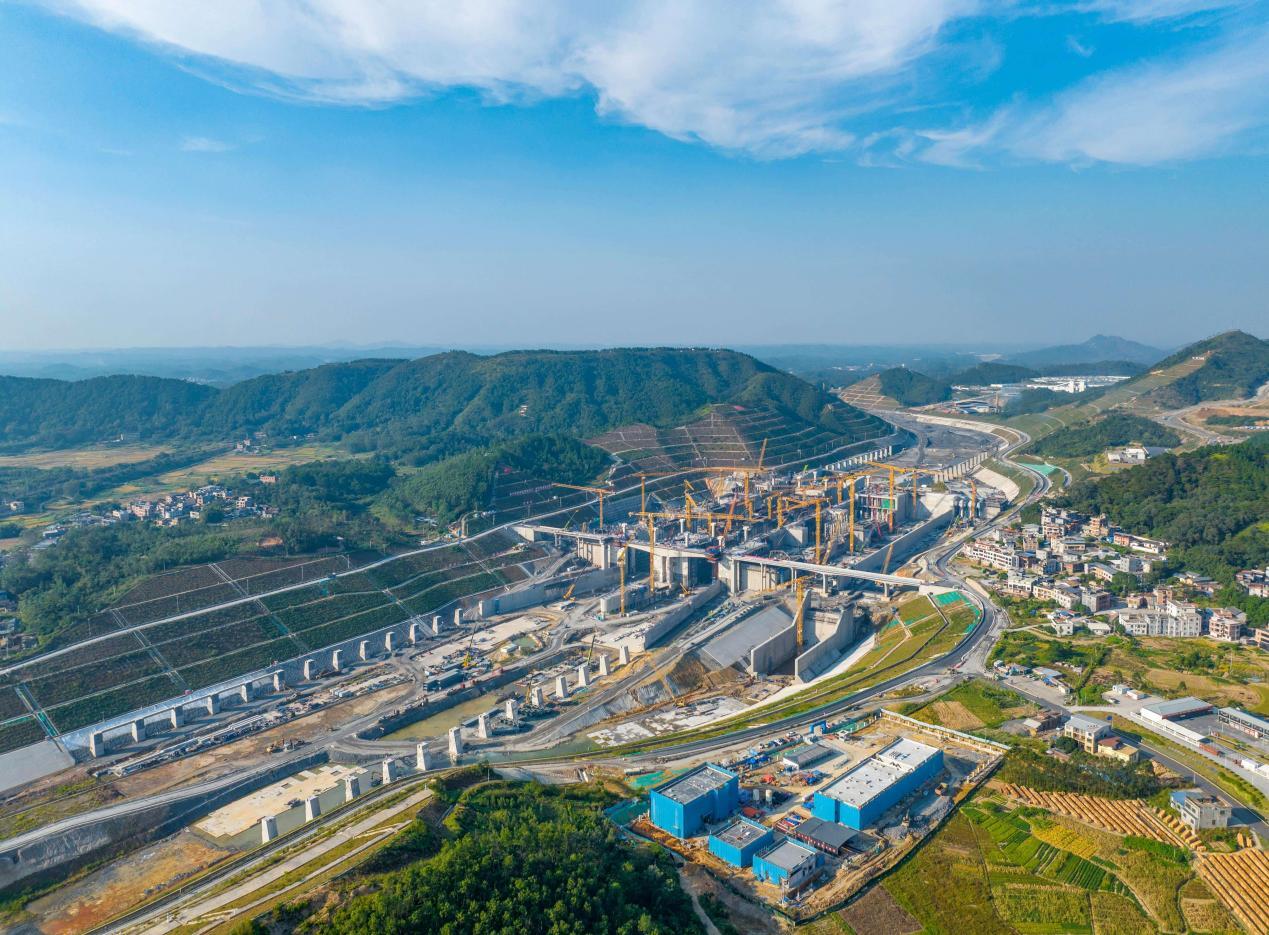
Today, the canals channel has largely taken shape. Towering sluice hubs line its banks, and its wide, sunlit waterway -- stretching over 100 meters in width -- quietly channels water toward the sea, signaling a transformative shift in regional connectivity.
A strategic link in the Chinese national infrastructure
A close look at the map of China reveals an intricate network of rivers crisscrossing Guangxi -- from west to east, the Xijiang, Hongshui, Qianjiang, and Guijiang Rivers meander like the veins of a phoenix tree leaf. The Pinglu Canal serves as the vital petiole connecting this inland network to the sea, functioning as a "lifeline" for waterborne transport in the region.
The canal integrates with the Xijiang shipping trunk line upstream, extending westward via the Zuojiang and Youjiang Rivers into Yunnan, eastward through the Yujiang River to the Guangdong-Hong Kong-Macao Greater Bay Area, and northward via the Qianjiang and Hongshui Rivers into Guizhou. To the south, it opens into the Beibu Gulf, establishing a direct inland waterway to the sea. Designed as a Class I inland waterway, the Pinglu Canal will accommodate 5,000-ton vessels, enabling seamless connectivity between inland provinces and global maritime trade routes.
Despite its coastal geography, Guangxis rivers historically flow eastward into the Pearl River Delta due to complex topography and elevation differences, leaving the region without a direct river-to-sea route. As a result, goods from western China have traditionally faced extended transport routes to reach international ports.
"Inland waterway transport offers substantial advantages over rail and road. It handles higher cargo volumes, lower costs, and reduced emissions, making it a critical element in optimizing Chinas transport infrastructure," said Yan Qiang, director of the science and technology information department at the Pinglu Canal Group.
Yan emphasized that the canals construction is driven by its significant and unique strategic value. "Once operational, it will greatly enhance the efficiency of trade between Guangxi, southwestern China, ASEAN, and beyond. Compared with the route through Guangzhou Port, the canal will shorten the journey by over 560 kilometers and save more than 5.2 billion yuan (approximately $731 million) in annual freight costs."
Engineering marvel with multifunctional benefits
The project encompasses the construction of a 134.2-kilometer-long, 5,000-ton-class inland waterway, three double-lane ship lock hubs, 27 newly built or reconstructed bridges, and supporting facilities.
"Unlike the Suez or Panama Canals, the Pinglu Canal is designed as a modern, multifunctional waterway that integrates navigation, flood control, water supply, irrigation, and ecological preservation," explained Yan. "Constructing such a complex system under tight deadlines, within challenging terrain and strict environmental constraints, has been a formidable engineering challenge."
Inside the projects central command and control center, two real-time metrics that reflect the scale of construction progress: earth and rock excavation, and concrete volume poured.
To carve the canals path through mountainous terrain, excavation has reached 315 million cubic meters -- nearly triple the volume excavated for the Three Gorges Project. Simultaneously, concrete pouring for the canals three cascade ship lock hubs -- Madao, Qishi, and Qingnian -- has reached 5.84 million cubic meters, enough to fill more than 2,300 standard swimming pools. These locks collectively manage a water level drop of approximately 65 meters, essential for vessel navigation.
"As of now, over 97 percent of the channel excavation has been completed, 80 percent of the banks have been reinforced, and water has been introduced to an initial 18-kilometer section," said Mo Rixiong, project manager at CCCC Guangzhou Dredging Co., Ltd., noting that the project has entered its final phase..


下一則: 賀中國足球小將 贏得 2026. 國際青少年盃冠軍."Chinese teenagers’ championship win reflects the spirit of the times.2026
限會員,要發表迴響,請先登入


