★ Dia
✎ deport (v.)
(1) To banish, as to another country; exile; remove. 放逐(異國);驅逐出境;遷離。
➜The federal authorities deported him for illegal entry.
(2) To behave (oneself); used reflexively. 舉止。
➜The young children deported themselves in a mannerly way.
(1) The act of leaving; a going away. 離去;離開。
(2) A beginning of a new course of action or thought. 新方針的開始。
(3) Death. 死亡。
(4) Deviation, as from a standard, rule, etc. 偏差; 逸出正軌。
(5) Distance due east or west made by a boat or aircraft on its course.航程 (只飛機、輪船而言)
★ De
✎ decline
(1) To bend or lean downward; droop. 彎下;低垂;下垂。
➜The sun declined toward the west.
(2) To draw to a close; become weak.接近終了;萎縮;變虛弱。
➜His health is declining.
(3) To turn aside; deviate from or as if from a straight course.偏轉;入歧路。
(4) To refuse.辭謝。
➜He was invited, but declined.
(v.t.)
(1) To refuse.拒絕。
➜He declined the invitation with thanks.
(1) To bend downward; depress. 向下彎;壓下。
(2) To inflect with declensional endings, as a noun, adjective, or pronoun.
【文法】使(名詞、形容詞或代名詞的)字尾變化。
(n.)
(1) A lessening; decay. (常用單數)衰微;衰落。
➜a decline in prices
(2) A growing worse. (常用單數);惡化。
(3) The closing part of something. 事情的末尾。
(3) Wasting disease, esp. consumption. 損耗體力的病(尤指肺癆)。
✎depreciate
(v.t.)
(1) To lower the value or rate of. 減價;貶值。
➜Runaway inflation has depreciated the country's currency.
(2) To speak slightingly of. 輕視。
➜He depreciates all my efforts to help him.
(v.i.)
(1) To fall in value. 減 值。
➜The property will depreciate in value if not kept in repairs.
★ ium
✎aquarium (n.)
(1) A tank in which water plants and animals are kept. (蓄養水產動植物之)水池;水族箱。
(2) A building for collections of water plants and animals. 水族館。
✎equilibrium (n.)
(1) A condition in which all acting influences are canceled by others, resulting in a stable,
balanced, or unchanging system.
(2) Mental or emotional balance; poise.
★ seum
✎ coliseum (n.)
(1) Colosseum. 古羅馬競技場。
(2) A large sports stadium or building designed like the Colosseum for public entertainments.
競技場;體育館。
✎ museum (n.)
(1) A collection of natural, scientific, or literary curiosities, or of works of art. 博物之收藏。
(2)The building containing such a collection. 博物館; 陳列所。
★ Ab
✎abnormal (adj.)
(1) Irregular; deformed; unnatural; not forming to rule or type. 不規則的;畸形的;異常的;
不符常規的;變態的。
✎aboriginal
(adj.)
(1) Original; first; existing from the beginning. 原始的;最初的;土著的。
(n.)
(1) Inhabitant, plant, etc. that has been in a place from the earliest times.土著;原住民;土
生動植物。
★ Monotheism
Monotheism, which means that the there is only one all-encompassing God's religion and thought. Encyclopedia Britannica is defined as "Belief in the existence of a God, or believe in the uniqueness of God." "Creationism" from religious origins and the basic doctrines of view, the Egyptian pharaoh Akhenaten created by probably the earliest monotheistic religion. Existing main monotheistic Abrahamic religions, mainly include Judaism, Christianity, Islam, in addition to India's Sikh is monotheism. And monotheism is opposed to polytheism and pantheism, they believe that there were more than one God, or anything in the world are all God.
★ Polytheism
Polytheism refers to the worship of or belief in multiple deities usually assembled into a pantheon of gods and goddesses, along with their own religions and rituals. In most religions which accept polytheism, the different gods and goddesses are representations of forces of nature or ancestral principles, and can be viewed either as autonomous or as aspects or emanations of a creator God or transcendental absolute principle, which manifests immanently in nature. It is a type of theism. Within theism, it contrasts with monotheism, the belief in a singular God, in most cases transcendent. Polytheists do not always worship all the gods equally, but can be henotheists, specializing in the worship of one particular deity. Other polytheists can be Kat henotheists, worshiping different deities at different times.
★ Lyre
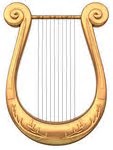
The lyre is a string instrument known for its use in Greek classical antiquity and later periods. The lyre is similar in appearance to a small but with distinct differences.
★ Atreus
In Greek mythology, Atreus was a king of Mycenae in the Peloponnese, the son of Pelops and Hippodamia, and the father of Agamemnon and Menelaus. Collectively, his descendants are known as Atreidai or Atreidae.
Atreus and his twin brother Thyestes were exiled by their father for murdering their half-brother Chrysippus in their desire for the throne of Olympia. They took refuge in Mycenae, where they ascended to the throne in the absence of King Eurystheus, who was fighting the Heracleidae. Eurystheus had meant for their stewardship to be temporary, but it became permanent after his death in battle.
★ Asclepius

Asclepius was a god of medicine in ancient Greek religion and mythology. Asclepius represents the healing aspect of the medical arts; his daughters are Hygieia ("Hygiene", the goddess/personification of health, cleanliness, and sanitation), Iaso (the goddess of recuperation from illness), Aceso (the goddess of the healing process), Aglæa/Ægle (the goddess of beauty, splendor, glory, magnificence, and adornment), and Panacea (the goddess of universal remedy). He was associated with the Roman/Etruscan god Vediovis. He was one of Apollo's sons, sharing with Apollo the epithet Paean ("the Healer") the rod of Asclepius, a snake-entwined staff, remains a symbol of medicine today. Those physicians and attendants who served this god were known as the Therapeutic of Asclepius.
★ Patronage
Patronage is the support, encouragement, privilege, or financial aid that an organization or individual bestows to another. In some countries the term is used to describe political patronage, which is the use of state resources to reward individuals for their electoral support.
★ Poseidon
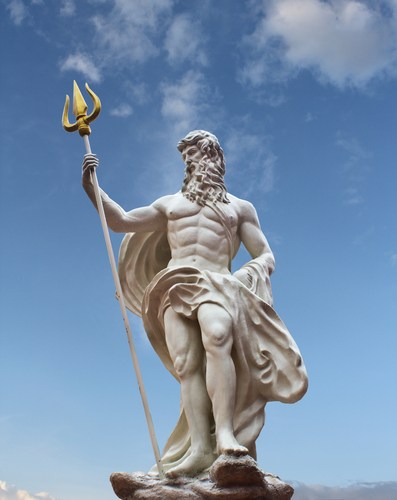
Poseidon is one of the twelve Olympian deities of the pantheon in Greek mythology. His main domain is the ocean, and he is called the "God of the Sea". Additionally, he is referred to as "Earth-Shaker" due to his role in causing earthquakes, and has been called the "tamer of horses". He is usually depicted as an older male with curly hair and beard.
The name of the sea-god Nethuns in Etruscan was adopted in Latin for Neptune in Roman mythology; both were sea gods analogous to Poseidon. Linear B tablets show that Poseidon was venerated at Pylos and Thebes in pre-Olympian Bronze Age Greece as a chief deity, but he was integrated into the Olympian gods as the brother of Zeus and Hades. According to some folklore, he was saved by his mother Rhea, who concealed him among a flock of lambs and pretended to have given birth to a colt, which was devoured by Cronos
There is a Homeric hymn to Poseidon, who was the protector of many Hellenic cities, although he lost the contest for Athens to Athena. According to the references from Plato in his dialogues Timeous and Caritas, the island of Atlantis was the chosen domain of Poseidon.


