1.
complement( v. )-something that completes, makes up a whole, or brings
to perfection.
-the quantity or number needed to make up a whole.
compliment( n. )- an expression of praise, admiration, or congratulation or a formal act of civility, courtesy, or respect.
-compliments Good wishes; regards
Example: Thanks for your compliments.
2.
discreet-careful to avoid social embarrassment or distress, esp by keeping
confidences secret; tactful.
indiscreet- not discreet; lacking prudence, good judgment, or circumspection.
3.
-al, suffix standing for noun
removal- the act of removing or change of residence, position, etc.
-dismissal, as from an office.
refusal- the act or an instance of refusing.
-the opportunity or right to accept or reject something before it is offered elsewhere.
approval- the act of approving; approbation or permission; sanction.
4.
reach the goal/ target/ agreement
5.
trivial- of little significance or value.
-concerned with or involving unimportant matters; superficial.
consent- to permit, approve, or comply; agree, as to an expressed wish or a proposed action (often fol. by to or an infinitive).
-permission, approval, or agreement; compliance.
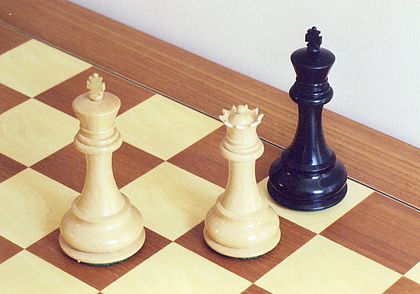
checkmate- is a game position in chess (and in other board games of the chaturanga family) in which a player's king is in check (threatened with capture) and there is no way to remove the threat. Checkmating the opponent wins the game.
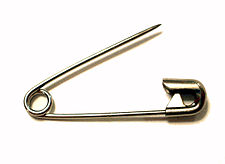
safety pin- is a variation of the regular pin which includes a simple spring mechanism and a clasp. The clasp serves two purposes: to form a closed loop thereby properly fastening the pin to whatever it is applied to, and to cover the end of the pin to protect the user from the sharp point.
6.
ethnic group- is a category of people who identify with each other based on common ancestral, social, cultural or national experience. Unlike most other social groups, ethnicity is primarily an inherited status. Membership of an ethnic group tends to be defined by a shared cultural heritage, ancestry, origin myth, history, homeland, language and/or dialect, symbolic systems such as religion, mythology and ritual, cuisine, dressing style, art, and physical appearance. Ethnic groups, derived from the same historical founder population, often continue to speak related and share a similar gene pool. By way of language shift, acculturation, adoption and religious conversion, it is possible for some individuals or groups to leave one ethnic group and become part of another (except for ethnic groups emphasizing racial purity as a key membership criterion).
ethnic group types-
Archaeological, Biological, Social, Cultural, Linguistic
7.
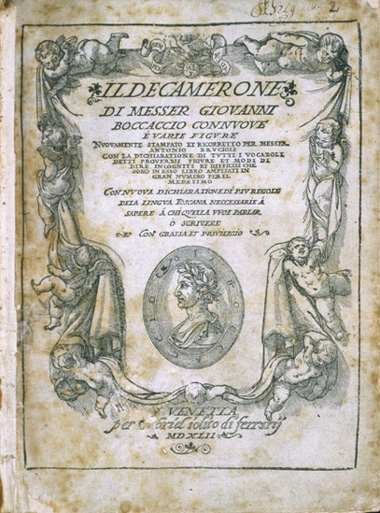
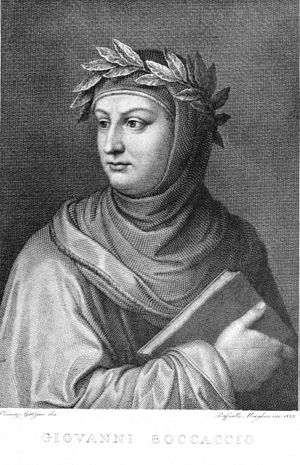
Giovanni Boccaccio-was an Italian writer, poet, correspondent of Petrarch, and an important Renaissance humanist. Boccaccio wrote a number of notable works, including The Decameron and On Famous Women. As a poet who wrote in the Italian vernacular, Boccaccio is particularly noted for his realistic dialogue, which differed from that of his contemporaries, medieval writers who usually followed formulaic models for character and plot.
Decameron- is a collection of novellas by the 14th-century Italian author Giovanni Boccaccio (1313–1375). The book is structured as a frame story containing 100 tales told by a group of seven young women and three young men sheltering in a secluded villa just outside Florence to escape the Black Death, which was afflicting the city. Boccaccio probably conceived the Decameron after the epidemic of 1348, and completed it by 1353. The various tales of love in The Decameronrange from the erotic to the tragic. Tales of wit, practical jokes, and life lessons contribute to the mosaic. In addition to its literary value and widespread influence (for example on Chaucer's The Canterbury Tales), it provides a document of life at the time. Written in the vernacular of the Florentine language, it is considered a masterpiece of classical early Italian prose.