1.
ab- from, away, off
abducted-to carry off or lead away (a person) illegally and in secret or by force,
esp. to kidnap.
-to move or draw away from the axis of the body or a limb (opposed to adduct).
abnormal- not normal; deviating from the usual or typical; extraordinary or odd in behavior or appearance; strange.
abandon-to leave completely and finally; forsake utterly; desert.
- to give up; discontinue; withdraw from.
-to give up the control of.
2.
audi- to listen
auditorium-a large room to accommodate an audience in a building such as a school
or theater or a large building for public meetings or performances.
audience-a group of viewers or listeners of a work of art or entertainment, especially those present at a performance.
spectator- a person who looks on or watches; onlooker; observer.
-a member of the audience at a public spectacle, display, or the like.
3.
Term Explanation
dramatic irony- this type of irony is the device of giving the spectator an item of information that at least one of the characters in the narrative is unaware of, thus placing the spectator a step ahead of at least one of the characters. dramatic irony has three stages—installation, exploitation, and resolution —producing dramatic conflict in what one character relies or appears to rely upon, the contrary of which is known by observers (especially the audience; sometimes to other characters within the drama) to be true.
hubris- means in a modern context, extreme pride or self-confidence; in its ancient Greek context, it typically describes violent and excessive behavior rather than an attitude. When it offends the gods of ancient Greece, it is usually punished. Hubris is usually perceived as a characteristic of an individual rather than a group, although the group the offender belongs to may suffer consequences from the wrongful act. Hubris often indicates a loss of contact with reality and an overestimation of one's own competence, accomplishments or capabilities, especially when the person exhibiting it is in a position of power.
trilogy- is a set of three works of art that are connected, and that can be seen either as a single work or as three individual works. They are commonly found in literature, film, or video games. Three-part works that are considered components of a larger work also exist, such as the triptych or the three-movement sonata, but they are not commonly referred to with the term "trilogy."
chorus- is a homogeneous, non-individualized group of performers in the plays of classical Greece, who comment with a collective voice on the dramatic action. The chorus consisted of between 12 and 50 players, who variously danced, sang or spoke their lines in unison and sometimes wore masks.
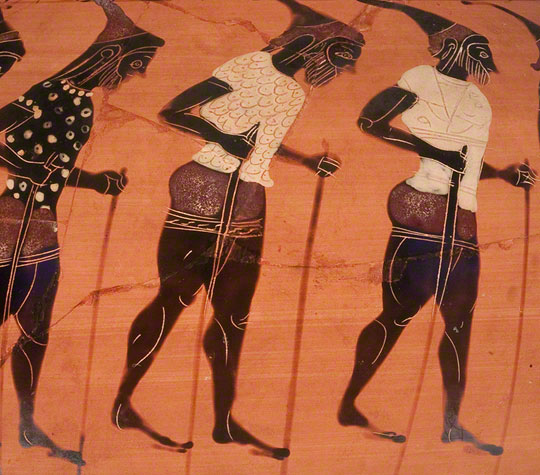
hamartia (tragic flaw)- means “to miss the mark” or “to err”. It is most often associated with Greek tragedy, although it is also used in Christian theology. Hamartia as it pertains to dramatic literature was first used by Aristotle in his Poetics. In tragedy, hamartia is commonly understood to refer to the protagonist’s error or flaw that leads to a chain of plot actions culminating in a reversal from their good fortune to bad. What qualifies as the error or flaw can include an error resulting from ignorance, an error of judgment, a flaw in character, or sin.
4.
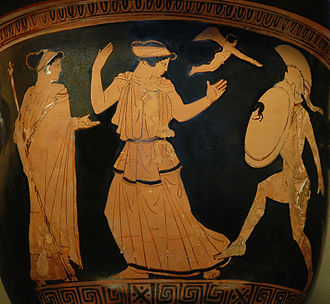
Helen of Troy-
"Was this the face that launched a thousand ships,
/ And burnt the topless towers of Ilium."