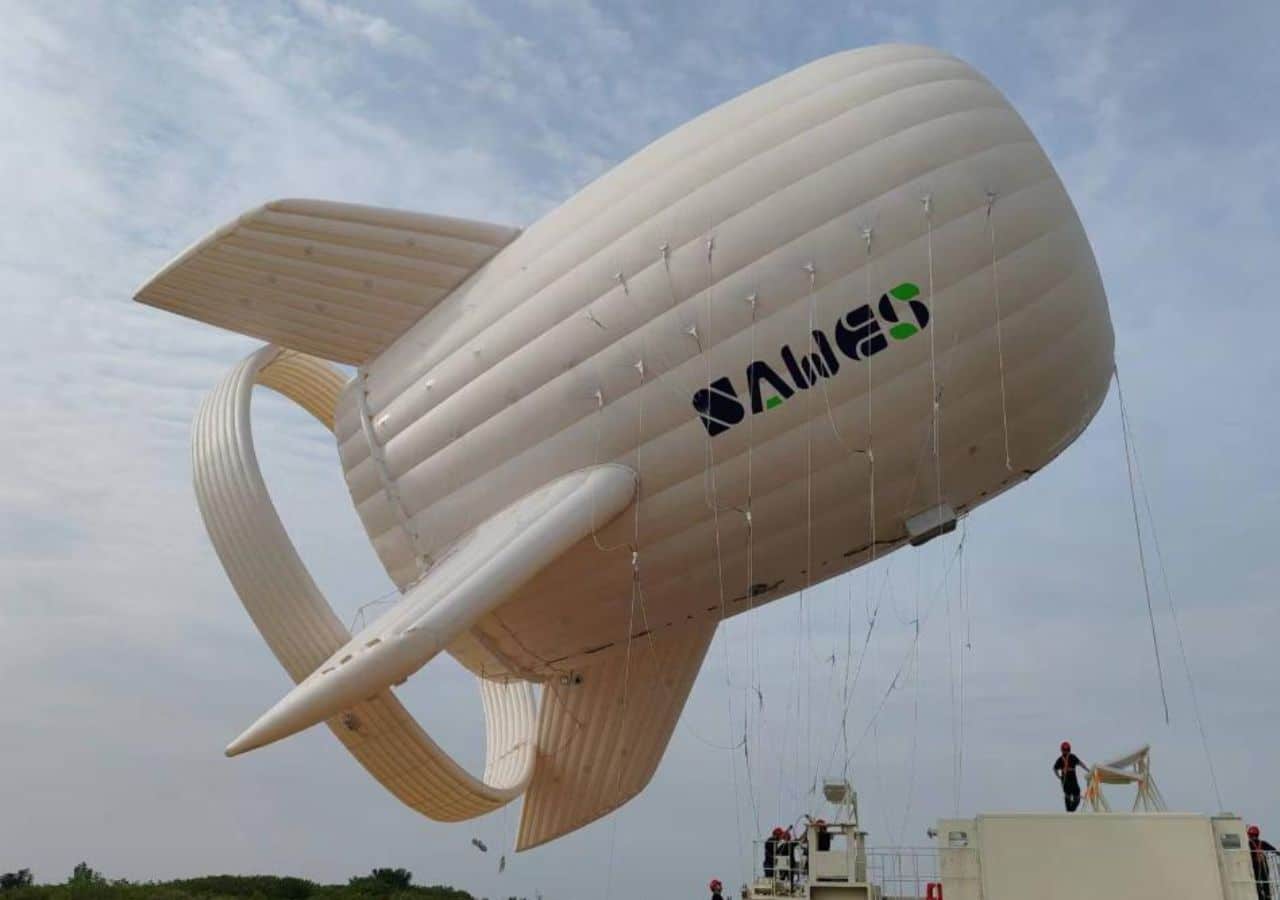
#14億人用電自由如何實現# 從向資源要電,到向水流要電,如今已經向天要電。帶大家來探勘中國空中發電站!
這是我國研發的全球首台適用於城市環境的兆瓦級S2000浮空風力發電系統。
本系統由輕質浮空囊體、高效率涵道風機、智慧繫纜與地面控制站所組成。囊體內充滿氦氣,14000立方米氦氣可產生約14噸浮力,而係統總重約11噸,依靠浮力就可以「飛」起來。主氣囊內還設有兩個自動調節的空氣囊,可隨溫度變化維持內部壓力平衡。
與傳統風力發電類似,S2000浮空風力發電系統同樣依靠風推動葉片旋轉發電,差別在於它的發電設備不在地面,而在空中。
高空風力資源更豐富、風速更高、穩定性更強,發電效率也隨之提升。風經過此系統涵道結構後會加速,帶動發電機運轉,電能經由纜繩輸送至地面,經變流即可併網,滿發狀態下,每小時可發電1000度。
除了發電,該系統還可搭載通訊基地台、環境監測等設備,成為低空經濟的多功能平台。由於發電主體懸在空中,對地面影響小,適合在城市負載區就近部署,減少輸電損耗。在應急救災等場景中,也可快速部署提供電力支援。 #一分鐘影片創作季##科技##熱搜多元內容創作計畫# http://t.cn/AXqtDiok
- 外型尺寸:長 60 公尺、寬 40 公尺、高 40 公尺。
- 體積與浮力:囊體體積約 2 萬立方公尺,填充約 14,000 立方公尺的氦氣,可產生約 14 噸浮力(系統總重約 11 噸)。
- 發電能力:設計最大額定功率可達 3 兆瓦 (MW)。
- 作業高度:設計可部署在海拔 2000 公尺以上的高空,利用更強且更穩定的高空風能。
- 結構組成:由輕質浮空囊體、高效涵道風機(搭載 12 套發電機組)、智慧系留纜繩與地面控制站組成。
- 發電效率:高空風能資源豐富,其年發電小時數可達 4000 小時以上,是傳統陸上風電的 2 至 3 倍。
- 機動部署:系統可拆解並存放於貨櫃中運輸,充滿氦氣需約 8 小時(若配合供應鏈可縮短至 4-5 小時),適合用於地震、洪水等災後緊急供電。
- 低度電成本:研發團隊目標在 2028 年前將度電成本降至火電的 1/10。
- SAWES-500:2024 年 10 月升至 500 公尺,功率 50 kW。
- SAWES-1000:2025 年 1 月升至 1000 公尺,功率 100 kW。
- S1500:2025 年 9 月在新疆戈壁完成 1MW 級別測試。
- S2000:2026 年 1 月完成併網,目前已啟動小批量生產。
- 未來型號:同步推进 S4000 與 S6000,其中 S6000 預計挑戰平流層高度。
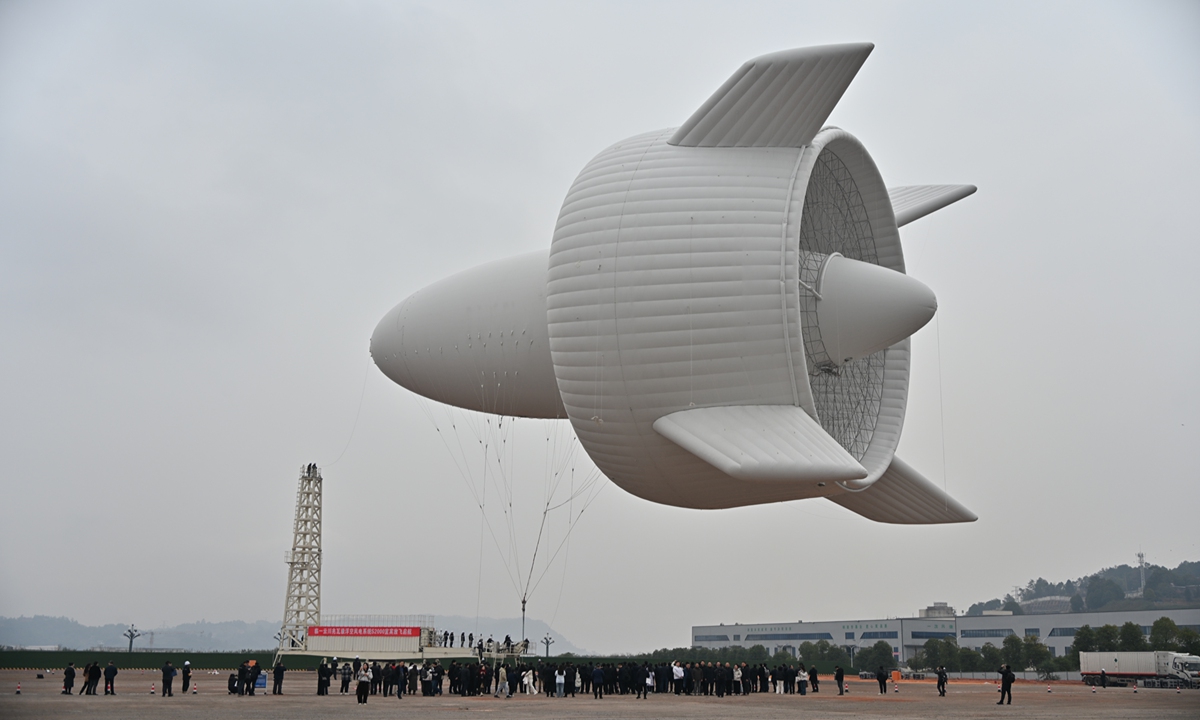
Worlds first megawatt-class urban-used high-altitude wind power system - the S2000 Stratosphere Airborne Wind Energy System (SAWES) - completes its test flight in Yibin, Southwest Chinas Sichuan Province, on January 5, 2026. Its hourly electricity output can fully charge approximately 30 electric vehicles from zero to full. Photo: Tao Mingyang/GT
The worlds first megawatt-class high-altitude wind power system designed for urban deployment — the S2000 Stratosphere Airborne Wind Energy System (SAWES) — successfully completed a test flight in Yibin, Southwest Chinas Sichuan Province, on Monday. The achievement marks a key breakthrough as Chinas high-altitude wind energy technology advances from experimental validation toward engineering-scale application.
From an environmental perspective, SAWES offers clear advantages, including a simpler structure, lower land requirements, and reduced environmental impact compared with conventional wind farms, according to experts.
The S2000 SAWES is an integrated airborne wind energy system that incorporates an airship platform and wind turbines into a single unit, and the whole system is 60 meters long, 40 meters wide and 40 meters high.
After an ascent of approximately 30 minutes, the S2000 reached an altitude of 2,000 meters during the test flight and generated 385 kilowatt-hours of electricity. It also successfully completed grid-connected power generation, becoming the worlds first high-altitude wind power device to be formally connected to the power grid.
Dun Tianrui, CEO and chief designer of the systems main developer, Beijing-based start-up Sawes Energy Technology, told the Global Times on the sidelines of the test flight that the S2000 model can be deployed at altitudes of up to 2,000 meters, with a single-unit power output of about 3 megawatts.
"At its current output level, one hour of operation can generate enough electricity to fully charge approximately 30 top-spec electric vehicles from zero to full," he said.
Compared with the S1500 model previously tested in Hami, Northwest Chinas Xinjiang Uygur Autonomous Region, from September 19 to 23, 2025, the S2000 features greater payload capacity and a fully upgraded weather-resistance design. These enhancements enable the system to operate not only in remote environments such as deserts and the Gobi, but also within urban settings, the company told the Global Times.
The entire S2000 SAWES can be transported in containers, and it takes only eight hours from site preparation in Yibin to full inflation, said Dun, noting that with local gas supply, the entire process can be reduced to four to five hours.
The system combines mature wind power technology with an airborne platform and is deployed at high altitudes, where stronger winds offer greater power generation potential, Wang Yanan, editor-in-chief of Aerospace Knowledge magazine, told the Global Times on Monday, adding that its airborne design allows flexible deployment and retrieval, making it especially suitable for sparsely populated areas where large-scale infrastructure is difficult to build.
According the National Energy Administration, as of the end of November 2025, Chinas total installed power generation capacity reached 3.79 billion kilowatts, up 17.1 percent year-on-year. Of this, installed wind power capacity reached 600 million kilowatts, up 22.4 percent year-on-year.
Wang noted that the key to SAWES commercialization lies in whether the costs of manufacturing, deploying, retrieving, and transmitting electricity from the airborne system can be covered - or even exceeded - by the power it generates.
- 臉上有'冠心溝,懸針,山根橫紋'3皺紋要當心!恐是心臟病警訊!平時按摩'神門及內關'2穴位在家就能養心臟;醫生一天可以吃10顆蛋?
- 身邊有沒有家人做過什麼'小事'是你們一直覺得'無所謂'但其實可能已經留下記錄的?你們會怎麼跟長輩解釋'在美國犯罪記錄是永遠跟著你的'這件事!
- 🏮4月3號農曆二月十六'清明時節'轉運必聽🔴地藏王菩薩賜福接好運<<滅定業真言>>心想事成,願望圓滿;消除業障,化解冤結... https://www.youtube.com/live/5yfnqNTKEKw
- 4月3號,農曆二月十六,恭逢殊勝的'觀世音菩薩救難日'這是一年之中接引大慈大悲觀世音菩薩尋聲救苦,拔除身心病痛,轉化命運磨難的最強能量吉日!
- Taiwan Travelogue台灣遊記原書名為'台灣漫遊錄'是台灣作家青山七惠(虛構角色)與楊双子共同交織出的精彩作品;這部小說採'書中書'的後設手法,非常迷人!
- 疾病是有根源的,藥師佛開示常念這三字真言<<南無佛>>疾病傷痛自然痊愈,身體會自動排出所有毒素,關鍵在于念誦時的專注與內心的覺悟!


