*en-/-en: to increase
ex. endangered species/strengthen/encourage/empower/deepen/enlarge/widen
*-ium/-eum: a place which is surrounded
*spect-: to see
ex. sanitarium/museum/millennium/auditorium-spectator/aquarium/conservatorium
inspect
perspective
fame-good:reputation/infamous:notorious
*di-: divide one into two
mockingbird
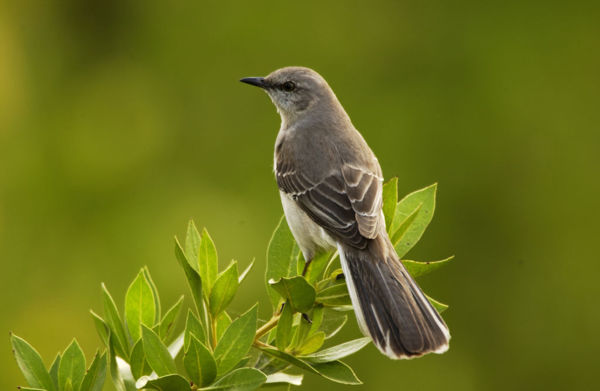
Mockingbirds are a group of New World passerine birds from the Mimidae family. They are best known for the habit of some species mimicking the songs of other birds and the sounds of insects and amphibians,often loudly and in rapid succession. There are about 17 species in three genera. These do not appear to form a monophyletic lineage: Mimus and Nesomimus are quite closely related; their closest living relatives appear to be some thrashers, such as the sage thrasher. Melanotis is more distinct; it seems to represent a very ancient basal lineage of Mimidae.
Sigh no more one foot in sea and one on shore
Sigh no more, ladies, sigh no more.
Men were deceivers ever,
One foot in sea, and one on shore,
To one thing constant never.
Then sigh not so, but let them go,
And be you blithe and bonny,
Converting all your sounds of woe
Into hey nonny, nonny.
Sing no more ditties, sing no more
Of dumps so dull and heavy.
The fraud of men was ever so
Since summer first was leafy.
Then sigh not so, but let them go,
And be you blithe and bonny,
Converting all your sounds of woe
Into hey, nonny, nonny.
lie to /deceive/cheat on
befriend/beloved/bemused/bewitched/bewilder
Tales from the crypt

*de-: away from
demon deity
*di-/dic: to say
dictation
preface
prologe
1100 Vocabularies WEEK 7
1.arbitrary (adj.) early 15c., "deciding by one's own discretion," from Old French arbitraire (14c.) or directly from Latin arbitrarius "depending on the will, uncertain," from arbiter (see arbiter). The original meaning gradually descended to "capricious" and "despotic" (1640s). Related: Arbitrarily; arbitrariness.
2. cognizant (adj.) 1820, back-formation from cognizance.
3. effigy (n.) "image of a person," 1530s, from Middle French effigie (13c.), from Latin effigies "copy or imitation of something, likeness, image, statue," from or related to effingere "to mold, fashion, portray," from assimilated form of ex "out" (see ex-) + fingere "to form, shape" (see fiction). The Latin word was regarded as plural and the -s was lopped off by 18c. Especially figures made of stuffed clothing; the burning or hanging of them is attested by 1670s. Formerly done by judicial authorities as symbolic punishment of criminals who had escaped their jurisdiction; later a popular expression against persons deemed obnoxious. Related: Effigial.
4. exacerbate (v.) 1650s, a back-formation from exacerbation or else from Latin exacerbatus, past participle of exacerbare "irritate, provoke." Related: Exacerbated; exacerbating.
5. flout (v.)
"treat with disdain or contempt" (transitive), 1550s, intransitive sense "mock, jeer, scoff" is from 1570s; of uncertain origin; perhaps a special use of Middle English flowten "to play the flute" (compare Middle Dutch fluyten "to play the flute," also "to jeer"). Related: Flouted; flouting.
6. forthwith (prep.) c. 1200, from forth + with. The Old English equivalent was forð mid. As an adverb, early 14c.
7. fray (n.)mid-14c., "feeling of alarm," shortening of affray (q.v.; see also afraid). Meaning "a brawl, a fight" is from early 15c. (late 14c. in Anglo-Latin). Fraymaker "fighter, brawler" is found in a 1530s statute recorded by Prynne ("Soveraigne Power of Parliaments and Kingdomes," 1643). Nares' "Glossary" has frayment (1540s).
fray (v.)
"wear off by rubbing," c. 1400, from Old French fraiier, froiier "to rub against, scrape; thrust against" (also in reference to copulation), from Latin fricare "to rub, rub down" (see friction). Intransitive sense "to ravel out" (of fabric, etc.) is from 1721. The noun meaning "a frayed place in a garment" is from 1620s. Related: Frayed; fraying.
8. harass (v.) 1610s, "to lay waste, devastate" (obsolete); 1620s, "to vex by repeated attacks," from French harasser "tire out, vex" (16c.), which is of uncertain origin; possibly from Old French harer "stir up, provoke; set a dog on," and perhaps blended with Old French harier "to harry, draw, drag" [Barnhart]. Related: Harassed; harassing.
9. implacable (adj.) "unappeasable," early 15c., from Old French implacable, from Latin implacabilis "unappeasable," from assimilated form of in- "not, opposite of" (see in- (1)) + placabilis "easily appeased" (see placate). Related: Implacably.
10. indigent (adj.) c. 1400, from Old French indigent "poor, needy," from Latin indigentem "in want of, needing" (see indigence). As a noun, "poor person," from early 15c.
11. jurisdiction (n.) early 14c., jurisdiccioun, jurediction, etc., "administration of justice," from Old French juridicion (13c., Modern French juridiction) and directly from Latin iurisdictionem (nominative iurisdictio) "administration of justice, jurisdiction," from phrase iuris dictio, genitive of ius "law, right" (see jurist) + dictio "a saying" (see diction). Meaning "extent or range of administrative power, domain over which a legal or judicial authority extends" is from late 14c. Meaning "judicial authority, right of making and enforcing laws" is from early 15c. The form in English assimilated to Latin 16c. Related: Jurisdictional.
12. monolithic (adj.)
1825, "formed of a single block," from monolith + -ic. Figurative use from 1920.
13. oust (v.) early 15c., from Anglo-French oster (late 13c.), Old French oster "remove, take away, take off; evict, dispel; liberate, release" (Modern French ôter), from Latin obstare "stand before, be opposite, stand opposite to, block," in Vulgar Latin, "hinder," from ob "against" (see ob-) + stare "to stand," from PIE root *sta- "to stand" (see stet). Related: Ousted; ousting.
14. paroxysm (n.) "sudden attack, convulsion," early 15c., from Middle French paroxysme (16c.), earlier paroxime (13c.), from Medieval Latin paroxysmus "irritation, fit of a disease," from Greek paroxysmos "irritation, exasperation," from paroxynein "to irritate, goad, provoke," from para- "beyond" (see para- (1)) + oxynein "sharpen, goad," from oxys "sharp, pointed" (see acro-). Non-medical sense first attested c. 1600. Related: Paroxysmal.
15. reprehensible (adj.) late 14c., from Old French reprehensible (14c.) or directly from Late Latin reprehensibilis, from reprehens-, past participle stem of Latin reprehendere "to blame, censure, rebuke; seize, restrain" (see reprehend). Related: Reprehensibly; reprehensibility.
16. revert (v.) c. 1300, "to come to oneself again," from Old French revertir "return, change back," from Vulgar Latin *revertire, variant of Latin revertere "turn back, turn about; come back, return," from re- "back" (see re-) + vertere "to turn" (see versus). Of position or property from mid-15c.; application to customs and ideas is from 1610s.
17. skirmish (v.) c. 1200, from Old French escarmouchier, from Italian scaramucciare (see skirmish (n.)). Related: Skirmished; skirmishing.
skirmish (n.) late 14c., from Old French escarmouche "skirmish," from Italian scaramuccia, earlier schermugio, probably from a Germanic source (compare Old High German skirmen "to protect, defend"), with a diminutive or depreciatory suffix, from Proto-Germanic *skerm-, from PIE *(s)ker- (1) "to cut" (see shear (v.)).
Influenced in Middle English by a separate verb skirmysshen "to brandish a weapon," from Old French eskirmiss-, stem of eskirmir "to fence," from Frankish *skirmjan, from the same Germanic source. Compare scrimmage. Other modern Germanic forms have an additional diminutive affix: German scharmützel, Dutch schermutseling, Danish skjærmydsel. Skirmish-line attested by 1864.
18. stymie (v.) 1857, in golf, from stymie (n.) "condition in which an opponent's ball blocks the hole" (1834), perhaps from Scottish stymie "person who sees poorly," from stime "the least bit" (early 14c.), of uncertain origin. General sense of "block, hinder, thwart" is from 1902. Related: Stymied.
19. terminate (v.) early 15c., "bring to an end," from Latin terminatus, past participle of terminare "to mark the end or boundary," from terminus "end, limit" (see terminus). Intransitive sense of "to come to an end" is recorded from 1640s; meaning "dismiss from a job" is recorded from 1973; that of "to assassinate" is from 1975. Related: Terminated; terminating.
20. turbulent (adj.)
early 15c., "disorderly, tumultuous, unruly" (of persons), from Middle French turbulent (12c.), from Latin turbulentus "full of commotion, restless, disturbed, boisterous, stormy," figuratively "troubled, confused," from turba "turmoil, crowd" (see turbid). In reference to weather, from 1570s. Related: Turbulently.
限會員,要發表迴響,請先登入


