 Hans Christian Andersen
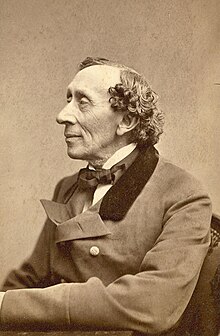
Hans Christian Andersen (/ˈhɑːnz ˈkrɪstʃən ˈændər.sən/; Danish: [ˈhanˀs ˈkʁæsdjan ˈɑnɐsn̩]; often referred to in Scandinavia as H. C. Andersen; 2 April 1805 – 4 August 1875) was a Danish author. Although a prolific writer of plays, travelogues, novels, and poems, Andersen is best remembered for his fairy tales. Andersen's popularity is not limited to children; his stories, called eventyr in Danish, or "fairy-tales" in English, express themes that transcend age and nationality.
Andersen's fairy tales, which have been translated into more than 125 languages, have become culturally embedded in the West's collective consciousness, readily accessible to children, but presenting lessons of virtue and resilience in the face of adversity for mature readers as well. Some of his most famous fairy tales include "The Little Mermaid", "The Snow Queen", "The Ugly Duckling", "The Nightingale", "The Emperor's New Clothes" and many more. His stories have inspired plays, ballets, and both live-action and animated films.
early works
A very early fairy tale by Andersen called The Tallow Candle (Danish: Tællelyset) was discovered in a Danish archive in October 2012. The story, written in the 1820s, was about a candle who did not feel appreciated. It was written while he was still in school and dedicated to a benefactor, in whose family's possession it remained until it turned up among other family papers in a suitcase in a local archive.
In 1829, Andersen enjoyed considerable success with a short story titled A Journey on Foot from Holmen's Canal to the East Point of Amager. In the book, the protagonist meets characters ranging from Saint Peter to a talking cat. He followed this success with a theatrical piece, Love on St. Nicholas Church Tower and a short volume of poems. Though he made little progress writing and publishing immediately thereafter, in 1833 he received a small traveling grant from the King, enabling him to set out on the first of many journeys through Europe. At Jura, near Le Locle, Switzerland, he wrote the story, Agnete and the Merman. He spent an evening in the Italian seaside village of Sestri Levante the same year, inspiring the name, The Bay of Fables. In October 1834, he arrived in Rome. Andersen's travels in Italy would be reflected in his first novel; an autobiography titled The Improvisatore (Improvisatoren) which was published in 1835, receiving instant acclaim.

the works
 The Little Mermaid 電子版連結
"The Little Mermaid" (Danish: Den lille havfrue) is a well-known fairy tale by the Danish author Hans Christian Andersen about a young mermaid willing to give up her life in the sea and her identity as a mermaid to gain a human soul and the love of a human prince.
The tale was first published in 1837 and has been adapted to various media, including musical theatre and animated film.

The Snow Queen 電子版連結
"The Snow Queen" (Danish: Snedronningen) is an original fairy tale written by Hans Christian Andersen (1805–1875). The tale was first published 21 December 1844 in New Fairy Tales. First Volume. Second Collection. 1845. (Danish: Nye Eventyr. Første Bind. Anden Samling. 1845.) The story centers on the struggle between good and evil as experienced by Gerda and her friend, Kai.
The story is one of Andersen's longest and most highly acclaimed stories. It is regularly included in selected tales and collections of his work and is frequently reprinted in illustrated storybook editions for children.

The Ugly Ducking 電子版連結
"The Ugly Duckling" (Danish: Den grimme ælling) is a literary fairy tale by Danish poet and author Hans Christian Andersen (1805 – 1875). The story tells of a homely little bird born in a barnyard who suffers abuse from the others around him until, much to his delight (and to the surprise of others), he matures into a beautiful swan, the most beautiful bird of all. The story is beloved around the world as a tale about personal transformation for the better. “The Ugly Duckling” was first published 11 November 1843 with three other tales by Andersen in Copenhagen, Denmark to great critical acclaim. The tale has been adapted to various media including opera, musical, and animated film. The tale is completely Andersen's invention and owes no debt to fairy tales or folklore.

The Princess and the Pea 電子版連結
The Princess and the Pea (Danish: "Prinsessen paa Ærten"; literal translation: "The Princess on the Pea")[1] is a literary fairy tale by Hans Christian Andersen about a young woman whose royal identity is established by a test of her physical sensitivity. The tale was first published with three others by Andersen in an inexpensive booklet on 8 May 1835 in Copenhagen by C.A. Reitzel.
Andersen had heard the story as a child, and it likely has its source in folk material, possibly originating from Sweden as it is unknown in the Danish oral tradition. Neither "The Princess and the Pea" nor Andersen's other tales of 1835 were well received by Danish critics, who disliked their casual, chatty style, and their lack of morals.
In 1959 "The Princess and the Pea" was adapted to the musical stage in a production called Once Upon a Mattress starring Carol Burnett.


