 Aesop
Aesop
Aesop (/ˈiːsɒp/ ee-sop; Ancient Greek: Αἴσωπος, Aisōpos, c. 620–564 BCE) was an Ancient Greek fabulist or story teller credited with a number of fables now collectively known as Aesop's Fables. Although his existence remains uncertain and (if he ever existed) no writings by him survive, numerous tales credited to him were gathered across the centuries and in many languages in a storytelling tradition that continues to this day. Many of the tales are characterized by animals and inanimate objects that speak, solve problems, and generally have human characteristics.
Scattered details of Aesop's life can be found in ancient sources, including Aristotle, Herodotus, and Plutarch. An ancient literary work called The Aesop Romance tells an episodic, probably highly fictional version of his life, including the traditional description of him as a strikingly ugly slave (δοῦλος) who by his cleverness acquires freedom and becomes an adviser to kings and city-states. Older spellings of his name have included Esop(e) and Isope. Depictions of Aesop in popular culture over the last 2500 years have included several works of art and his appearance as a character in numerous books, films, plays, and television programs.

Ass Carrying Salt
at his old tricks again
instead of
on purpose
→The same measure
The bat, the birds, and the beats
→He that is neither one thing nor the other has no friends.
When a neighbor's house is on fire, you better look at yours. 他山之石可以攻錯
Misery loves company. 禍不單行
be ashamed to
summon/call a meeting召集開會、高峰會
pro- in favor of, many, much
ex. protagonist (antagonist), proponent倡議人, propose (n. proposal), approve (n. approval)
Aesop is reported as a prolific writer, for he wrote many work.
op/ob差別 (發音差別)
ex. opponent, opposite, obstacle
-semble
assemble→(n.) assembly大會
resemble→(n.) resemblance共同點
ensemble
It was in the way.擋路
There is always someone who is worse off than you are.
hare 棕兔(swiftness敏捷);tortoise陸龜
course行程
fatigue身心俱疲
Moby-Dick→Starbucks
Perseverance is surer swiftness.吃緊弄破碗
Men are apt to condemn in others the very thing they do themselves.
crane鶴,起重機
The cunning Fox and the clever stork狐狸請鶴吃飯
The wolf and the crane伴君如伴虎
A Wolf, having a bone stuck in his throat, hired a Crane, for a large sum, to put her head into his throat and draw out the bone. When the Crane had extracted the bone, and demanded the promised payment, the Wolf, grinning and grinding his teeth, exclaimed: "Why, you have surely already a sufficient recompense, in having been permitted to draw out your head in safety from the mouth and jaws of a Wolf."
In serving the wicked, expect no reward, and be thankful if you escape injury for your pains.

The Fox and the Grapes
A famished Fox saw some clusters of ripe black grapes hanging from a trellised vine. She resorted to all her tricks to get at them, but wearied herself in vain, for she could not reach them. At last she turned away, beguiling herself of her disappointment, and saying: "The Grapes are sour, and not ripe as I thought."
Revile not things beyond your reach.


succinct短篇
Fable
Fable is a literary genre. A fable is a succinct fictional story, in prose or verse, that features animals, mythical creatures, plants, inanimate objects or forces of nature which are anthropomorphized (given human qualities such as verbal communication), and that illustrates or leads to an interpretation of a moral lesson (a "moral"), which may at the end be added explicitly in a pithymaxim.
A fable differs from a parable in that the latter excludes animals, plants, inanimate objects, and forces of nature as actors that assume speech and other powers of humankind.
Usage has not always been so clearly distinguished. In the King James Version of the New Testament, "μῦθος" ("mythos") was rendered by the translators as "fable"[1] in the First Epistle to Timothy, the Second Epistle to Timothy, the Epistle to Titus and the First Epistle of Peter.[2]
A person who writes fables is a fabulist.
human form
無→lesson, inform
有→entertainment, escape, pleasure

Parable
A parable is a succinct, didactic story, in prose or verse, which illustrates one or more instructive lessons or principles. It differs from afable in that fables employ animals, plants, inanimate objects, or forces of nature as characters, whereas parables have human characters. A parable is a type of analogy.
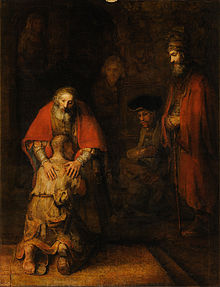
Some scholars of the canonical gospels and the New Testament apply the term "parable" only to the parables of Jesus, though that is not a common restriction of the term. Parables such as "The Prodigal Son" are central to Jesus' teaching method in both the canonical narratives and the apocrypha.
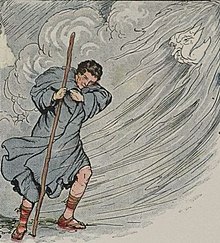
anthropomorphism
Anthropomorphism, or personification, is attribution of human form or other characteristics to anything other than a human being. Examples include depicting deities with human form, creating fictional non-human animal characters with human physical traits, and ascribing human emotions or motives to forces of nature, such as hurricanes or earthquakes.
Anthropomorphism has ancient roots as a literary device in storytelling, and also in art. Most cultures have traditional fables with anthropomorphised animals, who can stand or talk as if human, as characters.
The word anthropomorphism was first used in the mid-1700s.[1][2] The word derives from the Greek ἄνθρωπος (ánthrōpos), "human", and μορφή (morphē), "shape" or "form".
書名畫線;"短篇小說引號"


