 Why Mosquitoes Buzz in People’s Ears
Why Mosquitoes Buzz in People's Ears: A West African Tale is a picture book told in the form of a cumulative tale written for young children, which tells an African legend. In this origin story, the mosquito lies to a lizard, who puts sticks in his ears and ends up frightening another animal, which down a long line causes a panic. In the end, an owlet is killed and the owl is too sad to wake the sun until the animals hold court and find out who is responsible. The mosquito is eventually found out, but it hides in order to escape punishment. So now it constantly buzzes in people's ears to find out if everyone is still angry at it.
The book won a Caldecott Medal in 1976 for its illustrators, Leo and Diane Dillon.[1] The artwork was made using watercolor airbrush, pastels, and India ink. The cutout shapes were made by using friskets and vellum cut shapes at different angles.[2] It was the first of their two consecutive Caldecott wins; the second was for Ashanti to Zulu: African Traditions.[1]
This story is a resource for teachers to teach the skill; cause and effect.
"A cause is something that makes something else happen; An effect is what happens as a result of the cause" (Dell)
The idea that the mosquito is to blame for the unfortunate death of the owlet is an example of cause and effect. The actions from the other animals also offers several more examples of cause and effect as each animal does something that causes the next animal to do something. This chain of events finally causes the owlet to die. Therefore teachers can use this text to show students how actions (causes) make other things happen (effect).
The book was adapted into an animated short in 1984, and was narrated by James Earl Jones.
 Picture book / learning verbs / exaggerate / 神話傳說故事
故事高潮: 媽媽知道小孩怎麼死的,叫醒太陽

Picture Book
A picture book combines visual and verbal narratives in a book format, most often aimed at young children. The images in picture books use a range of media such as oil paints, acrylics, watercolor, and pencil, among others. Two of the earliest books with something like the format picture books still retain now were Heinrich Hoffmann's Struwwelpeter from 1845 and Beatrix Potter's The Tale of Peter Rabbit from 1902. Some of the best-known picture books are Robert McCloskey's Make Way for Ducklings, Dr. Seuss' The Cat In The Hat, andMaurice Sendak's Where the Wild Things Are. The Caldecott Medal (established 1938) and Kate Greenaway Medal (established 1955) are awarded annually for illustrations in children's literature. From the mid-1960s several children's literature awards include a category for picture books.

Discussion Guide
Focus a discussion on themes from the story that children can relate to their own lives. Guide students in recognizing cause and effect.
→ What happens when the grumpy iguana goes lumbering off with sticks stuck in his ears?
→ How does one misunderstanding become a big problem?
→ What do you learn about the lion from the way he handled the problem?
→ Have you and a friend ever had a misunderstanding? What happened?
驚嚇程度
frighten(make or become afraid; terrify)→scare→startle→alarm→kill
The Farrie Queene
The Faerie Queene is an incomplete English epic poem by Edmund Spenser. The first half was published in 1590, and a second installment was published in 1596. The Faerie Queene is notable for its form: it was the first work written in Spenserian stanza and is one of the longest poems in the English language.[1] It is an allegorical work, and can be read (as Spenser presumably intended) on several levels of allegory, including as praise of Queen Elizabeth I. In a completely allegorical context, the poem follows several knights in an examination of several virtues. In Spenser's "Letter of the Authors," he states that the entire epic poem is "cloudily enwrapped in allegorical devices," and that the aim of publishing The Faerie Queene was to “fashion a gentleman or noble person in virtuous and gentle discipline.”
The Faerie Queene found such favour with Elizabeth I that Spenser was granted a pension for life amounting to fifty pounds a year, though there is no evidence that Elizabeth I read any of the poem. This royal patronage helped the poem along to such a level of success that it became Spenser's defining work.[2]

Fable
Fable is a literary genre. A fable is a succinct fictional story, in prose or verse, that features animals, mythical creatures, plants, inanimate objects or forces of nature which are anthropomorphized (given human qualities such as verbal communication), and that illustrates or leads to an interpretation of a moral lesson (a "moral"), which may at the end be added explicitly in a pithymaxim.
→短篇、虛構、擬人(animal)
Aesop_
sour grapes
the boy crying wolf
The tale concerns a shepherd boy who repeatedly tricks nearby villagers into thinking a wolf is attacking his flock. When one actually does appear and the boy again calls for help, the villagers believe that it is another false alarm and the sheep (or, in some versions of the story, the boy) are eaten by the wolf.
The moral stated at the end of the Greek version is, "this shows how liars are rewarded: even if they tell the truth, no one believes them". It echoes a statement attributed toAristotle by Diogenes Laërtius in his The Lives and Opinions of Eminent Philosophers, where the sage was asked what those who tell lies gain by it and he answered "that when they speak truth they are not believed".[3] William Caxton similarly closes his version with the remark that "men bileve not lyghtly hym whiche is knowen for a lyer"

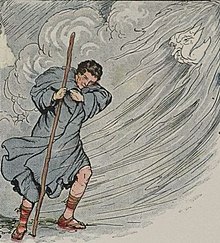
the north wind and the sun
The story concerns a competition between the North wind and the Sun to decide which is the stronger of the two. The challenge was to make a passing traveler remove his cloak. However hard the North Wind blew, the traveler only wrapped his cloak tighter to keep warm, but when the Sun shone, the traveler was overcome with heat and soon took his cloak off.
The fable was well known in Ancient Greece; Athenaeus recorded that Hieronymus of Rhodes, in his Historical Notes, quotes an epigram of Sophocles against Euripides which parodies the story of Helios and Boreas. It relates how Sophocles had his cloak stolen by a boy to whom he had made love. Euripides joked that he had had that boy too and it did not cost him anything. Sophocles' reply satirises the adulteries of Euripides: "It was the Sun, and not a boy, whose heat stripped me naked; as for you, Euripides, when you were kissing someone else's wife the North Wind screwed you. You are unwise, you who sow in another's field, to accuse Eros of being a snatch-thief."

WORD
di- 負面的;四散的、一分為二
ex. diversity, divide


