 Charlotte’s Web
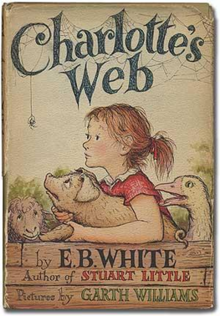
Charlotte's Web is a children's novel by American author E. B. White and illustrated by Garth Williams; it was published in 1952 byHarper & Brothers. The novel tells the story of a pig named Wilbur and his friendship with a barn spider named Charlotte. When Wilbur is in danger of being slaughtered by the farmer, Charlotte writes messages praising Wilbur (such as "Some Pig") in her web in order to persuade the farmer to let him live.
Written in White's dry, low-key manner, Charlotte's Web is considered a classic of children's literature, enjoyable to adults as well as children. The description of the experience of swinging on a rope swing at the farm is an often cited example of rhythm in writing, as the pace of the sentences reflects the motion of the swing. Publishers Weekly listed the book as the best-selling children's paperback of all time as of 2000.[1]
Charlotte's Web was adapted into an animated feature by Hanna-Barbera Productions and Sagittarius Productions in 1973. Paramount released a direct-to-video sequel, Charlotte's Web 2: Wilbur's Great Adventure, in the U.S. in 2003 (Universal released the film internationally). A live-action film version of E. B. White's original story was released in 2006. A video game based on this adaption was also released in 2006.
summary
After sparing the life of a piglet almost slaughtered as runt of the litter, a little girl named Fern Arable nurtures it lovingly, naming it Wilbur. On greater maturity, Wilbur is sold to Fern's uncle, Homer Zuckerman, in whose barnyard he is left yearning for companionship but is snubbed by other barn animals, until befriended by a barn spider named Charlotte, living on a web overlooking Wilbur's enclosure. Upon Wilbur's discovery that he is intended for slaughter, she promises to hatch a plan guaranteed to spare his life. Accordingly she secretly weaves praise of him into her web, attracting publicity among Zuckerman's neighbors who attribute the praise to divine intervention. As time passes, more engravings appear on Charlotte's webs, increasing his renown. Therefore Wilbur is entered in the county fair, accompanied by Charlotte and the rat Templeton, whom she employs in gathering inspiration for her messages. There, Charlotte spins an egg sac containing her unborn offspring, and Wilbur, despite winning no prizes, is later celebrated by the fair's staff and visitors (thus made too prestigious alive, to justify killing him). Exhausted apparently by laying eggs, Charlotte remains at the fair and dies shortly after Wilbur's departure. Having returned to Zuckerman's farm, Wilbur guards Charlotte's egg sac, and is saddened further when the new spiders depart shortly after hatching, leaving behind their three smallest. Pleased at finding new friends, Wilbur names the spiderlings Joy, Nellie, and Aranea, and the book concludes mentioning that more generations of spiders kept him company in subsequent years.
conflict: Is the pig should die?
Barnyard Smells
White researched every detail that went into his three books for children: Stuart Little (1945),Charlotte's Web (1952), and The Trumpet of the Swan (1970). For Charlotte's Web the research was close to home—at White's own farm in Maine.
As a result, the barnyard of Charlotte's Web seems real in every detail, and so do the habits of its animals. Despite Charlotte's sophisticated vocabulary, she is still a spider who traps flies in her web and sucks their blood. Likewise, though Wilbur expresses deep emotions, he is still a pig who likes to lie in the mud and breathe in the warm smell of manure.
Saving a Pig's Life
In Charlotte's Web, a spider saves a pig from slaughter. In real life, the author had tried to save a pig—and failed. A few years before Charlotte's Web, White wrote an essay about caring for a dying pig at his farm. Even though White had raised the pig to make bacon, at the end he found himself desperately trying to save the pig's life, "cast suddenly in the role of pig's friend and physician."
Although farm pigs are, in a sense, born to die—being destined for the butcher—White had always had mixed feelings about this fact of farm life. "One day when I was on my way to feed the pig, I began to feel sorry for the pig because, like most pigs, he was doomed," he recalled. "This made me sad. So I started thinking of ways to save a pig's life." Soon the story of Wilbur was born.
A Change of Scene
During the 1920s, White was a successful essayist and poet in New York City. In 1939, however, he moved with his family to a farm in quiet North Brooklin, Maine. "I can't claim to be a real farmer," White said, "but we do farm and I like to work outside." The Whites had sheep, chickens, and pigs, as well as rambling gardens.
Surrounded by mountains and sea, White lived on his farm until he died in 1985. He wrote his children's novels at an old typewriter in ths boathouse. When not writing or doing farm chores, White would ride his bike long distances, even in bad weather.
The Life of the Imagination
In a letter to a young reader, White wrote:
"in real life, a spider doesn't spin words in her web . . . But real life is only one kind of life—there is also the life of the imagination. And although my stories are imaginary, I like to think that there is some truth in them, too—truth about the way people and animals feel and think and act."
E.B. White
Elwyn Brooks "E. B." White (July 11, 1899 – October 1, 1985)[1] was an American writer. He was a contributor to The New Yorkermagazine and a co-author of the English language style guide The Elements of Style, which is commonly known as "Strunk & White". He also wrote books for children, including Charlotte's Web, Stuart Little and The Trumpet of the Swan. Charlotte's Web was voted the top children's novel in a 2012 survey of School Library Journal readers, not for the first time.

quotes
It is not often that someone comes along who is a true friend and a good writer. Charlotte was both.
Notes on Charlotte's Web
 author: E.B. White
topic: friendship
barn spider (web)
Wilbur's three character: some pig, terrific, radiant, humble
comic relief: glutton (Templeton)
memorable quotes:
1. friend
2. Wilbur→白目小孩 / Templeton→不公平的大人
3. 生死學
4. 雙關
5. "Good things come to those who wait." 好酒沉甕底
6. humble
Quiz: <看小說>
pro字首: prolific breeder, protagonist, proliferaion
Templeton 太陽穴some pig 好一隻豬啊!(感嘆)
some pigs 一些豬
at + 精確時間、地點a promise is supposed to be
promise (v.) (n.) - make/keep/ break a promise keep a promise/journal/cat/woman
four words to describe myself: tacful,
IMDB → quotes
Miss. Potter→ understatement(murder)
hyperble 誇飾法
Hyperbole (/haɪˈpɜrbəliː/ hy-pur-bə-lee; Greek: ὑπερβολή hyperbolē, "exaggeration") is the use of exaggeration as a rhetorical device or figure of speech. It may be used to evoke strong feelings or to create a strong impression, but is not meant to be taken literally.
Hyperboles are exaggerations to create emphasis or effect. As a literary device, hyperbole is often used in poetry, and is frequently encountered in casual speech. An example of hyperbole is: "The bag weighed a ton. Hyperbole makes the point that the bag was very heavy, though it probably does not weigh a ton.
In rhetoric, some opposites of hyperbole are meiosis, litotes, understatement, lackluster, prosaic, dull and bathos (the 'letdown' after a hyperbole in a phrase).
define the word
"I was just thinking," said the spider, "that people are very gullible."
"What does 'gullible' mean?"
"Easy to fool," said Charlotte.
"Salutations!" said the voice.
Wilbur jumped to his feet. "Salu-what?" he cried.
"Salutations!" repeated the voice.
"What are they, and where are you?" screamed Wilbur. "Please, please, tell me where you are. And what are salutations?"
"Salutations are greeings," said the voice. "When I say 'salutations,' it's just my fancy way of saying hello or good morning. Actually, it's a silly expression, and I am surprised that I used it at all."
seven deadly sins 但丁神曲 → wrath, greed,
Divine Comedy → Inferno, Purgatorio, Paradiso
seven virtues
The seven deadly sins, also known as the capital vices or cardinal sins, is a classification of vices (part of Christian ethics) that has been used since early Christian times to educate and instruct Christians concerning fallen humanity's tendency to sin. In the currently recognized version, the sins are usually given as wrath, greed, sloth, pride, lust, envy, and gluttony. Each is a form of Idolatry-of-Self wherein the subjective reigns over the objective.


