 Children’s Literature
Children's literature or juvenile literature includes stories, books, magazines, and poems that are enjoyed by children. Modern children's literature is classified in two different ways: genre or the intended age of the reader.
Children's literature can be traced to stories and songs, part of a wider oral tradition, that adults shared with children before publishing existed. The development of early children's literature, before printing was invented, is difficult to trace. Even after printing became widespread, many classic "children's" tales were originally created for adults and later adapted for a younger audience. Since the 1400s, a large quantity of literature, often with a moral or religious message, has been aimed specifically at children. The late nineteenth and early twentieth centuries became known as the "Golden Age of Children's Literature" as this period included the publication of many books acknowledged today as classics.
picture book
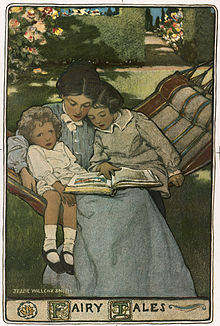
A picture book combines visual and verbal narratives in a book format, most often aimed at young children. The images in picture books use a range of media such as oil paints, acrylics, watercolor, and pencil, among others. Two of the earliest books with something like the format picture books still retain now were Heinrich Hoffmann's Struwwelpeter from 1845 and Beatrix Potter's The Tale of Peter Rabbitfrom 1902. Some of the best-known picture books are Robert McCloskey's Make Way for Ducklings, Dr. Seuss' The Cat In The Hat, andMaurice Sendak's Where the Wild Things Are. The Caldecott Medal (established 1938) and Kate Greenaway Medal (established 1955) are awarded annually for illustrations in children's literature. From the mid-1960s several children's literature awards include a category for picture books.

fairy tale
A fairy tale (pronounced /ˈfeəriˌteɪl/) is a type of short story that typically features European folkloric fantasy characters, such asdwarves, elves, fairies, giants, gnomes, goblins, mermaids, trolls, or witches, and usually magic or enchantments. Fairy tales may be distinguished from other folk narratives such as legends (which generally involve belief in the veracity of the events described)[1] and explicitly moral tales, including beast fables.
fable
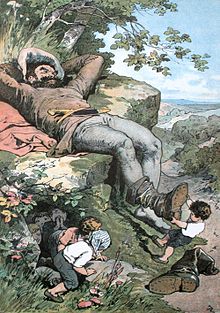
Fable is a literary genre. A fable is a succinct fictional story, in prose or verse, that features animals, mythical creatures, plants, inanimate objects or forces of nature which are anthropomorphized (given human qualities such as verbal communication), and that illustrates or leads to an interpretation of a moral lesson (a "moral"), which may at the end be added explicitly in a pithymaxim.

nursery rhyme
A nursery rhyme is a traditional poem or song for young children in Britain and many other countries, but usage only dates from the late 18th/early 19th century and in North America the term Mother Goose Rhymes, introduced in the mid-1700s, is still often used.

fantasy
Fantasy is a genre of fiction that commonly uses magic and other supernatural phenomena as a primary plot element, theme, or setting. Many works within the genre take place in imaginary worlds where magic and magical creatures are common. Fantasy is generally distinguished from the genres of science fiction and horror by the expectation that it steers clear of scientific and macabre themes, respectively, though there is a great deal of overlap between the three, all of which are subgenres of speculative fiction.
In popular culture, the fantasy genre is predominantly of the medievalist form. In its broadest sense, however, fantasy comprises works by many writers, artists, filmmakers, and musicians, from ancient myths and legends to many recent works embraced by a wide audience today.

realistic fiction
Literary realism is part of the realist art movement beginning with mid nineteenth-century French literature (Stendhal), and Russian literature (Alexander Pushkin) and extending to the late nineteenth and early twentieth-century.[citation needed] Literary realism, in contrast to idealism, attempts to represent familiar things as they are.[1] Realist authors chose to depict everyday and banal activities and experiences, instead of using a romanticized or similarly stylized presentation. Literary critic Ian Watt, however, dates the origins of realism in United Kingdom to the early 18th-century novel.[2] Subsequent related developments in the arts are naturalism, social realism, and in the 1930s, socialist realism.
 Bildungsroman
In literary criticism, a Bildungsroman (German pronunciation: [ˈbɪldʊŋs.ʁoˌmaːn]; German: "novel of formation/education/culture"),[a] novel of formation, novel of education,[2]or coming-of-age story (though it may also be known as a subset of the coming-of-age story) is a literary genre that focuses on the psychological and moral growth of theprotagonist from youth to adulthood (coming of age),[3] and in which, therefore, character change is extremely important.[4][5]
onomatopoeia
An onomatopoeia (/ˌɒnɵmætəˈpiː.ə/ or (chiefly NZ) /-ˈpeɪə/,  pronunciation (US) (help·info); from the Greek ὀνοματοποιία;[1] ὄνομα for "name"[2] and ποιέω for "I make",[3] adjectival form: "onomatopoeic" or "onomatopoetic") is a word that phonetically imitates, resembles or suggests the source of the sound that it describes. Onomatopoeia (as an uncountable noun) refers to the property of such words. Common occurrences of onomatopoeias include animal noises such as "oink", "miaow" (or "meow"), "roar" or "chirp". Onomatopoeias are not the same across all languages; they conform to some extent to the broader linguistic system they are part of;[4][5] hence the sound of a clock may be tick tock in English, dī dā in Mandarin, or katchin katchin in Japanese.
Although in the English language the term onomatopoeia means the imitation of a sound, in the Greek language the compound word onomatopoeia (ονοματοποιία) means "making or creating names"[6]. For words that imitate sounds the term Ηχομιμητικό (echomimetico or echomimetic) is used. Ηχομιμητικό (echomimetico) from Ηχώ meaning "echo or sound" and μιμητικό meaning "mimetic or imitation".


