〈Fireflies, Fly On:The Nanzhuang Ri A-Guai Anti-Japanese Uprising〉2
by Chen Ching-Yang
This novel has been adapted into a feature film screenplay.
The film adaptation rights are available for USD 1,000,000.
For licensing inquiries, please contact:
Chen Qingyang
📧 54088rabbit@gmail.com
Chapter One: K’bus in April
K’bus in April is like a beautiful, moving song-poem.
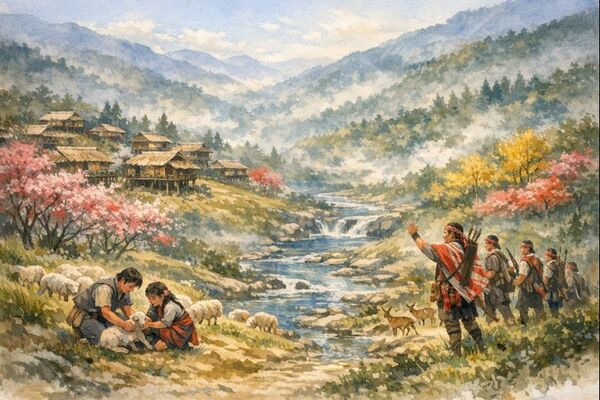
At dawn, mountain mist fills the entire valley. Scattered across the upland terrace are more than a hundred stilted houses—this is an Atayal tribal settlement. Apart from the crisp calls of birds, wild deer move silently through the forest. As the slanting morning sun pours into the valley, Atayal children drive their flocks of sheep up the gentle slopes. At this hour, fiery-red mountain cherry blossoms are interwoven among groves of ginkgo trees, like patches of burning wildfire.
The Han people call this place “Luchang”—the Deer Grounds. Waterways thread through the area, with tributaries of the Dong River winding through the center. Clear streams murmur as they flow, forming deep ravines, meandering channels, and elevated river terraces. Layer upon layer of emerald-green mountains rise around it, creating a landscape like a paradise beyond the world.
Luhu Creek originates from Luchang Mountain, flows northward along the western edge of the Luchang terrace, and joins Fengmei Creek from Jiali Mountain and Bilin Creek from Bilin Mountain. From that point onward it is known as the Upper Gang River, also called the Dong River; downstream it becomes the Zhonggang River. The Atayal people call this place “K’bus,” meaning a land where wild deer roam.
At the foot of the mountains, Ri Chang-Fu and his younger sister Mei-Lan are busy inside a sheep pen, helping two ewes deliver their lambs.
Across the valley, Walis Beling, the deputy headman of Luchang Village, wears a red-and-white striped Atayal warrior’s garment. A longbow is slung diagonally across his shoulder as he leads more than a dozen young men of similar age into the mountains to hunt deer.
From across the valley, Beling waves to the siblings.
“Brother Chang-Fu, Mei-Lan—good morning!”
“We’re helping ewes give birth,” Chang-Fu calls back as he stands. “Where are you off hunting so early, Beling?”
“Yes!” Beling replies loudly. “Taking these youngsters into the mountains to gain experience and sharpen their hunting skills. Mei-Lan, when we return, I’ll leave the deerskins with you—could you sew me a small vest?”
“Of course. May you have good fortune!” Mei-Lan waves in reply.
Every year from April to May is the lambing season. During this time, Mei-Lan helps deliver lambs and fawns at the pastures of Luchang and Dong River villages. At twenty years of age, Mei-Lan is youthful and radiant, blossoming into a graceful beauty. She is the cherished jewel of Ri A-Guai, the supreme chief of Lianxing Village.
By evening, Beling’s hunting party returns with three deer and one wild boar.
In the small plaza before the meeting hall, Chang-Fu and Mei-Lan sit around a bonfire with Beling and dozens of Atayal youths. They drink millet wine, eat roasted venison, and celebrate the “Festival of Flowing Fire”—the village’s festival of love for unmarried youth.
The young men place fireflies inside bamboo tubes carved with their clan totems, fastening them at their waists as they dance. At the right moment, they present the glowing bamboo tubes to the girls they admire, singing love songs to express their feelings. If a girl does not wish to accept a suitor’s affection, she lifts the bamboo-leaf lid and lets the fireflies fly away.
Tonight, three bamboo tubes rest beside Mei-Lan. One by one, she lifts their lids.
For Beling, it seems this year brings disappointment once again.
After night falls, black-winged fireflies, striped fireflies, mountain-window fireflies, and orange fireflies drift through the valley, carrying tiny lanterns. Their luminous trails flicker like cold stars scattered across the dark forest.
By the dying embers of the bonfire, Beling drinks alone, brooding.
It has been the same for the second year in a row.
Chapter Two: The Japanese Arrive at the Village
Three Japanese men, dressed in dark blue short-sleeved jackets and gray hakama-style trousers, long samurai swords hanging at their waists, travel by ox cart along the left bank of the Zhonggang River valley. They are led by Liu Jin-Cai, a Hakka deerskin merchant, and are heading upstream toward Shilihing Settlement, a Saisiyat village.
This area is a narrow river-valley plain. At this season, the fields lie fallow, and wild billygoat weed stretches across the land like a sea of purple flowers. The time is October 1895, shortly after the Qing court ceded Taiwan to Japan.
As the four approach the wooden village gate archway, flanked by fences woven from thick bamboo, their arrival immediately stirs unrest among the villagers. They are stopped by young warriors guarding the entrance. Liu Jin-Cai, who has long traded deerskins and frequently traveled among nearby Saisiyat and Atayal villages around Nanzhuang, is well acquainted with the locals.
“Master Liu,” says the guard Wadan, eyeing the three Japanese who resemble wandering rōnin, “what brings you here with these Japanese men?”
Smiling, Liu replies, “Wadan, these three are representatives of the Mitsui Company’s Zhunan District branch. They’ve come to speak with the chief about business. They don’t know the roads, so they asked me to guide them.”
Wadan frowns. “Master Liu, you know Lianxing Village has never liked dealing with Japanese. The chief won’t receive them. You’d best take them back.”
Looking slightly awkward, Liu answers, “Please don’t say that. Guests are guests. The Japanese now rule Taiwan—we cannot avoid dealing with them.”
He reaches into his robe and produces two cigarette cases. “Just a small token. Please accept them.”
Handing the cases to Wadan and Chaisang, Liu adds warmly, “These company representatives sincerely wish to discuss cooperation in forestry development and camphor production. No matter what, please inform the chief.”
“Very well. Wait here while I report it,” Wadan says, turning toward the village.
While waiting, Liu turns and quietly speaks in Japanese with Miyamoto Takeo, the leader of the group, informing him that they may soon meet Chief Ri A-Guai.
Before long, Wadan returns. “The chief is willing to receive you. Follow me.”
Liu clasps his hands in thanks. “Much obliged, Wadan.”
“Before entering, the guests must surrender any weapons,” Wadan reminds them.
“No problem. I’ll tell them,” Liu says, turning to speak with the three men, who promptly hand over their swords to Chaisang for safekeeping.
“Please follow me.”
They pass through a long stone path bordered by orange-jasmine hedges, winding through rows of thatched stilt houses. Soon they reach a grand courtyard residence enclosed by tall granite walls—remarkably imposing for such a remote place. This is the residence of Chief Ri A-Guai.
The three Japanese notice that each outer stone wall is lined with two rows of evenly spaced gun ports. From the outside, the compound resembles a fortified stronghold. Four imposing guards stand at the main gate. Above it hangs a cypress-wood plaque inscribed horizontally in Han clerical script with three bold characters: “Lianxing Village.” The inscription bears the signature of the former Governor of Taiwan, Liu Mingchuan.
Led inside, they enter a series of three courtyards. The first contains the main hall. Ri A-Guai sits inside with two elders, four formidable guards standing nearby. Leaning back in a grand armchair, his hair graying, a long beard flowing, Ri A-Guai draws slowly on a water pipe. Behind him hangs the skin of a black bear, its massive head baring its teeth. In the flickering lamplight, it appears ferocious.
Wadan steps forward and bows. “Chief, the guests have arrived.”
Ri A-Guai gestures for him to withdraw.
Liu Jin-Cai bows with clasped hands. “Chief, thank you for granting an audience. These three gentlemen represent the Mitsui Company’s Zhunan branch. They have come especially to seek cooperation with you in forestry development and camphor production.”
Ri A-Guai’s face darkens as he exhales a ring of smoke. “Lianxing Village has only done business with Han merchants and Westerners. We have no intention of dealing with Japanese.”
Smiling politely, Liu replies, “Chief, forgive my frankness. Times have changed. The Qing court has ceded Taiwan to Japan. The Japanese are now in control. As the saying goes, those who understand the times are the wise. We cannot conduct business without engaging them.”
Ri A-Guai exhales slowly, lowers his gaze, and remains silent for a long moment as all eyes rest on him.
Finally, he gestures to the seats. “Please, sit.”
Once seated, Liu continues, “Mitsui is financially powerful, with distribution networks throughout East and South Asia. They see great potential in our local camphor and timber industries. Through me, they sincerely express their wish to cooperate with you in developing these resources and creating shared prosperity. I urge you to give this rare opportunity careful consideration.”
“Master Liu,” Ri A-Guai replies, “from a business standpoint, I would not turn away opportunity. But now that Japan rules Taiwan, Japanese companies inevitably have government backing. If they fail to honor their word, Lianxing Village may suffer losses with no justice to be had. That is my chief concern.”
He pinches tobacco into his pipe and takes two deep puffs.
“We have no choice but to trade with Japanese companies,” Liu explains. “As for dealing with the authorities, it is unavoidable if goods are to flow smoothly. As long as we remain cautious, they cannot easily take advantage of us.”
Ri A-Guai nods. “That is true. Still, this matter is重大. I must consult the other village leaders before giving a formal reply.”
“No rush,” Liu smiles. “What matters is making a beginning.”
He rises and introduces the guests. “This gentleman to your right is Miyamoto Takeo, director of Mitsui’s Zhunan branch. To his left is Manager Ōhashi. Behind them is Saku Nobuo, the company secretary—he is fluent in Chinese.”
Each man stands, removes his hat, and bows.
Ri A-Guai looks with mild surprise at Nobuo. “Oh? Secretary Nobuo speaks Chinese?”
Nobuo bows respectfully. “It runs in the family. I have learned the language.”
Liu adds, “While Your Excellency considers this cooperative venture, Director Miyamoto requests that Secretary Saku Nobuo remain here to facilitate communication between both sides. Would that be acceptable?”
Ri A-Guai taps his pipe. “Very well. Let the secretary stay. I will have my people arrange his lodging and meals. In half a month, he may carry my message back.”
Chapter Three: First Encounter with Ri Mei-Lan
Ri A-Guai had three sons and one daughter.
His second son, Ri Chang-Fu, was in charge of forestry operations, overseeing timber felling, reforestation, the breeding of sika deer, and the harvesting of mountain produce.
The eldest son, Ri Chang-Sheng, managed production at the camphor refinery.
The third son, Ri Chang-Gui, handled the marketing and trade of camphor, timber, and deerskins.
The youngest child, Ri Mei-Lan, took care of household affairs and was highly skilled in weaving, sewing, and other traditional women’s crafts.
Saku Nobuo moved into the east wing of Ri A-Guai’s courtyard residence, where he was received and hosted by Ri Chang-Gui.
On the surface, Saku Nobuo’s mission was to act as the Mitsui Company’s liaison, awaiting Ri A-Guai’s decision. In secret, however, he was tasked with gathering intelligence and assessing the scale of Ri A-Guai’s enterprises. Director Miyamoto had told him this was a standard investigative procedure before selecting business partners, and Nobuo naïvely believed that was all there was to it.
That morning, in the main hall of Ri A-Guai’s residence, Saku Nobuo met Ri Mei-Lan for the first time—the “beautiful maiden of Nanzhuang” spoken of by the deerskin merchant Liu Jin-Cai.
“Did you sleep well last night, Nobuo-kun?” Chang-Gui asked warmly.
“I slept very well. Nights in the mountains are refreshingly quiet—just like my hometown, Kyoto,” Nobuo replied, full of energy.
“Kyoto?” Chang-Gui’s eyes lit up. “I hear it’s an ancient city steeped in culture and refinement.”
“Yes,” Nobuo nodded. “Much like Chang’an or Luoyang of the Qing Empire—centers of flourishing civilization.”
“Unfortunately, when I went to the Qing Empire, I only stayed in Beijing for a few years and never visited Chang’an or Luoyang.”
Nobuo smiled. “I’ve only heard of them from my elders as well. I’ve never been there myself.”
As they spoke, Mei-Lan entered the hall.
“Mei-Lan, perfect timing,” Chang-Gui beckoned her over. “Let me introduce someone.”
She walked toward them with a gentle smile. Her youthful vitality seemed to radiate like a secluded mountain orchid.
Nobuo froze for a moment, his eyes widening as he stared at her. Realizing his reaction was improper, he quickly straightened himself and took a deep breath.
“This is Mr. Saku Nobuo, secretary of the Mitsui Company—a well-traveled and talented young gentleman,” Chang-Gui introduced solemnly.
Nobuo stood and bowed. “A pleasure to meet you.”
“Nobuo-kun,” Chang-Gui added, “this younger sister of mine is my father’s treasured jewel. But she’s gentle by nature and has none of the spoiled airs of a pampered lady.”
Mei-Lan smiled quietly without replying. She was accustomed to encountering merchants from many regions in this hall, and she merely noticed that this Japanese guest dressed differently from Han traders.
Blushing slightly, Nobuo said, “Your sister is naturally beautiful. I lost my composure just now.”
“You flatter her,” Chang-Gui replied cheerfully.
“No, truly,” Nobuo said earnestly. “Miss Mei-Lan’s grace and sweetness are like a hidden valley orchid—enough to unsettle any man.”
Chang-Gui laughed heartily. “A ‘hidden valley orchid’—what a novel compliment!”
Turning to Mei-Lan, he said, “I need to make a trip to Hsinchu Prefecture shortly. I’ll leave Mr. Saku in your care.”
“Very well. Go ahead,” Mei-Lan replied.
Her voice, clear and melodious like a warbler emerging from the valley, washed over Nobuo’s ears like spring water from a mountain stream.
“Take Mr. Saku to see the forest first,” Chang-Gui instructed, “then arrange a visit to the camphor works.”
They strolled together along a shaded forest path.
Waving a slender green bamboo branch, Mei-Lan pointed toward the woods. “In this forest, you can see sambar deer at any time. Occasionally muntjac, mountain goats, and wild boars appear as well.”
“I noticed traces of them along the way,” Nobuo said curiously. “They don’t seem afraid of people here.”
Mei-Lan smiled sweetly. “Because every one of them is my darling.”
“Oh?” Nobuo widened his eyes. “How so?”
“Every sambar deer, muntjac, and mountain goat here was delivered by my own hands.”
Nobuo looked astonished. “Really? You’re so young—it’s hard to imagine you’re already such an experienced midwife.”
“When I was ten, my second brother taught me how to assist in deer births. I’ve loved it ever since.”
“Could you tell me more about how you do it?”
“In the late stages of pregnancy, we move the does and newborn fawns to nearby pastures,” Mei-Lan explained calmly. “That way we protect them from black bears and clouded leopards, and we can also check for complications like malposition or stillbirth.”
“Are black bears and clouded leopards common here?” Nobuo asked.
“They appear quite often. Our patrols frequently find them caught in traps.”
“And what do you do with such fierce beasts?” Nobuo asked, arms folded in fascination.
“You guess,” Mei-Lan teased, playing with her long braid.
“Kill them and skin them?” Nobuo gestured instinctively.
“Why would you think of something so cruel?” Mei-Lan asked in surprise.
“Isn’t there a bear skin hanging in your hall?” Nobuo asked.
“That’s a misunderstanding,” Mei-Lan smiled. “That bear was poached by outsiders and confiscated by our patrol.”
“What do you do with the captured beasts, then?”
“We leave them in the trap without food for several days. Once they’re too weak to resist, the patrol binds them, brands their foreheads with a firearm mark, feeds them, and releases them.”
“A lesson learned,” Nobuo nodded. “Aren’t you afraid they’ll return?”
“They usually don’t. One painful lesson is enough.”
“Is that really so?”
“Yes. For beasts—and for people, too.”
She tapped the bamboo lightly against the grass.
Nobuo nodded thoughtfully. “Perhaps so.”
For a moment, neither spoke. Nobuo studied her slender figure, her words echoing in his mind, sensing a maturity beyond her years.
“What are you thinking, Mr. Saku?” Mei-Lan asked.
“Oh—nothing,” he replied hastily, turning away.
“This month’s Pasta’ay—the Dwarf Spirit Festival—is approaching,” Mei-Lan said gently.
“I’ve heard of it from Director Miyamoto—the grandest annual festival of the Saisiyat people,” Nobuo said eagerly.
“You’re welcome to stay and witness it.”
“To be invited by you personally is my honor,” Nobuo bowed. “Could you tell me its origins?”
Mei-Lan sat on a nearby rock and began to tell the ancient legend…
Chapter Four: The Council of Chiefs
The main hall of Ri A-Guai’s residence was filled to capacity. Chiefs, village heads, and elders from the various settlements of Lianxing—Donghe, Erping, Danan, and Luchang—had gathered for council.
“Those summoned today should already know the matter to be discussed,” Ri A-Guai began succinctly.
“We cannot trust the Japanese,” Danan chief Dalagu Rumi spoke first. “If we must trade with them, we must be extremely cautious. I fear Lianxing will soon be swallowed by their companies.”
“If disputes arise, the Japanese authorities will never side against their own,” added Zhan Bai-Sheng, headman of the Hakka Erping settlement. “We will be the ones to suffer.”
Ri A-Guai turned to his son. “Chang-Gui, you oversee our trade. Share your assessment.”
Chang-Gui analyzed calmly, outlining Japan’s monopolization of trade routes and the looming loss of bargaining power. Heads nodded in agreement.
Beling spoke next. “Even if we refuse now, they’ll pressure us later through official power.”
A heavy silence followed.
“Old Instructor,” Ri A-Guai asked Lin Yong-Nian, “what do you think?”
“We must prepare ourselves,” the old man replied. “Step carefully. Guard against them at every turn.”
At last, Ri A-Guai concluded, “We will invite Japanese officials and Mitsui representatives to attend this year’s Dwarf Spirit Festival. Let them see our strength.”
The hall erupted in unified shouts, fists raised.
下一則: 〈A Love Letter from Lhasa〉6


