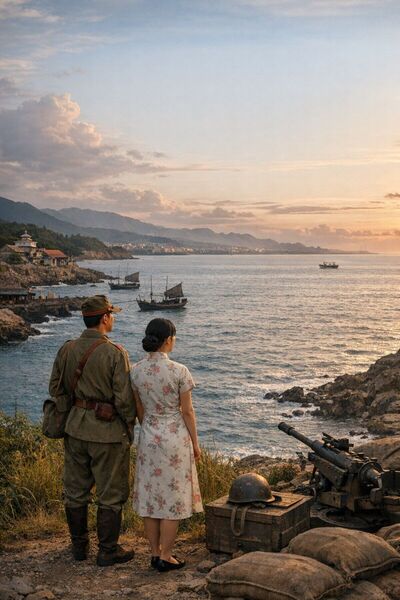
You Must Come Back Alive 1
by Chen Chin
This novel has been adapted into a feature film screenplay.
The film adaptation rights are available for USD 1,000,000.
For licensing inquiries, please contact:
Chen Qingyang
📧 54088rabbit@gmail.com
In 1895, with the outcome of the First Sino-Japanese War already decided, Taiwan and the Penghu Islands—severed from their motherland by an unequal treaty as if their umbilical cord had been cut alive—were reduced to colonies of the rising imperial power next door, Japan. The encounter between Japanese and Taiwanese peoples, divided by ethnicity and class, was destined to generate countless conflicts and stories of joy and sorrow. Over the long half-century of colonial rule, blood- and tear-stained dramas unfolded again and again.
The temporal and spatial setting of this story begins in 1920 in a prominent family of Qingshui Street, Taichung Prefecture, centering on the lives and deeds of the brothers Yang Zhaojia and Yang Zhaohua, and using the experiences of Zhaohua’s son, Yang Xintai—his studies in Tokyo and his later conscription to Malaya—as the narrative backbone.
During the period of Japanese rule, Taiwan was governed by the Governor-General’s Office. In Qingshui Street, Taichung, Yang Zhaojia was a rising young local leader. In 1920 (the 9th year of the Taishō era), the Japanese government implemented local administrative reforms, establishing an interdependent relationship between administrative districts and local public bodies. Yang Zhaojia became the first mayor of Qingshui Street under the new system. At only twenty-five, he began to contemplate how to make a meaningful impact.
An incident in the street market—where a Japanese couple cheated local vendors—sparked controversy when the police sought to shield their compatriots. Driven by a strong sense of justice, Yang Zhaojia stood up for a fish vendor nicknamed Huolong, even going so far as to organize a market strike and three days of street demonstrations. His actions won broad sympathy and support from local residents, drawing the attention of the district governor Abe and Police Chief Hashimoto. As a result, police abuses of power were curbed, and a local mediation committee was established to handle civil and commercial disputes in Qingshui Street.
Another local gentry figure, Cai Huiru, lived in Aofeng Town, Qingshui Street. Along with Lin Xiantang and Chiang Wei-shui, he was active in the Taiwanese New People’s Association. Lin and Chiang planned to establish a Taiwanese-led civic organization called the Taiwan Cultural Association, and through Cai Huiru they invited Yang Zhaojia to join. Though Yang hesitated at first because of his official post, encouragement from his elder brother Yang Zhaohua—a physician—convinced him to participate.
Yang Zhaohua, who studied medicine at Tokyo Imperial University, excelled academically and won the affection of his mentor Nishikawa Takashi’s beloved daughter, Riko. After marriage, the couple returned to Taiwan, where Zhaohua opened the Yang General Hospital in Qingshui Street. They had one son, Yang Xintai. One day after school, Xintai was kidnapped by an opium addict named Chen Qiu, who demanded ransom. When the family reported the case, Police Chief Hashimoto mobilized his force to pursue the culprit. Realizing the danger, Chen Qiu released Xintai without collecting ransom and was promptly arrested.
The case attracted the attention of Inspector Fukuda Sakae. Chen Qiu’s crime stemmed from his lack of money to purchase opium, while the local opium den Fangming House—protected by a thug nicknamed Black Dog—had recently beaten another addict, Li Zixian, to death. Inspector Fukuda regarded Fangming House as a major threat to public order. After persuading Hashimoto, he tightened surveillance of the den while enlisting Yang Zhaohua’s hospital to establish an opium rehabilitation clinic, addressing both symptoms and root causes. This strategy eventually forced Fangming House to close, restoring peace to the area.
As Taiwanese intellectuals gradually awakened, movements for local self-governance and democracy gained momentum. At Lin Xiantang’s residence in Wufeng, members of the Taiwan Cultural Association decided to form a formal political organization to unite like-minded people across the island. Yang Zhaojia drafted the organization’s charter, and Shi Huanchang traveled to Taipei to submit the registration. Spirits were high and unity strong. However, at the Taipei Prefectural Police Headquarters, Director Sato Chiki’s response was pessimistic, noting that after the departure of the enlightened former director Shimomura Hiroshi, the new official Kaku held a different stance.
In February 1923, the Taiwan Parliament Petition League convened its first assembly, which was banned on the pretext of violating the Public Security Police Law. Cai Peihuo, Chiang Wei-shui, Lin Chenglu, and Chen Fengyuan carried a petition to Tokyo, where they gained support from local Taiwanese students. They decided to relocate the league’s headquarters there, successfully registering it with the Waseda Police Station through Lin Chenglu.
This angered the Governor-General’s Office. Chief Administrator Kaku and Police Bureau Director Maruo Shinpei sought to make an example of the movement. On December 16, under the “Police Regulations,” they arrested key members including Chiang Wei-shui, Cai Peihuo, Cai Huiru, Lin Chenglu, Shi Huanchang, Lin Youchun, and Chen Fengyuan, sentencing them to three to four months each. Though the news spread fear across Taiwan, unexpected support from Japanese media, officials, scholars, and youth rallied behind Taiwan’s democratic movement. The Governor-General’s image suffered greatly, and the parliamentary movement was effectively cleared of its unconstitutional stigma.
In July 1937, the Marco Polo Bridge Incident triggered full-scale war between China and Japan. The Governor-General’s Office ordered a ban on Chinese writing throughout Taiwan and launched the imperialization movement. At the time, Yang Xintai was studying at Taichung First High School. His mixed Chinese-Japanese heritage made him particularly sensitive to ethnic identity. When a privately carried copy of Romance of the Three Kingdoms led to his being summoned for questioning, it awakened his sense of self and Taiwanese identity. Upon returning home, Xintai spoke with his mother Riko, who hoped he would later study medicine at Tokyo Imperial University and return to help manage his father’s hospital.
After graduating from high school, Xintai followed his parents’ wishes, bidding farewell to his childhood sweetheart Liao Meixiu and his classmates to study medicine in Tokyo. He lived with his maternal grandfather Nishikawa Takashi in Ueno. Meixiu worked as a teacher at Qingshui Public School, patiently waiting for Xintai’s return to marry her. In the Nishikawa household, Xintai took the name Nishikawa Tetsuhiko. Takashi’s adopted son Hironin and his wife Reiko had two daughters, Masako and Keiko. Masako, close in age to Xintai, often went out with him.
In December 1941, Japan attacked Pearl Harbor, igniting the Pacific War. Japanese forces advanced into Hong Kong, the Philippines, Malaya, and Singapore, aiming next at Burma. The rapid expansion of the “Southern Advance Policy” accelerated Japan’s assimilation policies in Taiwan, turning the island into a southern operations base. Through coercion and inducement, authorities launched a wave of forced name changes under the imperialization movement.
By the middle of the Pacific War, many young men in Japan were conscripted, and even Tokyo grew increasingly desolate. Worried about the future of the family line embodied in Nishikawa Tetsuhiko (Yang Xintai), Nishikawa Takashi entrusted him to his prized student Matsushita Daisuke, head of surgery at the Imperial University medical school. Takashi hoped Matsushita would pass on his medical expertise and, as a major general in the Army Medical Corps, use his influence to protect Xintai.
Takashi’s wife Michiko proposed arranging a marriage between Masako and Xintai to secure an heir for the Nishikawa family. Masako, having grown attached to Xintai, willingly accepted the sacrifice. Though Riko Nishikawa and Yang Zhaohua felt uneasy, parental pressure forced their acquiescence. Xintai initially resisted, but when struck by sudden illness and touched by Masako’s devoted care, he agreed. Witnessed by Matsushita, the two became husband and wife. To spare Meixiu humiliation, the family kept the marriage secret. The following year, Masako gave birth to twins, and the Nishikawa household enjoyed a brief period of harmony.
Back in Taiwan, Meixiu often helped at the hospital. As patient numbers grew, she resigned from teaching and, at Yang Zhaohua’s invitation, became head nurse of the inpatient ward. Her father Wu-xiong was pleased, believing that marrying a doctor would secure her future. In contrast, Meixiu’s brother Yingjun was irresponsible, bullying villagers with his cronies and provoking a local gambling boss, Xu Laizhi. Though he narrowly escaped retaliation, Wu-xiong sought mediation from Qingshui Mayor Cai Dengke. Once a local tough himself, Cai Dengke had been recommended by Yang Zhaojia and supported by Dajia Sub-prefect Dohi Shinichi to become mayor. Grateful, Wu-xiong later invited Cai to serve as matchmaker at Meixiu’s wedding.
In October 1943, Xintai passed the medical licensing exam. Riko traveled to Tokyo to bring him home. Masako wished to return with him, but due to frequent Allied bombings around Qingshui, Riko persuaded her to remain in Tokyo to raise the children, Nenta and Kikuko. Back in Taiwan, Xintai joined his father’s hospital, and Meixiu became head nurse of his surgical team. Together they treated many wounded Taiwanese soldiers returning from the front, deeply affecting them both.
When conscription expanded island-wide, Yingjun sought to avoid enlistment. To protect his only son, Wu-xiong arranged for Yingjun and his men to go to Xiamen to learn business from a cousin. Yingjun, however, reverted to violence, injuring someone in a brawl. Wu-xiong rushed to Xiamen to bribe Detective Du Jincheng, only to have Du invite Yingjun to join a covert intelligence unit destined for underground operations in Taiwan.
In March 1945, Xintai received his call-up order. Through Matsushita’s arrangements, he was sent to a battlefield hospital in Malaya. En route, his ship was sunk, and Xintai fell into the sea, listed as missing. He was rescued by Zhang Zhiling, a teacher at a local orphanage in Johor, but lost his memory due to injuries. Matsushita posted reward notices seeking him. From these, Zhiling learned Xintai’s identity. When an air raid injured an orphan named A-wen, Xintai agreed to return to the military hospital under Matsushita in exchange for medical treatment for the child.
As a military doctor, Xintai’s upright character offended Artillery Battalion Commander Suzuki Takeo. Suzuki’s uncle, General Kawano, visited to inspect the hospital, resolved the conflict, and announced that with Allied landings imminent, the hospital would relocate to an abandoned underground bunker. Near the orphanage, wounded soldiers found comfort in the children’s innocence, while the children helped with chores in exchange for snacks. Amid war, an unexpectedly warm haven emerged.
As General Kawano’s forces retreated, he ordered withdrawal from Xingan Mountain into the jungle, removing medical staff as well. Xintai volunteered to stay, caring for nearly a hundred severely wounded soldiers with the orphans. When U.S. forces discovered the bunker and attempted entry, Mother Mary negotiated with them. With the children’s help, the wounded were spared. Within a month, the hospital relocated back to Johor Bahru, renamed the Allied Malayan Field Hospital. Locals returned, Zhiling became director of a new Chinese school, and the orphans were resettled. Fluent in English, Xintai was promoted to major and served as an English-Japanese interpreter.
As the war neared its end, Xintai and Zhiling, bound by hardship, grew close. His memories of Masako and Meixiu had yet to return. In May, they visited the ruins of the former orphanage at Kunlai Fishing Village, walking hand in hand among the wreckage, recalling their days sheltering from air raids. Xintai promised to take Zhiling home. Yet on Taiwan’s distant shores in Qingshui, the devoted Meixiu still knew nothing of Xintai’s fate, her sorrow unanswered but by the heavens.
Xintai returned to Taiwan with Zhiling and her family. Though Yang Zhaohua had received Xintai’s letters, the marriage was already a fait accompli, leaving the parents distressed over how to face Wu-xiong and Meixiu. Learning of Xintai’s new marriage, Wu-xiong felt deeply wronged on Meixiu’s behalf and refused reconciliation. Yingjun, now Qingshui Police Chief, sought revenge, framing Xintai on charges of collaborating with bandits and attempting to have him executed. Wu-xiong opposed his son’s actions and tried to report the abuse of power but was blocked.
Yang Zhaohua urgently telegraphed Zhiling’s father Zhang Youcai, asking him to use his intelligence connections to rescue Xintai. Youcai enlisted former subordinate Tian Yingjie, who arrested Yingjun and uncovered evidence of abuse, removing him from office. Wu-xiong pleaded for his son’s release. Considering the circumstances, Youcai agreed. The Yang and Liao families reconciled, and Zhiling and Meixiu became friends.
By late 1945, Nationalist troops stationed in Qingshui clashed with locals amid poor discipline. The February 28 Incident swept across Taiwan, reaching Qingshui. Local militia led by Cai Dengke and his brother fought government forces, eventually retreating. To protect his son, Yang Zhaohua sent Xintai and Zhiling to Lion Islet to avoid the White Terror. Though they escaped persecution, Xintai remained unable to return home, gazing northward across the sea, longing for Taiwan.
(End)