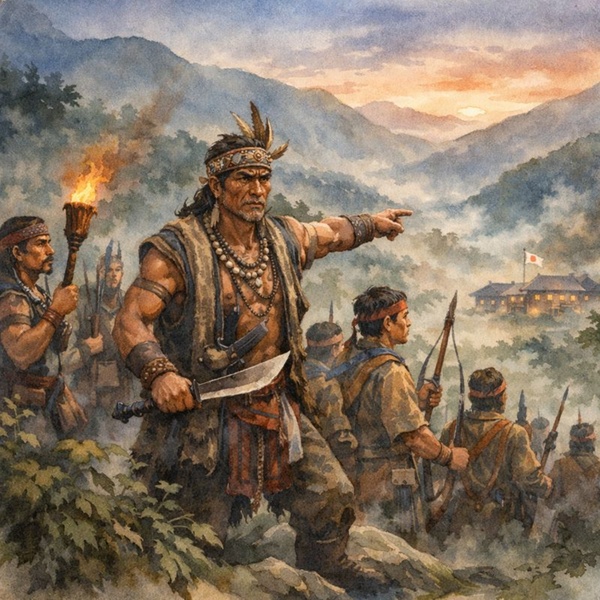
〈Fireflies, Fly On:The Nanzhuang Ri A-Guai Anti-Japanese Uprising〉1
by Chen Ching-Yang
This novel has been adapted into a feature film screenplay.
The film adaptation rights are available for USD 1,000,000.
For licensing inquiries, please contact:
Chen Qingyang
📧 54088rabbit@gmail.com
Table of Contents
- Creative Concept ........................................ 2
- Story Synopsis .......................................... 3
- Character List .......................................... 6
- The Novel .............................................. 10
1. Creative Concept
The “Nanzhuang Ri A-Guai Anti-Japanese Uprising” took place in 1902—twenty-eight years earlier than the more widely known 1930 “Wushe Incident led by Mona Rudao.” Yet Ri A-Guai’s resistance movement remains little known, with limited historical records and scholarly discussion. Through long-term field research, interviews with local elders, and on-site investigations of several former battlefields, the author has gradually reconstructed this Indigenous anti-colonial uprising from more than a century ago.
Ri A-Guai was a legendary figure of the Saisiyat people. Originally Han Chinese, he came to Taiwan with his parents at the age of eight. After landing at the Zhonggang River (present-day Zhunan), his parents died from illness caused by the unfamiliar climate. He was temporarily raised by a relative, who later sold him to a Saisiyat man, Ri Lai-You, as an adopted son. Gifted with keen intelligence, a resolute character, and strong leadership, Ri A-Guai earned deep respect among the Saisiyat and Atayal peoples, as well as the local Hakka community, and was acclaimed as supreme chief.
Taking Shilihing Settlement as his base, Ri A-Guai raised three sons and one daughter. His eldest son, Chang-Sheng, managed forestry operations, including logging, reforestation, sika deer breeding, and the collection of mountain products. The second son, Chang-Fu, oversaw camphor production. The third son, Chang-Gui, handled the marketing of camphor, timber, and deerskins. His youngest daughter, Ri Mei-Lan, managed household affairs and excelled in weaving and sewing.
The conflict was triggered by Japanese trading companies and merchants, backed by colonial authorities, who forcibly exploited camphor forests, timber, deerskins, and livestock in the Nanzhuang region. This predatory extraction intensified ethnic consciousness among the Indigenous peoples—primarily the Saisiyat and Atayal—and ultimately led to a large-scale armed confrontation, historically known as the “Ri A-Guai Anti-Japanese Incident.”
This novel dramatizes historical materials in a theatrical manner—remaining faithful to the spirit of historical truth without being constrained by literal documentation. The work guides readers back to the early years of Japanese rule in Taiwan, a period marked by brutal military and police repression and the reality of “official oppression forcing popular revolt.” Through portraying the bloodshed and sacrifice of Indigenous and Han communities who rose up against violent suppression and economic exploitation under colonial rule, this drama explores the root causes of resistance. It seeks to draw lessons from history, reminding future generations to cherish the hard-won fruits of democracy today.
2. Story Synopsis
Ri A-Guai was a legendary figure among the Saisiyat people. Originally Han Chinese, he arrived in Taiwan with his parents at the age of eight. After landing at the Zhonggang River (Zhunan), his parents succumbed to illness caused by the unfamiliar environment. He was raised by a relative, who later sold him to a Saisiyat man, Ri You-Lai, as an adopted son.
Exceptionally intelligent, strong-willed, and naturally gifted as a leader, A-Guai earned the deep admiration of the mountain peoples and was elected supreme chief of Lianxing Village. During the period of Japanese rule in Taiwan, camphor was regarded as a major source of colonial revenue. In 1896 (the 22nd year of the Guangxu reign), three Japanese businessmen entered the Nanzhuang mountains and signed a cooperative contract with Ri A-Guai for camphor and forestry development.
Saku Nobuo, fluent in Chinese, was retained in Lianxing Village by Miyamoto, director of the Mitsui Zhunan branch, to serve as liaison before the contract was finalized. Honest and sincere, Nobuo quickly gained the villagers’ trust. During his stay, he met Ri Mei-Lan and was instantly captivated by her beauty and grace.
Miyamoto intended to force Lianxing Village into submission through an unequal contract, but Nobuo strongly opposed the plan, even threatening resignation. Unable to coerce matters directly, Miyamoto—following the advice of manager Ōhashi—secretly appointed Nobuo as head of the Lianxing work station while deliberately sending him away. They then altered the contract clauses to seize control of the village’s assets.
As Nobuo and Mei-Lan’s romance deepened, Chang-Gui enthusiastically acted as matchmaker, and marriage was soon discussed. Around this time, coal deposits were discovered in the foothills of Jiali Mountain. Both Mitsui and Sumitomo corporations sought mining rights. To gain the upper hand and block Sumitomo’s expansion into Nanzhuang, Miyamoto, accompanied by local officials, brought the altered contract to confront Ri A-Guai.
When Miyamoto demanded full control over Lianxing Village’s industries, Ri A-Guai flatly refused. Nobuo appeared in time, denounced Miyamoto’s deceitful tactics, tore up the contract on the spot, and declared the work station independent of Mitsui. Miyamoto’s scheme collapsed, and Miyamoto, Ōhashi, Civil Affairs Director Nakasone, and Nanzhuang Garrison Commander Sanbon Seikichi were expelled from the village.
Grateful for Nobuo’s righteous stand, Ri A-Guai consented to his marriage with Mei-Lan. Nobuo’s reputation in Lianxing Village then reached its peak.
Sumitomo later secured mining rights for the Jiali coal mine and requested land from Lianxing Village to build a coal transport railway, which was refused. The company instead routed the railway from Hsinchu to Neiwān. After mining began, repeated accidents caused miner casualties due to poor management. Eventually, a gas explosion killed more than a hundred miners. Unable to handle the aftermath, Sumitomo avoided responsibility. Bereaved families, left without recourse, turned to Ri A-Guai for help.
Nobuo and Chang-Gui led the families to petition the local government, but officials lacked authority to compel Sumitomo’s response. Enraged, the families surrounded the residence of Ōshima, head of Sumitomo’s Kansai branch, forcing him to confront the issue.
Upon learning that Ōshima was being held by the victims’ families, the Nanzhuang Garrison dispatched armed police under Commander Sanbon Seikichi to rescue him and arrest more than a dozen so-called “troublemakers.” Entrusted by the families, Nobuo and Chang-Gui led a protest to the garrison headquarters demanding the villagers’ release. Sanbon ordered gunfire on the petitioners, killing several on the spot and arresting Nobuo and Chang-Gui.
Nobuo was soon released on bail through intervention by Mitsui’s chief director Fujii, but Chang-Gui was brutally tortured to death by Sanbon’s subordinates.
The killing of Ri A-Guai’s son Chang-Gui and the petitioners ignited widespread fury in Lianxing Village. Ri A-Guai united the Saisiyat, Atayal, and Hakka communities, assembling four to five hundred warriors, and in 1902 (the 28th year of Guangxu) launched an assault on the Nanzhuang Garrison. Japanese authorities responded by deploying thousands of regular troops equipped with modern weapons. The volunteer forces fought valiantly, but were ultimately defeated due to overwhelming odds. This conflict became known as the “Nanzhuang Incident,” also called the “Ri A-Guai Incident.”
Refusing to surrender, Ri A-Guai led a small group into the Jiali mountain region. Unfamiliar with the terrain, Japanese forces dared not pursue him. Living in seclusion, Ri A-Guai remained deeply despondent over his failure to defeat the Japanese. He died of illness in 1903 (the 29th year of Guangxu) at the age of sixty-four.
The Battle of Nanzhuang
Ri A-Guai — Never in Submission
I. March to War
Lilies are pinned to the tattooed chests of the warriors.
Millet wine is poured full;
farewell bamboo cups pass hand to hand through the ranks.
The shaman finishes the incantation,
sprinkling wild boar blood into the fire.
From the ashes, courage rises—
a thin, bloody smoke.
Majestic war songs echo through the valleys;
within those echoes, every heart swells
like a bowstring drawn tight.
Curved blades are raised over shoulders,
gleaming like torches in the morning sun.
Chief Ri A-Guai proclaims the crimes of the Japanese aloud:
“They are evil spider-demons in human guise,
spinning nets of law to ensnare us.
Yesterday they deceived us of our millet;
today they seize our land by force;
tomorrow they will tear open our flesh
and drink our blood to quench their thirst.”
II. Assault
The first arrow pierces an enemy’s chest,
finding its answer in a pool of blood.
The warriors charge toward the Nanzhuang garrison;
curved blades splash crimson.
My brother wipes the wine from the corner of his mouth,
a flush rising on his cheeks.
Alcohol carves his silhouette
into that of a fierce clouded leopard.
“These Japanese police tyrannize us in peacetime.
When we sever their heads,
mind and flesh are torn apart,
their shadows left behind to repent.
If I were that arrow loosed into the enemy’s chest,
I would sing with joy,
gulping blood in great mouthfuls.”
III. Father
After the bombardment,
on the smoke-choked forward line,
Father finds his final resting place.
I stand bewildered,
not knowing how life must burn
to release its hidden force.
As I touch Father’s charred body—
the trunk that once burned with fierce vitality—
his flesh, like crushed leaves,
splits open in despair.
Between his cheeks,
the tattoo seared by artillery fire
shines brighter than moon or stars.
The last glow of sunset spills through the clouds,
brushing green mountains and fertile plains near and far.
I begin to believe that only fearless sacrifice
can withstand the endless night,
illuminating this land
and its suffering people.
IV. Warriors
The warriors who fell in bloody combat
are gathered in by fallen leaves and moss.
Their souls seep into the dark soil;
after the spring rains,
new shoots thrust from the earth,
sharp as blades and spears.
Like vivid markers rising from memory,
they guide us on—
amid gunfire, beneath the massive shadows of cannon mouths,
unyielding as bedrock,
holding fast every mountain path and pass.
Resolute as morning stars resisting the night,
even when encircled by the enemy,
our altitude cannot be shaken.
As seasons turn, forests unfurl fresh green,
filled with love, hatred, death, and farewell.
My childhood was a vine climbing among shattered stones,
crawling and growing
through storms and cannon smoke.
I blacken my face with enemy blood,
drive my spear into their chests,
rip apart their entrails amid wild howls.
When I seize an enemy’s severed head
and stand upon the cliff,
I imagine myself—like a hawk—
coldly remembering,
before tearing and devouring
their flesh, sinews, and bones.
V. Lightning
War—this greedy hand—
repeatedly demands our kin and friends,
leaving us, like scarlet maples stripped bare after autumn,
to live exposed,
to taste loneliness and the vast desolation of heaven and earth.
Yet we will not cease resisting.
Our curved blades, keen and brimming with blood-spirit,
are fit to harvest millet
and the heads of our enemies alike.
Our blood mixes with the saltpeter of vengeance,
fierce beyond measure, violently surging.
People of the high mountains, descendants of fire—
we are meteoric stone that has never cooled,
burning into a roaring bonfire
on the dark horizon.
We are clouded leopards and black bears,
appearing and vanishing like ghosts,
tearing the enemy’s courage to shreds
within endlessly reverberating echoes.
Rending the overcast sky,
we are lightning in the mountains—
flashing in and out of sight,
yet never extinguished…
This poem won First Prize (Modern Poetry)
at the 2003 Miaoli County “Dream Blossom” Literary Awards.