04/24 青少年小說 Week 10 : Correct the Midterm Paper
2014/06/02 01:00
瀏覽612
迴響0
推薦0
引用0
- Mission in Araby : If I go I will bring you sth
- Bazaar is a fair and a retreat for the boy.
- Bazaar: A bazaar is a market and originates from the Middle Persian word Vāzār; a permanent enclosed merchandising area, marketplace, or street of shops where goods and services are exchanged or sold. Souq is another word used in the Middle East for an open-air marketplace or commercial quarter.
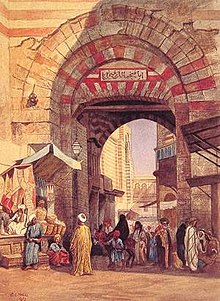
- England in the Middle ages: England in the Middle Ages concerns the history of England during the medieval period, from the end of the 5th century through to the start of the Early Modern period in 1485. When England emerged from the collapse of the Roman Empire, the economy was in tatters and many of the towns abandoned. After several centuries of Germanic immigration, new identities and cultures began to emerge, developing into predatory kingdoms that competed for power.
- chivalry(騎士精神): Chivalry is a code of conduct associated with the medieval institution of knighthood.
- Knight: Knights vowed to be loyal, generous, and "of noble bearing". Knights were required to tell the truth and respect the honour of women. Knights vowed to protect the weak and guard the honour of fellow knights. They were to obey those in authority, and to never refuse a challenge from an equal. Knights lived by honour and for glory. Knights were to fear God and maintain His Church. Knights always kept their faith and never turned their back on a foe. Knights despised pecuniary reward. They persevered to the end in any enterprise begun.
* King Arthur: King Arthur is a legendary British leader of the late 5th and early 6th centuries, who, according to medieval histories and romances, led the defence of Britain against Saxon invaders in the early 6th century. The details of Arthur's story are mainly composed of folklore and literary invention, and his historical existence is debated and disputed by modern historians.Arthur is a central figure in the legends making up the so-called Matter of Britain.
* Round Table: The Round Table is King Arthur's famed table in the Arthurian legend, around which he and his Knights congregate. As its name suggests, it has no head, implying that everyone who sits there has equal status. The table was first described in 1155 by Wace, who relied on previous depictions of Arthur's fabulous retinue. The symbolism of the Round Table developed over time; by the close of the 12th century it had come to represent the chivalric order associated with Arthur's court, the Knights of the Round Table.
- "One for all and all for one" fron The Three Musketeers
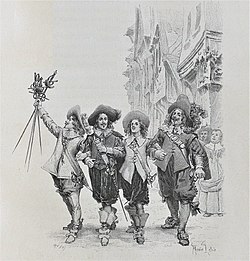
- Those knights help King Arthur because the brotherhood
=>brotherhood v.s. leadership - 石中劍 excalibur (ex- : out) : Excalibur is the legendary sword of King Arthur, sometimes attributed with magical powers or associated with the rightful sovereignty of Great Britain.
=> ephiphany (e-: out) - Feudalism封建制度 v.s. Catholicism天主教
1. Feudalism: It was a set of legal and military customs in medieval Europe that flourished between the 9th and 15th centuries. Broadly defined, it was a system for structuring society around relationships derived from the holding of land in exchange for service or labour.
2. Catholicism: It is a broad term for describing specific traditions in the Christian churches in theology and doctrine, liturgy, ethics and spirituality. For many the term usually refers to Christians and churches, western and eastern, in full communion with the Holy See, usually known as the Catholic Church or the Roman Catholic Church.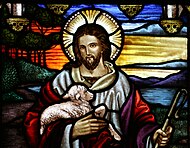
- The adoration to Virgin Mary (天主教 v.s. 新教徒)
=>尊重女性,聽命於國王: 騎士制度 - Elizabeth I: Elizabeth I (7 September 1533 – 24 March 1603) was queen regnant of England and Ireland from 17 November 1558 until her death. Sometimes called "The Virgin Queen", "Gloriana" or "Good Queen Bess", Elizabeth was the fifth and last monarch of the Tudor dynasty.
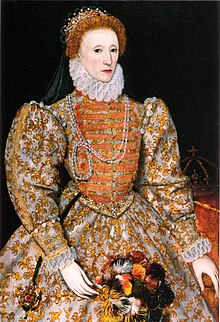
- The Faerie Queene: It is an incomplete English epic poem by Edmund Spenser.The Faerie Queene is notable for its form: it was the first work written in Spenserian stanza and is one of the longest poems in the English language. It is an allegorical work, and can be read (as Spenser presumably intended) on several levels of allegory, including as praise of Queen Elizabeth I.
- Edmund Spenser: He was an English poet best known for The Faerie Queene, an epic poem and fantastical allegory celebrating the Tudor dynasty and Elizabeth I. He is recognised as one of the premier craftsmen of Modern English verse in its infancy, and is often considered one of the greatest poets in the English language.
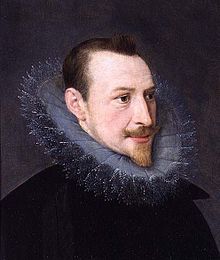
* Elizabeth I 實現騎士精神最極致 - Mary I of England: Mary I (18 February 1516 – 17 November 1558) was Queen of England and Ireland from July 1553 until her death. She is Elizabeth's sister. Her executions of Protestants caused her opponents to give her the sobriquet "Bloody Mary".

- Movie : Elizabeth: The Golden Age

- 神格化: Jesus (blind, crippled, 癩病)
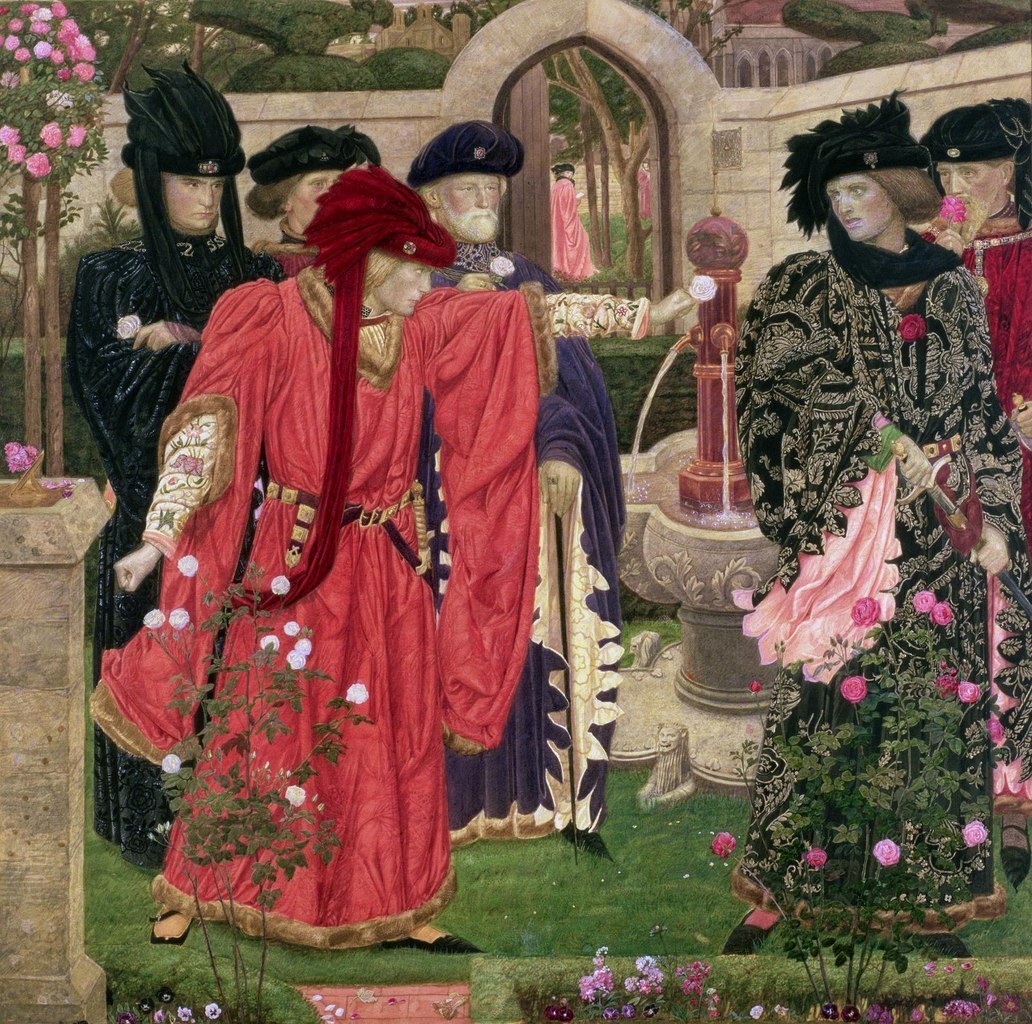
- Movie:Alice in Wonderland (1951 film) 用紅白玫瑰用了英國文學的典故

- Wars of the Roses: The Wars of the Roses was a series of dynastic wars for the throne of England. They were fought between supporters of two rival branches of the royal House of Plantagenet, the houses of Lancaster and York.
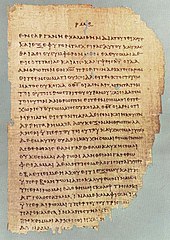
- no.7 Epiphany(holiday)主顯節:Epiphany which traditionally falls on January 6, is a Christian feast day that celebrates the revelation of God the Son as a human being in Jesus Christ.In the Church of England, the eve of the feast used to be celebrated as Twelfth Night. The Monday after Epiphany is known as Plough Monday.
- Book of Revelation (新約啟示錄):The Book of Revelation, often known simply as Revelation or the Apocalypse, is the final book of the New Testament and occupies a central place in Christian eschatology. Written in Koine Greek, its title is derived from the first word of the text, apokalypsis, meaning "unveiling" or "revelation."
- Movie: She's the Man (足球尤物): She's the Man is a 2006 American romantic comedy film directed by Andy Fickman, inspired by William Shakespeare's play Twelfth Night. The film stars Amanda Bynes, Channing Tatum, Laura Ramsey, and Vinnie Jones.

- 戲劇手法: overhead=> Epiphany(feeling): is an experience of sudden and striking realization. Generally the term is used to describe scientific breakthrough, religious or philosophical discoveries, but it can apply in any situation in which an enlightening realization allows a problem or situation to be understood from a new and deeper perspective. Epiphanies are studied by psychologists and other scholars, particularly those attempting to study the process of innovation.
- no.9 The Holy Grail: The Holy Grail is a dish, plate, stone, or cup that is part of an important theme of Arthurian literature. The Grail legend became interwoven with legends of the Holy Chalice. The connection with Joseph of Arimathea and with vessels associated with the Last Supper and crucifixion of Jesus, dates from Robert de Boron's Joseph d'Arimathie (late 12th century) in which Joseph receives the Grail from an apparition of Jesus and sends it with his followers to Great Britain. Building upon this theme, later writers recounted how Joseph used the Grail to catch Christ's blood while interring him and how he founded a line of guardians to keep it safe in Britain. The legend may combine Christian lore with a Celtic myth of a cauldron endowed with special powers.

- no.11 Light and shadow constitute the above two citations. Identify the possible correlations of them if there’s any.
- Light stands for obsession: desire of no reason
- The contrast of light and shadow demonstrates the possible obsession, desire, longing of the boy’s toward female body, or romance.
- Rebrandt lighting v.s. natural light
Rebrandt light: Rembrandt lighting is a lighting technique that is used in studio portrait photography. It can be achieved using one light and a reflector, or two lights, and is popular because it is capable of producing images which appear both natural and compelling with a minimum of equipment. Rembrandt lighting is characterized by an illuminated triangle under the eye of the subject on the less illuminated side of the face. It is named for the Dutch painter Rembrandt, who often used this type of lighting. - Natural light: Natural light is also called sunlight. Sunlight is a portion of the electromagnetic radiation given off by the Sun, in particular infrared, visible, and ultraviolet light. On Earth, sunlight is filtered through the Earth's atmosphere, and is obvious as daylight when the Sun is above the horizon.
- Rembrandt: was a Dutch painter and etcher. He is generally considered one of the greatest painters and printmakers in European art and the most important in Dutch history. His contributions to art came in a period of great wealth and cultural achievement that historians call the Dutch Golden Age when Dutch Golden Age painting, although in many ways antithetical to the Baroque style that dominated Europe, was extremely prolific and innovative, and gave rise to important new genres in painting.

- Rebrandt--The Night Watch

- Monet:Oscar-Claude Monet (French: [klod mɔnɛ]; 14 November 1840 – 5 December 1926) was a founder of French Impressionist painting, and the most consistent and prolific practitioner of the movement's philosophy of expressing one's perceptions before nature, especially as applied to plein-air landscape painting.
*光影運用到最極致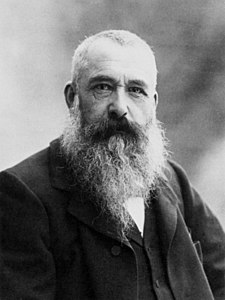
- Impression: Impressionism is a 19th-century art movement that originated with a group of Paris-based artists. Their independent exhibitions brought them to prominence during the 1870s and 1880s, in spite of harsh opposition from the conventional art community in France. The name of the style derives from the title of a Claude Monet work, Impression, soleil levant (Impression, Sunrise), which provoked the critic Louis Leroy to coin the term in a satirical review published in the Parisian newspaper Le Charivari.
- Impression, soleil levant (Impression, Sunrise)

- Commencement(graduation):Graduation is the action of receiving or conferring an academic degree or the ceremony that is sometimes associated, where students become graduates. Before the graduation, candidates are referred to as graduands. The date of graduation is often called graduation day. The graduation itself is also called commencement, convocation or invocation, though in some cases inaccurately. It's one of an initiation.
- Hooding ceremony (正冠儀式): A Hooding Ceremony is a special recognition ceremony for doctoral degree candidates during which a faculty advisor and the Dean of Graduate Academics place the doctoral hood, signifying his or her success in completing the graduate program. The ceremony is similar to a graduation in that the faculty and students are dressed in academic attire. The Hooding Ceremony is in addition to and does not replace the Graduate Commencement.

- 老師有講到自己不知道的要自己查,這是對知識求知的慾望
- 畢業式另一個階段的開始
自訂分類:青少年小說課堂筆記
上一則: 05/01 青少年小說 Week 11 : YA fiction & D.H. Lawrence下一則: 04/10 青少年小說 Week 8 : Essay Question & Araby
你可能會有興趣的文章:


