Essay Question
Question no. 19 about "write with heart but rewrite with head"
- Life never works out, Forrester replys that he didn't have to read a book to learn that.
Question no. 27 learn from each other
- Jamal learns from Forrester: find a place to write.
- Forrester learns from Jamal: find his self-confident.
- They both find their own identity.
- The movie title is "Finding Forrester", "finding" means it is in a process.
Question no. 33 about losing family & poor neighborhood
- Jamal starts reaing and writing after his abandoned.
- Jamal can escpe from real world by reading.
- Jamal doesn't eant to be subjusate and yield to destiny.
- Jamal can express his thought by writing.
Question no. 36
- apartment --> view as talented, trustworthy, important.
- Forrester's words," Dead can never realize how painful.
Question no. 37 about realizing the dream
- realize my dream once again: 再一次實踐夢想
- = carry dream out = materialize my dream
- With this question, you have to define his dream first!!
- Forrester's dream includes: write a book, defeat the shadow of his mind, go back to hometown, and own a good friend as well as family again.
- 五段論證法最後一段要re-empasize
- About Araby:
- "Araby" is a short story by James Joyce published in his 1914 collection Dubliners.
- The boy go to the market himeself is a symbol of an initiation journey and it was also a journey of no return.
-
"Araby" touches on a great number of themes:
2.1 coming of age
2.2 the loss of innocence
2.3 the life of the mind versus poverty (both physical and intellectual)
2.4 the consequences of idealization
2.5 the Catholic Church's influence to make Dublin a place of asceticism where desire and sensuality are seen as immoral
2.6 the pain that often comes when one encounters love in reality instead of its elevated form
2.7 paralysis
- About James Joyce:
- James Augustine Aloysius Joyce (2 February 1882 – 13 January 1941) was an Irish novelist and poet, considered to be one of the most influential writers in the modernist avant-garde of the early 20th century.
- Joyce is best known for Ulysses (1922).
- Other works: the short-story collection Dubliners (1914).

- About Dubliners:
- Dubliners is a collection of 15 short stories by James Joyce, first published in 1914. They form a naturalistic depiction of Irish middle class life in and around Dublin in the early years of the 20th century.
- The stories were written when Irish nationalism was at its peak, and a search for a national identity and purpose was raging.
- Some people centre on Joyce's idea of an epiphany: a moment where a character experiences self-understanding or illumination.

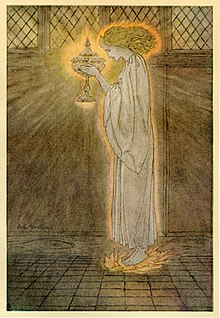
- Holy grail: The Holy Grail is a dish, plate, stone, or cup that is part of an important theme of Arthurian literature.
- Charon:A charon is the ferryman of Hades who carries souls of the newly deceased across the rivers Styx and Acheron that divided the world of the living from the world of the dead.

- The King James version of Ecclesiastes 1:2 says:"Vanity of vanities, saith the Preacher, vanity of vanities; all is vanity."
- About The Tell-Tale Heart:
- "The Tell-Tale Heart" is a short story by Edgar Allan Poe first published in 1843. It is told by an unnamed narrator who endeavors to convince the reader of his sanity, while describing a murder he committed.
- "The Tell-Tale Heart" is widely considered a classic of the Gothic fiction genre and is one of Poe's most famous short stories.
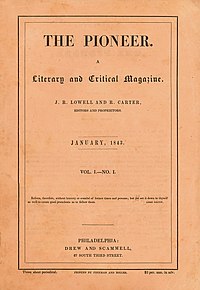
- A Psalm of Life by Longfellow ( from: http://www.potw.org/archive/potw232.html)
A PSALM OF LIFE
WHAT THE HEART OF THE YOUNG MAN
SAID TO THE PSALMIST
TELL me not, in mournful numbers,
Life is but an empty dream ! —
For the soul is dead that slumbers,
And things are not what they seem.
Life is real ! Life is earnest!
And the grave is not its goal ;
Dust thou art, to dust returnest,
Was not spoken of the soul.
Not enjoyment, and not sorrow,
Is our destined end or way ;
But to act, that each to-morrow
Find us farther than to-day.
Art is long, and Time is fleeting,
And our hearts, though stout and brave,
Still, like muffled drums, are beating
Funeral marches to the grave.
In the world's broad field of battle,
In the bivouac of Life,
Be not like dumb, driven cattle !
Be a hero in the strife !
Trust no Future, howe'er pleasant !
Let the dead Past bury its dead !
Act,— act in the living Present !
Heart within, and God o'erhead !
Lives of great men all remind us
We can make our lives sublime,
And, departing, leave behind us
Footprints on the sands of time ;
Footprints, that perhaps another,
Sailing o'er life's solemn main,
A forlorn and shipwrecked brother,
Seeing, shall take heart again.
Let us, then, be up and doing,
With a heart for any fate ;
Still achieving, still pursuing,
Learn to labor and to wait.
下一則: 03/27 青少年小說 Week6 : English literature and American literature


