Questioning a Korean Wedding Tradition
By CHOE SANG-HUN
When a daughter of Kim Jong-chang, South Korea’s top financial regulator, got married last June, Mr. Kim did something unusual: He eliminated the cashier and the cash-filled envelopes.
韓國金融監督機構首長金鍾昌六月嫁女,他做了一件不尋常的事:不收賀儀。
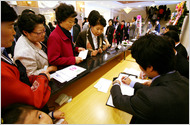
These are fixtures of a South Korean wedding, as much so as the wedding officiant. Before entering the wedding hall, guests line up in front of the cashier’s table to hand over an envelope stuffed with cash. The cashier opens the envelope and registers the guest’s name, and the amount given, in a velvet-covered ledger – often while the guest is still standing there.
南韓婚禮的固定禮俗如下。在進入婚禮場所前,大家先在受禮檯前排隊,依序遞上一個裝有現金的封套。通常出納在客人面前打開封套,登記客人的名字和送禮的金額。
“The problem with this tradition is that it can be abused for bribery,” said Mr. Kim, governor of the Financial Supervisory Service, which regulates the South Korean banking and securities industries. “In my case, many banking officials would have shown up with cash gifts. They would have wondered whether I was annoyed that they didn’t put enough in the envelope.”
監管南韓銀行與證券的金融監管服務局局長金先生說:「問題是這項傳統可能會形成賄賂。以我為例,很多銀行業者會帶著厚禮出席。如果他們被金檢,就會懷疑自己送的禮金是否不夠。」
Chipping in to help friends defray wedding or funeral expenses is an old custom here. But in recent months, it has been criticized as wasteful, and sometimes even as a conduit for vote-buying and bribery.
集資為朋友支付婚禮或喪葬花費是南韓的古老傳統。但在近月,它被批評為奢侈,有時更成為買票和賄賂的管道。
In May, after some critical news stories about extravagant weddings being held at five-star hotels during the economic downturn, President Lee Myung-bak exhorted
五月間,一些新聞抨擊在經濟不振時期於五星級飯店舉行的奢華婚禮。總統李明博勸誡南韓權貴,要成為抗拒「自負與奢華」婚禮文化的典範。
Mr. Kim is one of a small but growing number of people, from ordinary families to dignitaries, who are joining this campaign, refusing to accept cash gifts and keeping their guest lists relatively short. Ban Ki-moon, the South Korea-born secretary general of the United Nations, invited only a few close friends and relatives to the wedding of his son in May, as did Foreign Minister Yu Myung-hwan when his daughter married in April. In October, Chung Jung-kil, Mr. Lee’s chief of staff, followed suit.
金先生正是這少數但成長中的一群人,從一般家庭到顯要都加入這項行動,拒收現金賀儀,縮減宴客名單。聯合國秘書長潘基文的兒子五月娶媳,只邀請了少數友人和親戚。四月外長柳明桓嫁女,十月總統幕僚長均蕭規曹隨。
Still, these low-key weddings were considered such oddities that they made the news.
然而這種低調婚禮,仍被視為標新立異。
In
在南韓「面子」仍受重視,常以賓客多寡、禮金收入和酒宴花費來衡量一個家庭的社會地位。至於喪禮,由朋友、政商界提供的花圈則是檢視標準。
“Here, a wedding is less a celebration than an occasion for a family to show off,” said Lee Yoon-ji, who runs a wedding management agency and photo studio in
在漢城江南洞經營婚禮服務和婚紗攝影的李先生說:「在這兒,婚禮展現家庭實力的意義遠大於慶賀。舉例來說,如果女方發現他們的親友少於男方甚多,就是屈辱。」
Some families send out thousands of wedding invitations. A bank account number is sometimes included so people who can’t attend can still send money.
有些家庭送出上千請帖。有時會附上銀行帳號,方便不克出席者交付禮金。
Often, the decision of whether to attend is based on whether the couple, or their relatives, attended weddings or funerals in one’s own family – or might be expected to. Families keep records of how much they receive and from whom so that they can reciprocate. Failure to do so can ruin a friendship.
通常是否出席婚禮或葬禮,取決於與相關當事人的關係。主事者會保存收禮紀錄,以便往返。失禮就會失去友誼。
“Sometimes you even get invitations from people you don’t know very well,” Mr. Kim said. “They arrive like tax bills or I.O.U.’s.”
金先生說:「有時你會接到一些不大熟的人送來請柬。它就像稅單或欠條。」
Every year, the roughly 330,000 South Korean couples who get married spend an average of 15 million to 20 million won, or $13,000 to $17,000, in wedding expenses, said Lee Woong-jin, head of Sunoo, a matchmaking company that conducts an annual survey on wedding expenses. The cost can exceed 50 million won for hotel weddings.
一家婚配公司的李老闆,每年調查婚禮花費:每年約有33萬對佳偶成婚,平均費用是1.3萬至1.7萬美元。在飯店裡辦婚宴則會超過4萬美元。
Much of that is covered by the cash gifts. Last year, South Koreans gave out 8 trillion won, or 524,500 won for each household, in cash gifts for weddings and funerals, according to the National Statistical Office.
大部分的花費多由禮金支付。去年南韓國家統計局資料顯示,用於婚喪喜慶約為8兆韓圓,或平均每戶支出52萬餘韓圓。
“This is a ‘you-help-me, I-help-you’ tradition. I don’t see anything wrong with it. You chip in and you get help in return,” said Han Seung-ho, 33, a photographer whose wedding in October attracted 370 guests. “Without their cash gifts, my wedding would have been a serious financial burden for
十月新婚,33歲從事攝影的韓先生說:「這是『相互幫助』的傳統,我認為並無不妥。你出資你將獲得回報。」他的婚禮有370賓客參加。「如果沒有那些禮金,我的婚禮會造成個人的財務危機。」
But these envelopes also reflect a culture in which giving cash is considered so natural that people sometimes call it a “greeting” – and, in some cases, use it as a cover for bribery. When
這種送現金的紅包文化如此自然,以致人們稱之為「祝福」,某些情況下成為賄賂的掩護。2004年南韓修改選舉法,禁止政治人物發送紅包,但近親的婚、喪事除外。
Three candidates running for election at provincial farmers’ and fisheries’ cooperatives were indicted in September and October on charges of giving cash gifts at voters’ weddings. A provincial education chief was widely criticized in the media in April after he reportedly invited 2,000 people – including the principals of all 460 schools under his jurisdiction – to his son’s wedding.
九、十月間三名參加省級農、漁會選舉的候選人被以於選舉人婚禮時致贈紅包的罪名起訴。四月間媒體廣泛批判一位省級教育主管,為其子婚禮宴請2千人,其中包括受其督導的460所的學校校長。
Chung Woo-jin, 50, president of Q&Q Medi, a medical supplies company, said many wedding guests show up “reluctantly,” fearing they might lose out on business contracts or promotions if they don’t. “So they show up to prove that they were there, give the envelope and hurry off to have the meal, without even taking a look at the bride or groom,” he said.
50歲的鍾先生是Q&Q衛材供應公司的總裁表示,很多賓客「不情願」參加喜宴,擔心會失掉生意。他說:「他們露面只是證明確有出席,丟下紅包便匆匆離去,甚至未見到新娘或新郎。」
Mr. Chung refused to accept cash envelopes at his mother’s funeral in June. But he said he still felt compelled to attend 40 to 50 weddings or funerals a year for friends, employees and business acquaintances, each time donating an average of 100,000 won.
六月間鍾先生母親的喪禮未收奠儀。但他仍覺得每年被迫參加朋友、員工和商界熟識的婚、喪禮約40至50場,平均每次捐輸10萬韓圓。
Meanwhile, some younger couples are rebelling against what they call a “commercial” wedding culture controlled by parents. It is generally the parents who send out invitations, collect the cash and pay for the wedding, and by and large, more guests are there for the parents than for the couple getting married.
同時,有些年青夫妻抗拒由家長所掌控的所謂「商業婚禮文化」。通常由父母出面邀請賓客,負責收支,沖著家長而來的客人要較新人為多。
“Some of my friends feel frustrated, wondering if their wedding is for them or for their parents,” said Lee Eun-jeong, 35, who works at a publishing company in
在漢城一家出版社工作,現年35歲的李小姐,六月結婚時僅邀請135位來賓,並拒收賀儀。她說:「一些我的朋友都有挫折感,懷疑她們的婚禮是為了自己還是父母。」又說:「我們也痛恨那些失聯已久,卻突然在她將結婚時出現的朋友,顯然在她們的心中只有紅包。」
南韓曾經推行節約婚禮運動。1973年軍事強人朴正熙相信這種禮俗造成奢靡,並抵銷他為經濟現代化所作的努力,而試圖禁止廣發喜帖和婚、喪事時送花、送禮。
But enforcement was sporadic at best, and experts say weddings grew more extravagant after 1999, when the restrictions were lifted and five-star hotels and wedding agencies entered the market.
專家說,自1999年起禁令解除、五星級飯店和婚宴業者興起,婚禮逐漸奢華。
Mr. Kim, the financial watchdog chief, predicted that it would be some time before the cash envelope tradition faded.
金融監理頭頭金先生預測,消除紅包傳統尚需時日。
“Frankly, I found myself thinking, ‘I’ve given out all these envelopes over the years. Why shouldn’t I get them once for my daughter’s wedding?”’ he said. “It’s not always easy in our weddings to tell the difference between bribes and genuine gifts.”
他說:「坦白講,我曾經想『以往我送出那麼多的紅包,為何我不能在女兒結婚時收回。』但是實在不易判定賄賂和慷慨解囊間的差異。」
原文參照:
http://www.nytimes.com/2009/11/18/world/asia/18iht-gifts.html
譯後感:同樣的禮俗在南韓似乎變本加厲,其實在現今台灣也不惶多讓。也許有朝一日,韓國人會先把它申登為文化遺產。

限會員,要發表迴響,請先登入


