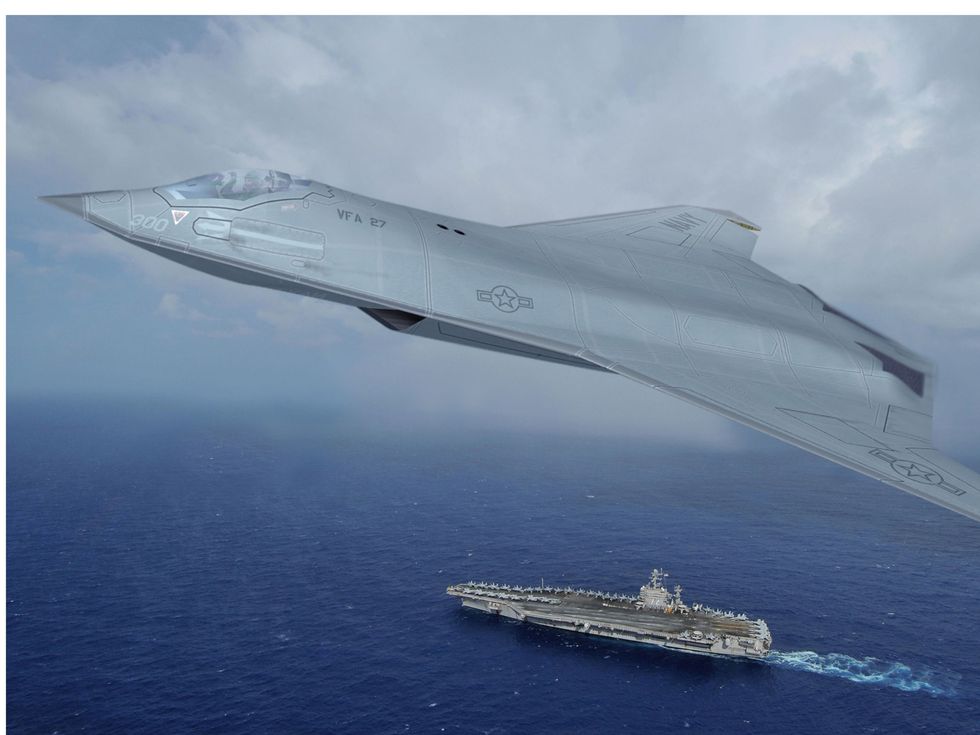
20200914.美國空軍成功的密秘試飛第六代戰鬥機

Faster, deadlier, ‘armed with drones and lasers’: US Air Force just flew its 6th generation fighter
The next-generation fighter jet secretly built and tested by the US Air Force has been flown for the first time, media reports say.
The news of the so-called 6th generation fighters, which are far superior to anything the world has seen so far, was first broken by Defense News this week.
The development has come as a bolt from the blue for even some military watchers, as the demonstration of a successful test flight was not expected for several years.
The US Air Force has “built and flown a full-scale flight demonstrator in the real world”, Defense News quoted the US Air Force’s head of acquisition Will Roper as saying.
Details still remain very sketchy, and enormous secrecy surrounds the project. But that has not stopped analysts and military experts from sharing their perspectives on the next level of aviation technology that will revolutionise air warfare.
From Gen 5 to Gen 6
Also known as the Next Generation Air Dominance (NGAD) fighter, the 6th generation fighters would follow the F-22 stealth jet, a fifth-generation fighter.
However, the US Air Force is re-thinking what it means to be ‘next gen’. The new leap forward is not just about a single plane that is technologically more advanced, but in fact reimagines an entire new system which includes both unmanned and manned planes.
Boeing and Lockheed (makers of the F-22) are both believed to be in the running to develop sixth-generation fighters, which are being described as “the most complicated systems that have ever been built” -- and some reports suggest that they may come armed with laser weapons.
On September 14, 2020, the USAF announced that a prototype aircraft part of the Next-Generation Air Dominance program had flown for the first time at the Air Force Foundations Air, Space, and Cyber Conference. The details remain highly classified. There are no available details about the planes first flight date and location or capabilities. Additionally, there is no available information on who the manufacturer of the aircraft is.


A (potential) game plan
The new NGAD program office will determine the final acquisition strategy for the Digital Century Series — including the length of the development cycle, procurement quantities and contracting mechanisms. However, Roper revealed to Defense News his thinking for how the program might work:
- Put at least two manufacturers on contract to design a fighter jet. These could include the existing companies capable of building combat aircraft — Boeing, Lockheed Martin and Northrop Grumman — as well as new entrants that could bring a unique technology to the table.
- Have each company create a hyper-realistic “digital twin” of its fighter design using advanced 3D modeling. Use those models to run myriad simulations of how production and sustainment could occur, hypothetically optimizing both and reducing cost and labor hours.
- Award a contract to a single fighter manufacturer for an initial batch of aircraft. Roper said that industry could build about a squadron’s worth of airplanes per year, or about 24 aircraft. Include options in the contract for additional batches of aircraft. Air Combat Command leadership has told Roper that 72 aircraft — about the number of aircraft in a typical Air Force wing — would be a viable amount for normal operations.
- While that vendor begins production, restart the competition, putting other companies on contract to begin designing the next aircraft.
As it forms the NGAD acquisition strategy, the new program office will also explore how defense primes would be compensated for their work. Most current Air Force programs are awarded to the company that can provide the most capability at the lowest price, leading to a status quo where vendors underbid to secure a contract and reap profits only when platforms are mass-produced and sustained.
One other important feature of the next-generation fighter jet would be its operability, with its capability to carry out combat missions with or without human participation, with unmanned operability becoming an absolute prerequisite to any futuristic sixth-generation jet, which could be further boosted if artificial intelligence (A.I) gets an all-clear
The sixth-generation aircraft would also boast of radio-photonic radars, travel at hypersonic speeds and fly into the near-Earth space.
俄羅斯軍事衛星曾經密秘監測美國空軍試飛第六代戰鬥機,截至筆者發稿為止,尚未有任何評論發表,目前中國及俄羅斯及英國都在積極開發新世代的戰鬥機 通過專家分析,“第六代戰鬥機”或許還會搭載超聲波巡航技術還將幫助新一代以超音速飛行,而無需使用輔助燃燒室。還有,戰機表面上的智慧蒙皮層是將某些技術或感測器放置在機身上這將有助於減少阻力,提高速度和可操縱性,同時增強感測器設備的技術能力。

美國六代戰機首次試飛成功,設計非常特殊顛覆傳統,配備鐳射大炮.美國空軍技術和後勤的助理部長(Will Roper)博士在20200915日,美軍下一代“天空大師”(NGAD)戰鬥機項目的試驗飛機已經成功進行了首飛任務。 在文章中說威爾·羅珀博士說:“我們已經建造並測試了完整的全尺寸原型機,並且打破了許多美軍以往的記錄,目前我們已經為下一代戰鬥機做好了準備。”
US Secretly Tests World’s First 6-Gen Fighter Jet That Is Hypersonic & Untraceable.
這架新一代戰鬥機的設計非常特殊顛覆了美國以往的戰機外形,它並沒有尾翼,且配備了鐳射大炮武器。該軍火承包商還特別指出,新一代戰鬥機配備的鐳射大炮武器可以切割至少兩架戰鬥機。同時,它裝置著各種全新的技術,由於種種原因目前它還不能被公開。

USAF just admitted it flew a 6th generation fighter jet demonstrator in secret?

With 6th Generation fighter are already Taking shape,Is Time for India to Start Developing 6th Gen Fighter?
A sixth-generation jet fighter is a conceptualized class of fighter aircraft design more advanced than the fifth-generation jet fighters that are currently in service and in development. Several countries have announced the development of a sixth-generation aircraft program, including the United States, Japan, Russia, Germany, India,China, Russia and the United Kingdom.
The United States Air Force (USAF) and United States Navy (USN) are anticipated to field their first sixth-generation fighters in the 2025–30 time frame.The USAF is pursuing development and acquisition of a sixth-generation fighter through the Penetrating Counter Air to replace its existing air superiority aircraft such as the McDonnell Douglas F-15 Eagle and complement existing platforms in service such as the Lockheed Martin F-22 Raptor. The USN is pursuing a similar program called the Next Generation Air Dominance, likewise intended to complement smaller Lockheed F-35 and replace its existing aircraft such as the Boeing F/A-18E/F Super Hornet.
The U.S., for instance, has been working on their sixth gen F/A-XX programme since its announcement in 2014. XX stands for a unique number, like 22 in the case of the F- 22 Raptor, that would take numeric form once the prototype sees the light of day. The fighter jet will have state of the art technology that would help it attain higher speeds and altitudes as compared to other jets.
The idea is to employ Adaptive Versatile Engine Technology or ADVENT to these next gen fighter jets, in order to help them achieve better fuel economy as well as hermeneutic cruise speeds. These jets can also be launched and land on the U.S.’s swanky new $16 billion warship USS Gerald R. Ford CVN-78. But that’s not all.
These fighter jets will also be covered in smart skins that will be built out of sensors and communicative channels that will gather information from all available sources, like satellites, and keep the pilot updated.
The best features of the fighter jet that caught our eye, at least, were improved stealth mechanisms that make it difficult to be detected and the possibility of flying it unmanned, because a reduced number of casualties is a sign of true advancement.
A 6th-generation combat aircraft would need to travel substantially faster and with less fuel intake than current 4.5th- and 5th-generation jets. After a plane achieves Mach 1 without afterburners, i.e. in supercruise mode, it can achieve faster speeds with relatively less energy. The variable cycle engine will possibly advance propulsion to speeds that are three to four times the speed of sound. At present, flying at these speeds has been achieved for only short periods of time. An engine that can sustain Mach 3 to 4 and maintain fuel efficiency would be a dramatic technological development. Some posit that a 6th-generation jet may be able to achieve hypersonic travel (five times the speed of sound or more), although most industry insiders doubt this would be possible by 2030, barring a revolution in engine technology. But hypersonic fight entails a whole new range of materials development, for sensors, fuzes, apertures, etc to ensure which must operate in that intense heat environment at … Mach 5-plus
Use of electric propulsion for SiGFA is an another possibility. A prototype of the first Japan-made stealth fighter X-2 Shinshin, formerly called ATD-X may be equipped with powerful batteries and electric motors. Such a hybrid would take advantage of a jet engine’s speed and use electric generators so as to give power to directed-energy weapons, including lasers. It would also fly at low speeds.
6th-generation fighter jets may also be able to initiate self-healing repairs while in the air .Lockheed Martin is currently working on an airplane prototype that has mechanical veins running throughout its external structure. These veins are filled with two products (a liquid resin and a hardener) that would immediately solidify upon contact with air. If any of these veins break, i.e. the plane is damaged; the resin and hardener would immediately fill cracks and reinforce vulnerable areas of the aircraft.
Next-generation aircraft will combine all of these features into a more detailed and comprehensive system. The range of the sensors will dramatically increase as well as their ability to recognise relevant battle developments and process complex mission planning. Instead of separate sensors and radar, the entire skin of a 6th-generation fighter could function as a large integrated sensor .Through improvements in nano-technology and composite skins, sensor capabilities could be embedded in areas of a jet previously off-limits due to heat and surface reasons. This would present a much more comprehensive view of the battlefield. The sensor skin would give the plane increased processing capabilities and possibly automatic target recognition capabilities. In short, the aircraft would be able to automatically identify objects, buildings, and even people.
The possibility of the next sixth generation fighter being fully autonomous is minimal. However, some form of artificial intelligence that integrates sensors and information will be possible. Using artificial intelligence we can make the aircraft “smart”, to learn and propose the best possible action to the controlling crew/ pilot. The aircraft will collect its own data and seamlessly fuse it with off-board sensors, including those on other aircraft.
For India which has started working on the development of 4.5 Generation Tejas MK1A and MCW (MK2) fighter jet just now will operationalize them in the same period when the world might have already moved on to 6th Generation fighter program and India’s own 5th Generation AMCA fighter program which is yet to kick-start officially is scheduled to go into production around same time when many countries around the world could have started producing 6th generation aircrafts which make India look like grossly late to the Big Boys Club when the advanced countries have already moved on to the next generation .
For modern air force, achieving air superiority remains the primary mission. Air superiority can be understood as that degree of air dominance which allows air, land, and sea forces to operate free from interference by an opponent’s air forces, while at the same time denying the opponent such dominance. To achieve air superiority, it is not enough to simply defeat an opponent’s air forces, but it is also necessary to sufficiently degrade, disrupt, or deny air defenses and air bases. With air superiority assured, ground forces can then move into areas without fear of attacks from the skies; aircraft can observe and strike the opponent without obstruction; navies can position themselves freely and support ground operations;
Indian military planners should take notice of changes which are happening in the combat arena and how the world is already shifting focus and also making efforts to move on to the 6th Generation fighter program. AMCA not only have to fast-tracked even Ghaatak UCAV Program too should be moved in Fastlane so that when the world moves to the 6th Generation fighter, India must necessarily have at least working 5th generation fighter in hand so that it can have enough expertise to start working on the 6th Generation program simultaneously so that India is not left behind too far .
Replacement of Sukhoi-30 by 2050 and Failure of FGFA joint venture with Russia has provided Indian designers and aerospace ecosystem in the country to come up with an alternative which can take on and replace Heavy Class fighter like Su-30 and yet be India’s frontline fighter in terms of technology. Indian military planners should start work on Advance Heavy Combat Aircraft (AHCA) concept which could be India’s 6th Generation fighter program which should materialize by 2040.


