 ..
..
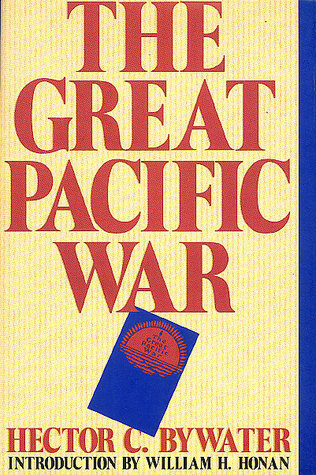
The fighting sea-saws back and forth for most of the book, with the US taking longer to train up its sailors and get into full wartime mode than Japan, and proves taxing on both nations. However, ultimately (again, just as in the actual war that would happen 16 years later), the American advantages of population, economy, and industry make them far more able to withstand this than Japan is. After less than 3 years, Japan has lost all ability to prosecute the war and has seen the US make major gains of territory across the Pacific, and can only try to negotiate for a peace treaty that doesnt leave them humiliated diplomatically as well as militarily; meanwhile the world is left wondering how the Japanese ever believed they could take on the United States in the first place...
.
THE GREAT PACIFIC WAR A HISTORY OF THE AMERICANFAPANESE CAMPAIGN OF 1931-33 BY HE@TQORwGy BYWATER: ASSOCIATE OF INST. NAY. ARCH., ASSOCIATE MEMBER OF U.S. NAV. INST. AUTHOR OF ‘“*SEA POWER IN THE PACIFIC” BOSTON - AND - NEW YORK HOUGHTON MIFFLIN COMPANY
PREFACE A.THouGH this book portrays the course of an imaginary war between the United States and Japan, it has not been written to support the view that such a conflict is either close at hand or inevitable. No doubt there are elements of danger in the immigration controversy, while further causes of friction may attend the growth of American commercial enterprise in the Far East. For the moment, however, the Pacific horizon is fairly free from clouds. But if war between the two nations is happily improbable, it remains a contingency that eannot be dismissed as wholly impossible. In a previous volume, ‘‘ Sea Power in the Pacific,” I discussed at some length the formidable problems of strategy that would confront the United States in the event of hostilities with Japan.
To naval officers the peculiar character of those problems had, of course, long been evident, but their recital appears to have aroused considerable interest among the public at large. To develop the theme further it was necessary to have recourse to the medium of fiction. In the present book I have sought to demonstrate that, notwithstanding the handicaps of distance and, on America’s side, the want of naval stations in the western area of the Pacific, means might still be found of establishing contact between the main belligerent forces and thus forcing matters to a decisive issue.
It is often averred that war between the United States and Japan is out of the question, if only because their respective fleets, divided as they are by thousands of miles of ocean and with no intermediate bases of supply, could never get sufficiently close to engage. This, however, is probably a delusion, as I have endeavoured to show.
In 1925,Hector Bywater, a British naval officer, published The Great Pacific War, a fictional novel that described a conflict that would eventually come to fruition.The author speculated about a conflict between Japan and the United States and described several events that would actually take place.
 .
.
The USS Arizona (BB-39) burning after the Japanese attack on Pearl Harbor, 7 December 1941. USS Arizona sunk at en:Pearl Harbor. The ship is resting on the harbor bottom
 .
.

 The Great Pacific War was a 1925 novel by British author Hector Charles Bywater which discussed a hypothetical future war between Japan and the United States. The novel accurately predicted a number of details about the Pacific Campaign of World War II. Bywater was a naval correspondent for the London Daily Telegraph..
. .
.
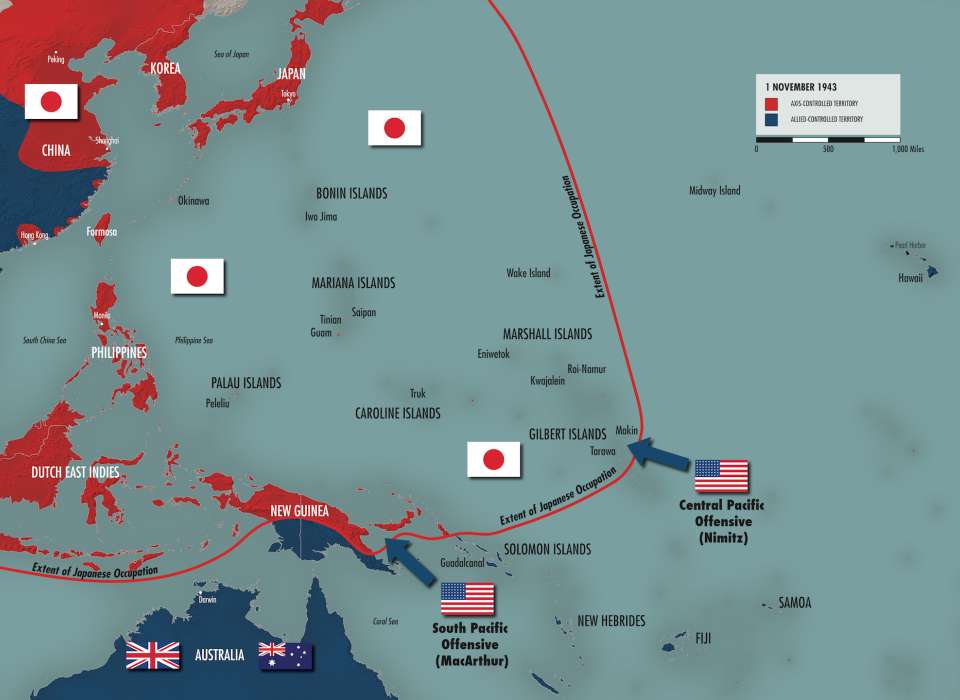
“The Pacific War” which ended 75 years ago this weekend, was not a single entity: It comprised a maelstrom of conflicts that were sparked by Japanese expansionism and were fought over the widest fronts in the history of warfare.
Though widely seen as the “Asian” sphere of World War II – militaristic Japan was, indeed allied with Fascist Germany and Italy in the wartime Axis – there was minimal correspondence between eastern and western theaters. Essentially, Japan fought an entirely separate war.

Great Pacific War: A History of the American-Japanese Campaign of 1931-33 .
《太平洋大戰》是英國作家赫克托·查爾斯·拜沃特(Hector Charles Bywater)於1925年撰寫的小說,該小說討論了日美之間假想的未來戰爭。這部小說準確地預測了有關第二次世界大戰的太平洋戰役的許多細節。拜沃特是《倫敦每日電訊報》的海軍記者。
在《恥辱:珍珠港事件及其後果》一書中,約翰·托蘭德指出,山本五十六於1925年身在美國,可能閱讀過紐約報紙上對《偉大的太平洋戰爭》的評論。該書已被翻譯成日語,並被日本帝國海軍的高級軍官閱讀。除此之外日本特高科的情報員亦步亦趨研究本書寫作動機與預測美國與日本在日後的太平洋戰爭中有所啟示.
拜沃特於1940年8月去世,就在日本偷襲珍珠港的前一年。
偷襲珍珠港的計畫源自日本與美國的外交衝突,前者自1937年侵華後,長期無法脫身,經濟也每況愈下;為了繼續對中國的戰爭,日本開始奪取他國的資源。1940年,日軍趁法國戰敗時佔領了法屬印度支那北部,引起了日美關係的緊張。1941年,美國政府要求日本軍隊撤離法屬印度支那,並連同荷蘭流亡政府與英國切斷了對日本的石油出口(ABCD包圍網)。


 In The Great Pacific War, the war begins with a Japanese invasion of Manchuria, Formosa and Korea. Japan then stages a surprise attack which results in the nearly complete destruction of the Panama Canal, by exploding a freighter full of explosives in the Gaillard Cut.
Bywater died in August 1940, just a year before the Japanese attack on Pearl Harbor....
On December 7, 1941, the Empire of Japan launched a surprise military strike on the United States Pacific Fleet at its naval base at Pearl Harbor on Oahu, Hawaii Territory. At the time, the US was a neutral country in World War II. The air raid on Pearl Harbor, which was launched from aircraft carriers, prompted the US to declare war on Japan the next day. The Japanese military leadership referred to the attack as the Hawaii Operation and Operation AI,[ and as Operation Z during its planning..

 .
.
“


限會員,要發表迴響,請先登入


