西洋文學概論Week11
The content of the course
1.myth
Seduction by Zeus and birth of Dionysus(連結)
2. Thespis
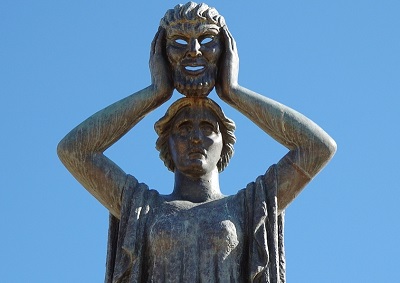
Thespis (/ˈθɛspɪs/) of Icaria (present-day Dionysos, Greece), according to certain Ancient Greek sources and especially Aristotle, was the first person ever to appear on stage as an actor playing a character in a play (instead of speaking as him or herself). In other sources, he is said to have introduced the first principal actor in addition to the chorus.
Thespis was a singer of dithyrambs (songs about stories from mythology with choric refrains). He is credited with introducing a new style in which one singer or actor performed the words of individual characters in the stories, distinguishing between the characters with the aid of different masks.
This new style was called tragedy, and Thespis was the most popular exponent of it. Eventually, in 534 BC competitions to find the best tragedy were instituted at the City Dionysia in Athens, and Thespis won the first documented competition. Capitalising on his success, Thespis also invented theatrical touring; he would tour various cities while carrying his costumes, masks and other props in a horse-drawn wagon.
3. Dionysus
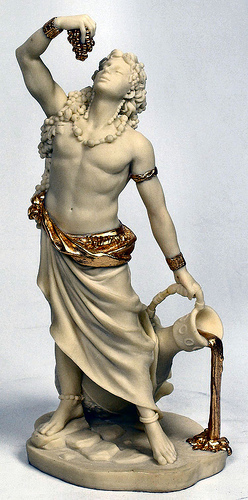
Dionysus is the god of the grape harvest, winemaking and wine, of ritual madness, fertility, theatre and religious ecstasy in Greek mythology. Alcohol, especially wine, played an important role in Greek culture with Dionysus being an important reason for this life style.
Also known as Bacchus (/ˈbækəs/ or /ˈbɑːkəs/), the name adopted by the Romans and the frenzy he induces, bakkheia. His thyrsus is sometimes wound with ivy and dripping with honey. It is a beneficent wand but also a weapon, and can be used to destroy those who oppose his cult and the freedoms he represents. He is also called Eleutherios ("the liberator"), whose wine, music and ecstatic dance frees his followers from self-conscious fear and care, and subverts the oppressive restraints of the powerful.
4.satyr
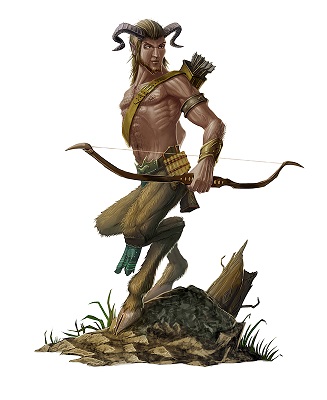
In Greek mythology, a satyr (UK /ˈsætə/, US /ˈseɪtər/) is one of a troop of ithyphallic male companions of Dionysus with horse-like (equine) features, including a horse-tail, horse-like ears, and sometimes a horse-like phallus because of permanent erection. Early artistic representations sometimes include horse-like legs, but in 6th-century BC black-figure pottery human legs are the most common. In Roman Mythology there is a concept similar to satyrs, with goat-like features: the faun, being half-man, half-goat.
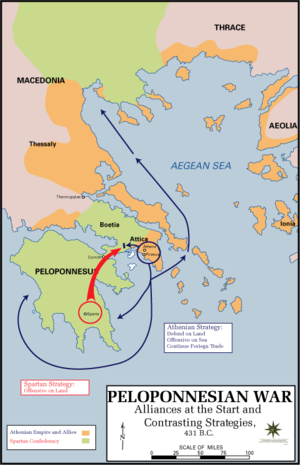
5.Peloponnesian War(連結)
6.vocabulary and phrase
Ecstasy: an overpowering emotion or exaltation; a state of sudden, intense feeling.
innovation: something new or different introduced.
chorus:
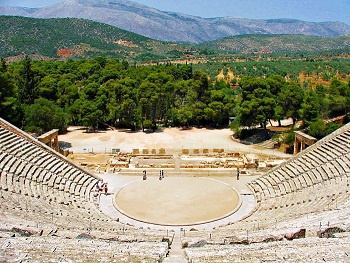
Theater.
a. a group of actors or a single actor having a function similar to that of the Greek chorus,
as in Elizabethan drama.
b. the part of a play performed by such a group or individual.
be credit with: to ascribe to a (thing, person, etc.)
catharsis:
1. the purging of the emotions or relieving of emotional tensions, especially through certain
kinds of art, as tragedy or music.
2. Medicine/Medical. purgation.
3. Psychiatry.
a. psychotherapy that encourages or permits the discharge of pent-up, socially unacceptable affects.
b. discharge of pent-up emotions so as to result in the alleviation of symptoms or the permanent
relief of the condition.
Inauguration: an act or ceremony of inaugurating.
Sara’s blog:
(1) how to take great notes(連結)
(2) 五段論證法(連結)
Study skills: boldface, capital words, colon, quotation, dash are the key point of the textbook.
Reference website:
Thespis
https://www.bing.com/images/search?q=thespis&view=detailv2&&id=BE3B51FB7A
48B5F6D72841162195C59148F5A997&selectedIndex=3&ccid=N2kfpgoX&simid=
608004582093227274&thid=OIP.M37691fa60a17a9584128334db4f7e711H0&ajaxhist=0
chorus
https://www.bing.com/images/search?q=greece+chorus&view=detailv2&&id=B49C1
A81FE4F40A0E7532658FB3E91EB8B6B776E&selectedIndex=27&ccid=js16RRxk
&simid=607994944185896229&thid=OIP.M8ecd7a451c6481d26790f1ec6dcf30a8o0
&ajaxhist=0
Peloponnesian War
https://www.bing.com/images/search?q=Peloponnesian+War&view=detailv2&&id=
8F3CE23A73C54D8C10D740A73AF89EF1DCACBA28&selectedIndex=7&ccid=
8tAIjyIz&simid=608052178921456614&thid=OIP.Mf2d0088f223364085540f9371
ee9b383H0&ajaxhist=0
Dionysus
https://www.bing.com/images/search?q=Dionysus&view=detailv2&&id=2C4E2D6
7E586F767B573F534C8BDF8F22A28C503&selectedIndex=7&ccid=ilo5zgJZ&
simid=608002739558613934&thid=OIP.M8a5a39ce0259e77f18ca305c8f9c96e7
H0&ajaxhist=0
satyr
https://www.bing.com/images/search?q=satyr&view=detailv2&&id=B959BA255
B30AA6577F190299D82C1C64D12D5E0&selectedIndex=0&ccid=CSH7ylJg&
simid=608040217441341012&thid=OIP.M0921fbca5260ac17243feb04f171b9
32H0&ajaxhist=0
限會員,要發表迴響,請先登入


