Control features and selection requirements of bipolar stepper motors
2025/07/01 17:10
瀏覽212
迴響0
推薦0
引用0
1. Basic introduction of bipolar stepper motors
Bipolar stepper motors, also known as two-phase four-wire stepper motors, have a structural feature that the motor contains two coils, each coil has two wires, a total of four wires, which are used to control the operation of the motor. Compared with unipolar stepper motors, bipolar stepper motors are more flexible in control methods, and can achieve more precise position control and higher dynamic performance.
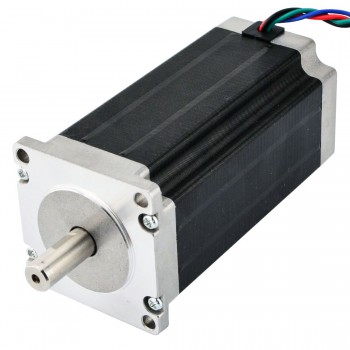
2. Working principle of bipolar stepper motors
1. Magnetic field action: When the coil on the stator is energized, a magnetic field is generated. This magnetic field interacts with the permanent magnet on the rotor to rotate the rotor to a new position.
2. Current direction change: In order for the rotor to continue to rotate, the current direction of the energized coil needs to be changed. This is usually achieved by switching the wiring of the coil, thereby changing the polarity of the magnetic field and allowing the rotor to continue to rotate.
3. Multi-phase control: Bipolar stepper motors usually have multi-phase control, and each phase coil is energized in turn, so that the rotor gradually rotates to the target position.
3. Control features of bipolar stepper motors
1. High-precision positioning: Bipolar stepper motors use stepping technology, and each step position is very accurate, which can accurately locate the required position. This high-precision positioning feature makes bipolar stepper motors have obvious advantages in situations where precise position control is required.
2. Strong reversibility: Since bipolar stepper motors have two independent coils, the direction of the current in the coils can be changed to achieve forward and reverse rotation of the motor. This strong reversibility makes bipolar stepper motors very adaptable in situations where the direction of the motor needs to be changed frequently.
3. Large static torque: Bipolar stepper motors can also provide high torque output in a stationary state, which allows them to withstand various loads and provide good starting power when they start to rotate.
4. Sensitive dynamic response: Bipolar stepper motors have a faster dynamic response speed and can quickly adjust the control amount to respond to changes in the system. This makes bipolar stepper motors have a good application effect in situations where fast response is required.
5. High control accuracy: The speed and angle of the bipolar stepper motor can be precisely adjusted according to the size and frequency of the control signal. This high control accuracy makes the bipolar stepper motor have a good application effect in occasions requiring high-precision control.
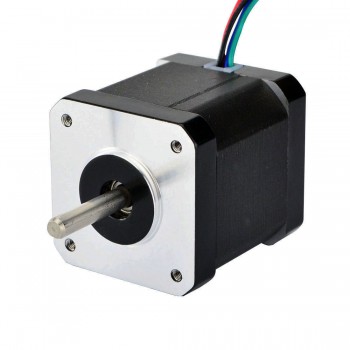
4. Selection requirements of bipolar stepper motors
1. Step angle selection: The step angle depends on the load accuracy requirements. The step angle of the stepper motor should be equal to or less than the minimum resolution of the load to ensure accuracy. Common step angles are 0.36 degrees, 0.72 degrees, 0.9 degrees, 1.8 degrees, 3 degrees, etc. .
2. Static torque selection: Static torque is one of the important parameters for selecting stepper motors, which determines the output torque of the motor at low speed. The static torque should be able to meet the needs of the load and should usually be 2-3 times the friction load. Motors with large static torque can provide greater torque and are suitable for occasions requiring large torque.
3. Current selection: The current parameter has an important influence on the operating characteristics of the motor. Motors with the same static torque will have different operating characteristics due to different currents. The torque-frequency characteristic curve can be used to determine the appropriate current.
4. Subdivision selection: Subdivision can improve the control accuracy and running smoothness of the motor. Select the appropriate subdivision level according to the application requirements. Common subdivision levels include full step, half step, quarter step, and eighth step.
5. Driver selection: Selecting a suitable driver is the key to ensuring the normal operation of the motor. The driver parameters include supply voltage, drive current, and subdivision settings, which need to be matched according to the needs of the motor.
6. Other parameters: Parameters such as inductance and number of leads will also affect the performance and application of the motor. Although the inductance parameter is not the main parameter, it has a certain impact on the drive circuit design; the number of leads varies according to the number of phases and polarity of the motor.
自訂分類:不分類
上一則: Design advantages and applications of pancake stepper motor下一則: Main construction and design features of variable frequency drive
你可能會有興趣的文章:
- Main construction and design features of variable frequency drive
- Main functions and common applications of hollow rotary actuators
- Drive type and design features of hybrid stepper motors
- Structural characteristics and application fields of helical planetary gearboxes
- Working principle and characteristics of high temperature stepper motor
- How to improve the operating efficiency of geared stepper motors
限會員,要發表迴響,請先登入


