Main uses and maintenance tips for stepper motor encoders
2025/05/19 16:48
瀏覽175
迴響0
推薦0
引用0
1. Definition and principle of stepper motor encoders
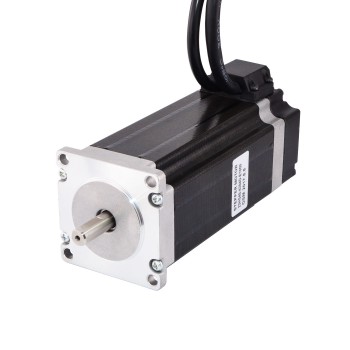
A stepper motor encoder is a sensor used to measure rotational position, speed and direction, and is often used in conjunction with a stepper motor. Its working principle is based on optical or magnetic principles. When the motor rotates, the relative movement between the rotating part and the fixed part inside the encoder causes changes in optical or magnetic signals, which are eventually converted into electrical signals. These electrical signals are transmitted to the control system to achieve precise control of the motor.
2. Main classifications of stepper motor encoders
1. Incremental encoders: Incremental encoders output three sets of square wave pulses A, B and Z phases through the principle of photoelectric conversion. The phase difference between the A and B groups of pulses is 90 degrees, which is used to determine the direction of rotation, while the Z phase is one pulse per rotation, which is used for reference point positioning. Its advantages are simple structure, long life, strong anti-interference ability, high reliability, and suitable for long-distance transmission, but it cannot output the absolute position information of the shaft rotation.
2. Absolute encoders: Absolute encoders directly output digital signals, and each position corresponds to a certain digital code. Its characteristics are that it does not require a counter, a fixed digital code can be read at any position, and the position information will not be lost after power failure. Absolute encoders are suitable for occasions that require high-precision position control.
3. Hybrid absolute encoder: The hybrid absolute encoder combines the characteristics of incremental and absolute. One set of information is used to detect the magnetic pole position (with absolute information function), and the other set of information is the same as the output of the incremental encoder. This encoder has both the position memory function of the absolute encoder and the output flexibility of the incremental encoder.
3. The main uses of stepper motor encoders
1. Improve accuracy: The encoder can feed back the actual position information of the motor to the controller, so that the controller can compare and calculate according to the preset target position and the actual position, thereby outputting a more accurate control signal to drive the motor. This ensures that the motor runs more stably and accurately, and avoids the problem of inaccurate positioning caused by error accumulation.
2. Improve stability: Through the feedback of the encoder, the controller can monitor the operating status of the motor in real time, such as speed, torque and other parameters. When the motor is abnormal, such as overload, overheating, etc., the controller can take timely measures, such as reducing the speed, stopping operation, etc., to protect the motor from damage.
3. Achieve precise control: The position feedback information provided by the encoder allows the controller to adjust the control strategy according to the actual situation, such as adopting a more sophisticated speed regulation algorithm, or to achieve more complex control tasks, such as trajectory tracking, positioning, etc. This is very important for application scenarios that require high precision and fast response.
4. Prevent overshoot and undershoot: The encoder provides the actual speed information of the motor. The controller can effectively adjust the operation of the motor based on this information to avoid overshoot or undershoot during the operation of the motor, thereby improving the operating performance of the system.
5. Achieve closed-loop control: The encoder is used in combination with the motor to achieve closed-loop control of the motor. This control method can improve the response speed, stability and accuracy of the system, so that the system can maintain stable operation in various complex environments.
6. Fault diagnosis: The encoder can also be used to monitor abnormal conditions of the motor, such as overspeed, stagnation, etc., to help timely discover and deal with potential problems.
4. Maintenance tips for stepper motor encoders
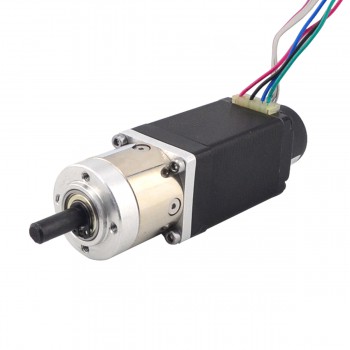
1. Regular cleaning and dust prevention: Use a dust-free cloth or soft brush to clean the encoder surface and vents regularly to prevent dust accumulation from affecting the sensitivity of the photoelectric sensor. For open encoders, check whether the grating disk is contaminated or scratched every quarter, and wipe it with anhydrous alcohol if necessary.
2. Connection and signal stability check: Check whether the encoder connection cable is loose, damaged or excessively bent every month, and use a multimeter to test the continuity, focusing on checking the plug oxidation or poor contact. It is recommended to use shielded cables and arrange them reasonably to reduce the impact of electromagnetic interference on pulse signals.
3. Power supply and grounding verification: Regularly measure the encoder supply voltage to ensure that it is within the rated range (such as 5V±5%), check whether the grounding resistance is less than 1Ω, and eliminate common mode interference.
4. Mechanical structure and installation status maintenance: Check whether the encoder bearing is abnormal or stuck every six months, and add special grease. For encoders with gear transmission, check the wear of the tooth surface. If the wear exceeds 30%, the gear set needs to be replaced. Check the connection screws between the encoder and the motor shaft every week to see if they are loose, and use a torque wrench to tighten them according to the manual requirements.
5. Performance calibration and parameter verification: When the encoder fails, the encoder is replaced, or the electrical zero position of the encoder does not coincide with the mechanical zero position, the encoder needs to be zero-point calibrated. The incremental encoder needs to monitor the Z-phase signal through an oscilloscope to ensure that the zero point is aligned with the motor pole; the absolute encoder needs to be calibrated once throughout the stroke.
6. Optimization of environment and use conditions: Pay attention to the changes in temperature and humidity during the use of the encoder, and ensure that the ambient temperature is between -10℃ and 60℃ and the humidity is less than 85%. In high-temperature environments, heat sinks or forced air cooling can be installed to avoid affecting the normal operation of the encoder.
自訂分類:不分類
上一則: Main construction and design features of variable frequency drive下一則: Main functions and common applications of hollow rotary actuators
你可能會有興趣的文章:
限會員,要發表迴響,請先登入


