Main construction and design features of variable frequency drive
2025/06/07 17:31
瀏覽178
迴響0
推薦0
引用0
1. Basic definition of variable frequency drive
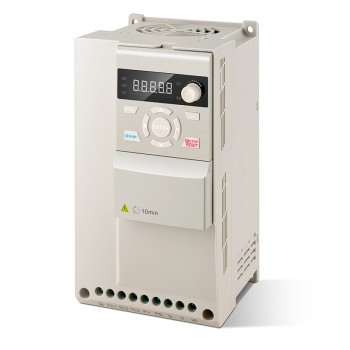
Variable frequency drive is an advanced power control device widely used in industrial production, transportation, air conditioning systems and other fields. It can adjust the speed of the motor according to the actual load demand, so that the motor always works in the best state and avoids unnecessary energy waste. In addition, VFD can also realize soft start and soft stop of the motor, reducing the impact on the power grid and wear of the equipment.
2. Working principle of variable frequency drive
The core function of variable frequency drive is to achieve precise control of motor speed by changing the power supply frequency and voltage supplied to the motor. Frequency (or Hertz) is directly related to motor speed (RPM). The faster the frequency, the faster the motor speed. By controlling the AC frequency, VFD can adjust the speed of the motor according to the actual load demand, so that the motor always works in the best state and avoids unnecessary energy waste.
3. Main construction of variable frequency drive
1. Rectifier: This is the first stage of variable frequency drive, which converts AC power from the main power supply to DC power. Rectifiers usually use electronic switching devices such as diodes, thyristors, transistors, etc. to convert AC power to DC power. Three-phase conversion requires at least six diodes to form a diode bridge to convert the three-phase AC signal into a single DC rail.
2. DC bus filter: The DC power from the rectifier section is fed to the DC link, which consists of capacitors and inductors to smooth the ripple and store the DC power. The DC bus capacitor is equivalent to an energy storage tank, providing a stable DC voltage source.
3. Inverter: The inverter receives signals from the control circuit and switches electronic switches such as IGBTs or MOSFETs at high speed to convert DC power into three-phase AC power with adjustable frequency and voltage. The output frequency of the inverter is proportional to the switching rate. A high switching rate provides a high-frequency output and a low switching rate provides a low-frequency output.
4. Control circuit: The control circuit consists of a microprocessor, a PWM signal generator, a current/voltage sensor, an operation panel/display interface, digital/analog input and output terminals, a communication interface, etc. It receives user instructions, detects the operating status, and generates precise PWM signals according to the preset algorithm to control the switching time and sequence of the IGBT.
4. Design features of variable frequency drive
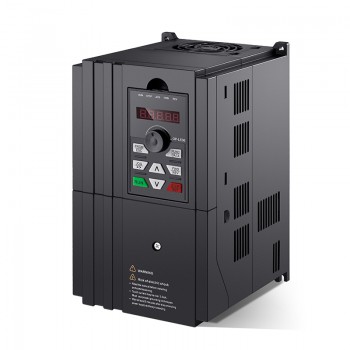
1. High efficiency and energy saving: VFD can automatically adjust the speed and power of the motor under different workloads by precisely controlling the speed and power of the motor, thereby achieving a higher energy efficiency ratio. Compared with traditional motor drives, VFD can reduce the motor speed at low loads, reduce energy consumption, and achieve energy saving effects.
2. Precise control: VFD has the ability to precisely control the motor speed and torque, and can meet the control requirements under various complex working conditions. Its control algorithms include speed control, torque control, and position control, etc. It can adjust the output frequency of the inverter according to the difference between the actual speed of the motor and the set speed, so that the speed of the motor gradually approaches the set value. In addition, VFD can also provide a variety of protection mechanisms to ensure the stable operation of the motor in a complex working environment.
3. Wide applicability: VFD is suitable for various types of AC motors, including asynchronous motors, synchronous motors, and special motors. It can also be used in conjunction with various control systems and sensors to achieve a higher level of automated control. VFD has a wide range of applications and is suitable for industrial production, transportation, air conditioning systems, and other fields, such as controlling motors on production lines, motors of electric vehicles and elevators, and fans of air conditioning systems.
4. Multiple protection mechanisms: VFDs usually have multiple protection functions such as overcurrent, overvoltage, and overload protection to ensure that the motor can operate stably in a complex working environment. These protection mechanisms include phase protection, undervoltage protection, and overvoltage protection, which can effectively prevent the motor from being damaged due to overload or voltage fluctuations.
自訂分類:不分類
上一則: Control features and selection requirements of bipolar stepper motors下一則: Main uses and maintenance tips for stepper motor encoders
限會員,要發表迴響,請先登入


